Yahoo Endorses Social Networks
Yahoo Inc. is joining an effort backed by Google Inc. and News Corp.'s MySpace to spur the creation of applications for social networks, a small but growing area of interest among software developers.
Yahoo said Tuesday it will endorse a technical specification called OpenSocial that was initiated by Google and supported by MySpace and other social- networking sites, a sign the initiative is gaining momentum after a slow start last fall. Yahoo, Google and MySpace also said they are planning an independent, nonprofit foundation to provide technology and intellectual-property guidelines for the evolving standard, while ensuring no one company has too much influence over its future.
Yahoo's move could pressure holdouts like Facebook Inc., which has stuck to its own software standards for developers, to join OpenSocial. Facebook, whose investors include Microsoft Corp., has indicated a willingness to license its platform to other sites. A Facebook representative said the company is evaluating OpenSocial. Microsoft, which has made a bid for Yahoo, hasn't joined OpenSocial, either. It declined to comment on if it would do so or to comment on Yahoo's move.
MySpace and Google's social network, Orkut, have both recently launched developer platforms compatible with OpenSocial. But Facebook, whose platform was announced in May 2007, has a head start and already offers some 20,000 applications to its users. MySpace owner News Corp. also owns Dow Jones & Co., publisher of The Wall Street Journal.
Internet companies are initiating the new guidelines to encourage software developers to build a range of entertainment and productivity services to keep users hooked on their sites. Developers, keen to reach the massive audiences, have done so eagerly, building tools like photo-sharing software or games that users can add to their profiles and share with their friends.
OpenSocial was designed to make it easier for developers to create these services across a range of Web sites. Developers can build their applications once and have them run across any site compatible with OpenSocial, with minimal modifications. But in the months after its launch, many developers were disappointed with the technology, which they said had holes and was not widely supported.
On a conference call with reporters, Joe Kraus, director of product management at Google, said developers will potentially be able to reach more than 200 million users through an OpenSocial-based application by next week. He added that the nonprofit will help to drive the effort by formalizing a range of guidelines critical to its success. For instance, the foundation will enable developers and sites to use the OpenSocial specification without fear of patent- infringement suits from contributors.
Wade Chambers, vice president of platforms for Yahoo, said on the call that Yahoo was not yet going to provide details about which Yahoo sites for which developers could build OpenSocial-compatible applications, but he said Yahoo wanted to sign on because it felt the standard was "rapidly maturing."
By Jessica E. Vascellaro
The Wall Street Journal; March 26, 2008

SEO Blog. Organic SEO Blog. Search Marketing News. SEO Done Right examines search engine optimization, the most effective form of internet marketing. Breaking SEO news and emerging developments at Google, Yahoo, and Bing. Leading Organic SEO Consultants Peak Positions debunk the many myths, hype, and spin related to SEO and search marketing.
Friday, March 28, 2008
Open Source "Social App Server" Might Crack Garden Walls?
From right here in Philly's backyard, Ringside Networks came out of stealth mode yesterday to launch the first open source "social application server."
And what is that exactly?
It's the software guts of a social network that you can use behind your own firewall, old school style, to build social networking "stuff" into your own site.
Companies that want to build social applications (for runners sharing times at Runlicious) or socially aware marketing programs (like Jeep owners sharing pictures and videos) will be able to use social servers to develop the whole thing on their own websites. Their brand on their site instead of their brand on Facebook next to the "get help for your gambling problem" advertisement.
Developing a social network will be harder to do this way than it would be using a white label network like Ning, but it will be completely customizable, will integrate neatly into the rest of the site, and all the data will be right there for the application owner to mine.
That's the simple version anyway; use social servers to roll your own social apps and sites. But I also wonder how it might upset the balance of power inside the behemoth walled gardens of Facebook and Myspace.
OpenSocial took the first shot at the garden walls with a goal of empowering users to keep their social data portable (well, portable inside Google anyway). However, while OpenSocial promises developers social apps without servers, Ringside is saying that at least some developers are going to want their own stuff under their control. I think social app servers are going to take shots at the wall too, but with the social networking advertisers and application ecosystem as the core constituency.
By supporting Facebook's API (with other API's to follow), Ringside makes it a lot simpler to take a social application written for Facebook and move it to its own site, or visa versa as shown in this picture. This kind of write once deliver anywhere approach to social applications raises all kinds of interesting possibilities.
Like,... Don't want to have to enter your favorite beers into Beer! in both Facebook and Myspace? If Beer! builds their application on a social server that can tie your Facebook user name to your Myspace user name, you won't have to. Facebook and Myspace just become two points of presence for the application, and they'll be on equal terms with Beer!'s own web site. Wherever you log in, you see your beers and (most of) your beer friends.
Facebook opened up this possibility when they designed their platform to have the developer's servers do the heavy lifting. Doing it this way meant they didn't have to provide all of the servers and gear to run the applications, but it also means that it's easier to stick a social server outside the wall and treat it and other branded networks like distribution shelf space. Once an application can seamlessly span the networks, it can do more than map a user's identity across sites, it may also piece together a social graph that is bigger than any one site's. Sort of an application-specific super graph.
In one possible end state, users own all of "their" social graph and data in OpenSocial, and application providers own all of "their" social graph and data in their own social application servers. Meanwhile, the big branded social networks are still in the game with very large "lily pad graphs," but they no longer see the whole picture for any one user or any single application.
As this evolves we may see developers building first for Facebook and Myspace to get quick viral adoption in a huge audience. However, as soon as they can they may start to drive traffic over to their own sites where they can provide a better or different interface with a more carefully managed brand experience. Imagine if NBC let you show your first YouTube video from a planned series at 7pm on Thursday, for free.
Or, developers may use the write once deliver everywhere strategy to deliver their app as widely as possible. Where Facebook and Myspace were once king, in this scenario they may end up as two of many application points of presence with awareness of only a piece of the associated social graph. The successful application developer with a network-spanning super graph might then be free to monetize it however and wherever they can.
Well, at least until the API wars start in earnest. There is a good reason for the server to be open source, it will spread the load of keeping up with all those inevitable API changes.
By: Jim Stogdill
O’Reilly Radar; March 25, 2008
From right here in Philly's backyard, Ringside Networks came out of stealth mode yesterday to launch the first open source "social application server."
And what is that exactly?
It's the software guts of a social network that you can use behind your own firewall, old school style, to build social networking "stuff" into your own site.
Companies that want to build social applications (for runners sharing times at Runlicious) or socially aware marketing programs (like Jeep owners sharing pictures and videos) will be able to use social servers to develop the whole thing on their own websites. Their brand on their site instead of their brand on Facebook next to the "get help for your gambling problem" advertisement.
Developing a social network will be harder to do this way than it would be using a white label network like Ning, but it will be completely customizable, will integrate neatly into the rest of the site, and all the data will be right there for the application owner to mine.
That's the simple version anyway; use social servers to roll your own social apps and sites. But I also wonder how it might upset the balance of power inside the behemoth walled gardens of Facebook and Myspace.
OpenSocial took the first shot at the garden walls with a goal of empowering users to keep their social data portable (well, portable inside Google anyway). However, while OpenSocial promises developers social apps without servers, Ringside is saying that at least some developers are going to want their own stuff under their control. I think social app servers are going to take shots at the wall too, but with the social networking advertisers and application ecosystem as the core constituency.
By supporting Facebook's API (with other API's to follow), Ringside makes it a lot simpler to take a social application written for Facebook and move it to its own site, or visa versa as shown in this picture. This kind of write once deliver anywhere approach to social applications raises all kinds of interesting possibilities.
Like,... Don't want to have to enter your favorite beers into Beer! in both Facebook and Myspace? If Beer! builds their application on a social server that can tie your Facebook user name to your Myspace user name, you won't have to. Facebook and Myspace just become two points of presence for the application, and they'll be on equal terms with Beer!'s own web site. Wherever you log in, you see your beers and (most of) your beer friends.
Facebook opened up this possibility when they designed their platform to have the developer's servers do the heavy lifting. Doing it this way meant they didn't have to provide all of the servers and gear to run the applications, but it also means that it's easier to stick a social server outside the wall and treat it and other branded networks like distribution shelf space. Once an application can seamlessly span the networks, it can do more than map a user's identity across sites, it may also piece together a social graph that is bigger than any one site's. Sort of an application-specific super graph.
In one possible end state, users own all of "their" social graph and data in OpenSocial, and application providers own all of "their" social graph and data in their own social application servers. Meanwhile, the big branded social networks are still in the game with very large "lily pad graphs," but they no longer see the whole picture for any one user or any single application.
As this evolves we may see developers building first for Facebook and Myspace to get quick viral adoption in a huge audience. However, as soon as they can they may start to drive traffic over to their own sites where they can provide a better or different interface with a more carefully managed brand experience. Imagine if NBC let you show your first YouTube video from a planned series at 7pm on Thursday, for free.
Or, developers may use the write once deliver everywhere strategy to deliver their app as widely as possible. Where Facebook and Myspace were once king, in this scenario they may end up as two of many application points of presence with awareness of only a piece of the associated social graph. The successful application developer with a network-spanning super graph might then be free to monetize it however and wherever they can.
Well, at least until the API wars start in earnest. There is a good reason for the server to be open source, it will spread the load of keeping up with all those inevitable API changes.
By: Jim Stogdill
O’Reilly Radar; March 25, 2008

 Justices turn down Microsoft appeal
Google CEO Eric Schmidt
former President of
Novell Frustrated with
Court Decision
WASHINGTON - The Supreme Court on Monday handed Microsoft Corp. a defeat by refusing to rule on the software giant's request to halt an antitrust suit against it.
The suit was brought in 2004 by Waltham, Mass.-based Novell Inc., which said in court papers that Microsoft "deliberately targeted and destroyed" its WordPerfect and QuattroPro programs in order to protect its Windows operating system monopoly.
Novell alleged that Microsoft targeted the programs because they could run on alternative operating systems and therefore could enable alternatives to Windows to gain market share.
Microsoft argued in court filings that Novell did not compete in the operating systems market, and therefore cannot claim to have been harmed by alleged anticompetitive conduct by Microsoft in that market.
A federal district court and the 4th U.S. Circuit Court of Appeals, based in Richmond, Va., sided with Novell and allowed the suit to proceed. Microsoft's lawyers said that decision expands the application of antitrust laws "far beyond their intended scope."
Plaintiffs in antitrust suits can seek damages that are triple the actual harm.
A federal court ruled in 2001 that Microsoft had illegally protected its Windows operating system monopoly. As part of a settlement with the federal government and 17 states the following year, Microsoft agreed to court oversight of its business practices. A federal judge in January extended that oversight to November 2009.
The federal government's antitrust lawsuit focused on Microsoft's anticompetitive actions against Netscape and Sun Microsystems Inc. Novell argues that its software is similar to Netscape's Navigator browser and Sun's Java: neither competed directly with Windows, but Microsoft saw them as benefiting potential competitors.
Novell sold WordPerfect and QuattroPro to Corel Corp. in 1996.
Despite the suit, the two companies later became business partners. In 2006 Microsoft agreed to pay Novell $240 million to license its Linux enterprise software and to spend $94 million over five years to market both Novell's software and Windows to its corporate customers. Microsoft also agreed to pay Novell $108 million under a patent agreement.
The deal also required Novell to pay millions in royalties to Microsoft.
The Supreme Court's decision allows Novell's lawsuit to continue. Microsoft said it would defend itself in lower court. "We believe the facts will show that Novell's claims, which are 12 to 14 years old, are without merit," David Bowermaster, a Microsoft spokesman, said in an e-mail.
The case is Microsoft Corp. v. Novell Inc., 07-924. Chief Justice John Roberts, who owns Microsoft stock, recused himself from the decision.
Microsoft shares rose 34 cents to close at $28.30 Monday, while Novell shares fell 6 cents to $6.01.
By Christopher S. Rugaber; Jessica Mintz contributed to this story
Associated Press; Mar 17, 2008
Comcast, Time Warner Cable in Wireless Talks
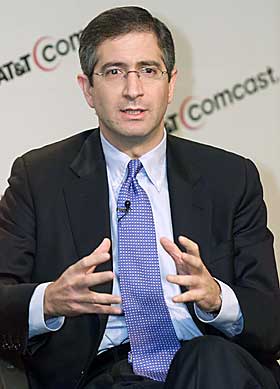
The two biggest U.S. cable providers, Comcast Corp. and Time Warner Cable Inc., are discussing a plan to provide funding for a new wireless company that would be operated by Sprint Nextel Corp. and Clearwire Corp., people familiar with the talks say.
The partnership would create a nationwide wireless network using WiMax technology, which is designed to provide high-speed Web access from laptops, cellphones and other mobile devices, as well as high-quality mobile video. Sprint and Clearwire have been working for months to cooperate on a WiMax rollout and are now trying to raise at least $3 billion for a joint venture.
Under the plan the parties are reviewing, Comcast -- the largest cable operator with 24 million subscribers -- would put as much as $1 billion into the venture, with No. 2 operator Time Warner Cable adding $500 million. The sixth- biggest cable operator, Bright House Networks, is also involved in the talks and would contribute between $100 million and $200 million, people familiar with the matter said. Comcast Chief Executive Brian Roberts has played a prominent role in the talks.
Sprint, of Overland Park, Kan., and Clearwire, a Kirkland, Wash., start-up founded by wireless pioneer Craig McCaw, are trying to line up other funding too. Intel Corp. has signaled a willingness to put in about $1 billion or more, depending on the terms, people familiar with the discussion say. And Google Inc. could provide hundreds of millions of dollars, the people say. The exact amount each would contribute could change, and people involved in the discussions said it is still possible the entire deal could fall through. Google and Intel both declined to comment.
Entering the wireless business is becoming a bigger priority for cable companies as they compete fiercely for customers with telecom giants AT&T Inc. and Verizon Communications Inc. Those phone companies have encroached on cable's turf by entering the pay-TV business and are positioning themselves to offer a " quadruple play" of services that includes landline phone, high-speed Web access, cellphone, and video. "That's obviously a concern, if Verizon can put together a converged service offering that starts to peel people away from cable operators, " said Mark Rowland, head of the wireless practice at IBB Consulting.
Cable companies' push into wireless would mark the next chapter in that escalating rivalry. It isn't clear precisely what wireless services the cable operators intend to offer via the WiMax venture. Executives at some of the operators feel the U.S. wireless market is already crowded, with 80% of U.S. consumers already owning a cellphone.
The companies are likely to try to distinguish themselves with advanced mobile data and video services that take advantage of the stockpiles of content they are already adept at licensing. People familiar with the discussions said some cable companies are looking at options to develop their own mobile devices in partnerships with manufacturers.
Sprint CEO Dan Hesse is pressing all parties to wrap up discussions in time for the wireless industry's trade show next week in Las Vegas, so Sprint can have something to present to investors. In addition to the $3 billion Sprint and Clearwire are trying to raise now to start rolling out WiMax, they will likely need more to complete a nationwide network. Sprint previously had told Wall Street the venture would cost $5 billion by 2010.
Mr. Hesse wants Sprint to begin building the WiMax network quickly so it can get a head-start over competitors AT&T and Verizon Wireless on advanced wireless broadband services. WiMax promises faster speeds than current technologies and a wider range of video and other services.
In exchange for funding the WiMax joint venture, the cable companies would get equity in the business and would be able to purchase wholesale access to the network to offer their own high-speed wireless data and voice services to customers, the people familiar with the discussions said.
The cable industry has been flirting with the idea of getting into wireless for years, but hasn't had a clear strategy. Investors have also discouraged cable companies from embarking on any big spending projects. A consortium of cable operators including Comcast, Time Warner Cable, Bright House Networks and Cox Communications Inc. bought more than $2 billion in radio spectrum in a 2006 government auction but never put it to use.
The same companies created a separate joint venture with Sprint in 2005, dubbed Pivot, that offered cellphone service in about 30 markets by the time it stopped marketing late last year amid low demand. One key problem was that cable providers didn't have significant control over pricing and marketing. They are asking for that control in the new WiMax venture. Comcast and other cable operators have also mulled acquiring a major wireless carrier.
Cox, the third-biggest cable operator, appears to be pursuing a separate wireless push. It acquired 22 radio spectrum licenses for $305 million last week, which would allow Cox to offer wireless service in its markets, predominantly in the south and southwest.
If cable operators dive into wireless, that will put more pressure on satellite TV providers, their other major competitors, to do the same. Satellite providers on their own can't offer high-speed Web access or voice services. Dish Network Corp. took a step into the wireless business through the FCC auction, winning 168 licenses throughout the country for $712 million. DirecTV Group Inc. hasn't announced any plans in wireless.
"This is like a game of three dimensional chess because the cable operators aren't just thinking about how this helps them compete with Verizon and AT&T, but how this helps them block potential threats from DirecTV and Dish," says Bernstein analyst Craig Moffett.
By Amol Sharma and Vishesh Kumar
The Wall Street JournalMarch 26, 2008
The two biggest U.S. cable providers, Comcast Corp. and Time Warner Cable Inc., are discussing a plan to provide funding for a new wireless company that would be operated by Sprint Nextel Corp. and Clearwire Corp., people familiar with the talks say.
The partnership would create a nationwide wireless network using WiMax technology, which is designed to provide high-speed Web access from laptops, cellphones and other mobile devices, as well as high-quality mobile video. Sprint and Clearwire have been working for months to cooperate on a WiMax rollout and are now trying to raise at least $3 billion for a joint venture.
Under the plan the parties are reviewing, Comcast -- the largest cable operator with 24 million subscribers -- would put as much as $1 billion into the venture, with No. 2 operator Time Warner Cable adding $500 million. The sixth- biggest cable operator, Bright House Networks, is also involved in the talks and would contribute between $100 million and $200 million, people familiar with the matter said. Comcast Chief Executive Brian Roberts has played a prominent role in the talks.
Sprint, of Overland Park, Kan., and Clearwire, a Kirkland, Wash., start-up founded by wireless pioneer Craig McCaw, are trying to line up other funding too. Intel Corp. has signaled a willingness to put in about $1 billion or more, depending on the terms, people familiar with the discussion say. And Google Inc. could provide hundreds of millions of dollars, the people say. The exact amount each would contribute could change, and people involved in the discussions said it is still possible the entire deal could fall through. Google and Intel both declined to comment.
Entering the wireless business is becoming a bigger priority for cable companies as they compete fiercely for customers with telecom giants AT&T Inc. and Verizon Communications Inc. Those phone companies have encroached on cable's turf by entering the pay-TV business and are positioning themselves to offer a " quadruple play" of services that includes landline phone, high-speed Web access, cellphone, and video. "That's obviously a concern, if Verizon can put together a converged service offering that starts to peel people away from cable operators, " said Mark Rowland, head of the wireless practice at IBB Consulting.
Cable companies' push into wireless would mark the next chapter in that escalating rivalry. It isn't clear precisely what wireless services the cable operators intend to offer via the WiMax venture. Executives at some of the operators feel the U.S. wireless market is already crowded, with 80% of U.S. consumers already owning a cellphone.
The companies are likely to try to distinguish themselves with advanced mobile data and video services that take advantage of the stockpiles of content they are already adept at licensing. People familiar with the discussions said some cable companies are looking at options to develop their own mobile devices in partnerships with manufacturers.
Sprint CEO Dan Hesse is pressing all parties to wrap up discussions in time for the wireless industry's trade show next week in Las Vegas, so Sprint can have something to present to investors. In addition to the $3 billion Sprint and Clearwire are trying to raise now to start rolling out WiMax, they will likely need more to complete a nationwide network. Sprint previously had told Wall Street the venture would cost $5 billion by 2010.
Mr. Hesse wants Sprint to begin building the WiMax network quickly so it can get a head-start over competitors AT&T and Verizon Wireless on advanced wireless broadband services. WiMax promises faster speeds than current technologies and a wider range of video and other services.
In exchange for funding the WiMax joint venture, the cable companies would get equity in the business and would be able to purchase wholesale access to the network to offer their own high-speed wireless data and voice services to customers, the people familiar with the discussions said.
The cable industry has been flirting with the idea of getting into wireless for years, but hasn't had a clear strategy. Investors have also discouraged cable companies from embarking on any big spending projects. A consortium of cable operators including Comcast, Time Warner Cable, Bright House Networks and Cox Communications Inc. bought more than $2 billion in radio spectrum in a 2006 government auction but never put it to use.
The same companies created a separate joint venture with Sprint in 2005, dubbed Pivot, that offered cellphone service in about 30 markets by the time it stopped marketing late last year amid low demand. One key problem was that cable providers didn't have significant control over pricing and marketing. They are asking for that control in the new WiMax venture. Comcast and other cable operators have also mulled acquiring a major wireless carrier.
Cox, the third-biggest cable operator, appears to be pursuing a separate wireless push. It acquired 22 radio spectrum licenses for $305 million last week, which would allow Cox to offer wireless service in its markets, predominantly in the south and southwest.
If cable operators dive into wireless, that will put more pressure on satellite TV providers, their other major competitors, to do the same. Satellite providers on their own can't offer high-speed Web access or voice services. Dish Network Corp. took a step into the wireless business through the FCC auction, winning 168 licenses throughout the country for $712 million. DirecTV Group Inc. hasn't announced any plans in wireless.
"This is like a game of three dimensional chess because the cable operators aren't just thinking about how this helps them compete with Verizon and AT&T, but how this helps them block potential threats from DirecTV and Dish," says Bernstein analyst Craig Moffett.
By Amol Sharma and Vishesh Kumar
The Wall Street JournalMarch 26, 2008
AOL Ad Project, 'Platform A,' Plots Plan B

Over the past two years, Lynda Clarizio has helped build Advertising.com, AOL's ad network, into one of the hottest properties in online advertising. Her reward: She gets to try to clean up one of the Internet company's messiest divisions.
Time Warner's AOL unit is aiming to transform itself from an Internet service provider into a full-service digital-advertising business. To that end, it has spent about $1 billion to buy seven ad-technology firms with different areas of expertise, from behavioral targeting to video ads. The next step is to knit them together with Advertising.com -- an entity AOL has dubbed Platform A, but has yet to take to market.
AOL's future largely hinges on the success of that transformation, which involves aggressively slashing costs, forsaking billions of dollars in overall subscription revenue, and laying off thousands of employees. Time Warner Chief Executive Jeff Bewkes has said that mission is key to plotting a new course for a company whose stock price has stagnated in recent years.
But Platform A is off to a rocky start. In its first six months, it has been marked by failed sales targets, tensions among its different business groups, and, most recently, the dismissal of its president, Curt Viebranz. A number of marketers say they are ready to spend their ad dollars with Platform A, but can't because the disparate units still operate independently.
The idea behind Platform A is that AOL can be a one-stop shop for placing ads both on AOL's own Web sites and on the broader Web, through its ad networks like Advertising.com, which sell ads on thousands of Web sites. So far, though, the company is a long way from that reality. AOL is fourth among the major Web portals -- behind Google, Microsoft's MSN and Yahoo -- in ad revenue, and the pace of its ad-revenue growth has also dropped off. AOL's ad revenue grew 12% in 2007, compared with 37% in 2006 and 38% in 2005, according to research firm eMarketer.
Even Advertising.com, a rare bright spot in AOL's business recently, is facing new pressures. A major part of a two-year deal with its biggest advertiser, Apollo Group's University of Phoenix, ended in January. Advertising.com was University of Phoenix's exclusive online marketing partner, managing its ad buys both on its network of sites and on other ad networks. The deal generated $215 million for AOL in 2007, up $58 million from $157 million in 2006, and accounted for 17% of AOL's ad-revenue growth last year. (University of Phoenix will continue to buy ads on the Advertising.com network, but decided to take its ad buying in-house.)
AOL's biggest competitors are developing their own ad networks, which will make life tougher for Advertising.com. "If I get the inkling they are not innovating, I'm going to look elsewhere and talk to Yahoo or any of the other Web giants," says Tom Hespos, president of Underscore Marketing, a closely held digital agency in New York.
AOL executives have picked Ms. Clarizio, 47 years old, to rescue Platform A, which has the widest reach of any ad network in the country -- reaching 90% of the U.S. online audience, according to comScore -- but isn't able to effectively sell across that spectrum yet. A nine-year veteran of AOL, Ms. Clarizio led the deal team that acquired Advertising.com in 2004 for $435 million. That unit has accounted for nearly a quarter of AOL's revenue and is one of the fastest-growing parts of the company.
Trained as a lawyer, Ms. Clarizio is known internally for an analytical mind and an ability to delegate. A graduate of Princeton University and Harvard Law School, she came to AOL from Washington law firm Arnold & Porter, where she was a partner for seven years and also worked as an AOL outside counsel.
While AOL is known as a relatively slow-moving, bureaucratic company, Advertising.com has developed a different reputation. "AOL has reinvented itself so many times. It is hard to keep track," says Adam Schlachter, senior partner and group director at Mediaedge:cia, a media-planning firm that is a part of WPP Group's Group M. "(Advertising.com) has been able to grow steadily, consistently and innovate."
Ad.com grew from a cramped townhouse on the outskirts of Baltimore, where brothers Scott and John Ferber opened a digital advertising company called TeknoSurf in 1998. Their idea was to piece together a network of Web sites where they would buy ad space, then resell it to advertisers at a premium. It changed its name to Advertising.com in 2000.
Ms. Clarizio tried to embrace Ad.com's start-up spirit. The company remained at its Baltimore headquarters, instead of relocating to AOL's Dulles, Va., base, 60 miles away. She dressed up for Halloween and competed in relay races.
She also has tried to get the company's various sales teams and engineers working on common goals. During daily 9 a.m. meetings in Ad.com's "War Room," midlevel executives discuss the previous day's results and chart the next day's goals.
Ms. Clarizio wants to replicate that culture at Platform A, which suffers from duplication among its sales, tech and other groups. Different ad units, for instance, call on the same clients -- in essence competing for the business. One of Ms. Clarizio's first moves in her new post was to announce a "leadership team" for Platform A. The new structure puts in place one sales team, one technology team, one product and operations team, one marketing team and one publisher-services team to cut across all the company's different ad units.
Some digital-advertising executives question whether combining sales teams is the right strategy. They fear Ad.com's emphasis on data-driven results will come to dominate Platform A, frustrating bigger-brand marketers used to the tailored campaigns they have gotten from some of AOL's ad-sales teams.
But Ms. Clarizio is moving full speed ahead with the integration. AOL also announced last week that it has integrated two of the companies that provided separate search-engine-marketing services -- Advertising.com and Quigo, a contextual targeting ad firm AOL acquired last fall. "It's an example of what we need to do across the board. It's definitely an iterative process and takes a lot of work to do that," Ms. Clarizio says.
By Emily Steel
Wall Street Journal; March 26, 2008
Digital Effort Aiming To Unite Multiple Fronts Faces Various Obstacles
Over the past two years, Lynda Clarizio has helped build Advertising.com, AOL's ad network, into one of the hottest properties in online advertising. Her reward: She gets to try to clean up one of the Internet company's messiest divisions.
Time Warner's AOL unit is aiming to transform itself from an Internet service provider into a full-service digital-advertising business. To that end, it has spent about $1 billion to buy seven ad-technology firms with different areas of expertise, from behavioral targeting to video ads. The next step is to knit them together with Advertising.com -- an entity AOL has dubbed Platform A, but has yet to take to market.
AOL's future largely hinges on the success of that transformation, which involves aggressively slashing costs, forsaking billions of dollars in overall subscription revenue, and laying off thousands of employees. Time Warner Chief Executive Jeff Bewkes has said that mission is key to plotting a new course for a company whose stock price has stagnated in recent years.
But Platform A is off to a rocky start. In its first six months, it has been marked by failed sales targets, tensions among its different business groups, and, most recently, the dismissal of its president, Curt Viebranz. A number of marketers say they are ready to spend their ad dollars with Platform A, but can't because the disparate units still operate independently.
The idea behind Platform A is that AOL can be a one-stop shop for placing ads both on AOL's own Web sites and on the broader Web, through its ad networks like Advertising.com, which sell ads on thousands of Web sites. So far, though, the company is a long way from that reality. AOL is fourth among the major Web portals -- behind Google, Microsoft's MSN and Yahoo -- in ad revenue, and the pace of its ad-revenue growth has also dropped off. AOL's ad revenue grew 12% in 2007, compared with 37% in 2006 and 38% in 2005, according to research firm eMarketer.
Even Advertising.com, a rare bright spot in AOL's business recently, is facing new pressures. A major part of a two-year deal with its biggest advertiser, Apollo Group's University of Phoenix, ended in January. Advertising.com was University of Phoenix's exclusive online marketing partner, managing its ad buys both on its network of sites and on other ad networks. The deal generated $215 million for AOL in 2007, up $58 million from $157 million in 2006, and accounted for 17% of AOL's ad-revenue growth last year. (University of Phoenix will continue to buy ads on the Advertising.com network, but decided to take its ad buying in-house.)
AOL's biggest competitors are developing their own ad networks, which will make life tougher for Advertising.com. "If I get the inkling they are not innovating, I'm going to look elsewhere and talk to Yahoo or any of the other Web giants," says Tom Hespos, president of Underscore Marketing, a closely held digital agency in New York.
AOL executives have picked Ms. Clarizio, 47 years old, to rescue Platform A, which has the widest reach of any ad network in the country -- reaching 90% of the U.S. online audience, according to comScore -- but isn't able to effectively sell across that spectrum yet. A nine-year veteran of AOL, Ms. Clarizio led the deal team that acquired Advertising.com in 2004 for $435 million. That unit has accounted for nearly a quarter of AOL's revenue and is one of the fastest-growing parts of the company.
Trained as a lawyer, Ms. Clarizio is known internally for an analytical mind and an ability to delegate. A graduate of Princeton University and Harvard Law School, she came to AOL from Washington law firm Arnold & Porter, where she was a partner for seven years and also worked as an AOL outside counsel.
While AOL is known as a relatively slow-moving, bureaucratic company, Advertising.com has developed a different reputation. "AOL has reinvented itself so many times. It is hard to keep track," says Adam Schlachter, senior partner and group director at Mediaedge:cia, a media-planning firm that is a part of WPP Group's Group M. "(Advertising.com) has been able to grow steadily, consistently and innovate."
Ad.com grew from a cramped townhouse on the outskirts of Baltimore, where brothers Scott and John Ferber opened a digital advertising company called TeknoSurf in 1998. Their idea was to piece together a network of Web sites where they would buy ad space, then resell it to advertisers at a premium. It changed its name to Advertising.com in 2000.
Ms. Clarizio tried to embrace Ad.com's start-up spirit. The company remained at its Baltimore headquarters, instead of relocating to AOL's Dulles, Va., base, 60 miles away. She dressed up for Halloween and competed in relay races.
She also has tried to get the company's various sales teams and engineers working on common goals. During daily 9 a.m. meetings in Ad.com's "War Room," midlevel executives discuss the previous day's results and chart the next day's goals.
Ms. Clarizio wants to replicate that culture at Platform A, which suffers from duplication among its sales, tech and other groups. Different ad units, for instance, call on the same clients -- in essence competing for the business. One of Ms. Clarizio's first moves in her new post was to announce a "leadership team" for Platform A. The new structure puts in place one sales team, one technology team, one product and operations team, one marketing team and one publisher-services team to cut across all the company's different ad units.
Some digital-advertising executives question whether combining sales teams is the right strategy. They fear Ad.com's emphasis on data-driven results will come to dominate Platform A, frustrating bigger-brand marketers used to the tailored campaigns they have gotten from some of AOL's ad-sales teams.
But Ms. Clarizio is moving full speed ahead with the integration. AOL also announced last week that it has integrated two of the companies that provided separate search-engine-marketing services -- Advertising.com and Quigo, a contextual targeting ad firm AOL acquired last fall. "It's an example of what we need to do across the board. It's definitely an iterative process and takes a lot of work to do that," Ms. Clarizio says.
By Emily Steel
Wall Street Journal; March 26, 2008
 Does the Web Deserve The Power It Gained To Influence Politics?
Considering how Barack Obama is one of YouTube's biggest stars -- the video of his Philadelphia speech on race is just the latest involving the senator that, by Web metrics, went platinum -- you'd think he would be one of the site's most unalloyed fans. The other day, though, he was vigorously ambivalent.
Those enlessly played clips showing Rev. Jeremiah Wright making controversial racial statements, Sen. Obama told an interviewer, aren't representative of the man. "I don't want to suggest that somehow, the loops you have been seeing typifies the services all the time," Sen. Obama said. "That is the danger of the YouTube era. It doesn't excuse what he said. But it gives it some perspective."
As with Nixon going to China, it might take an Obama, with solid youth-tech cred, to suggest any downside to the online world. Considering the rapidly growing number of Americans who rely on the Web to follow the election and judge its players -- even if mostly via mainstream-media sites -- it's a good time to look at all the Web does very well with politics, and at what it messes up.
Web videos, especially on YouTube, are a good place to start. They have been called the death of the TV sound bite, for the way voters can experience lengthy realities without the filters of a news show constrained by time limits and commercials. The 37 minutes of Sen. Obama's race speech quickly became one of the most widely downloaded.
Less clear is whether YouTube will be just as bad, or worse, at blurring the line between a fair point and a cheap shot than newspapers or TV ever were.
Elected officials, especially those in small communities, have complained since the invention of the camera that one sure way to get their picture into the paper is to fall asleep at some legislative event, even one that has lasted all night. But if a dozing politician thinks being in the day's newspaper or the night's newscast was a problem, wait until the clip gets viewed eternally online.
Montana Republican Sen. Conrad Burns had plenty of other problems when he ran for re-election in 2006, but the campaign wasn't helped when he was caught shutting his eyes for a few seconds at a Senate hearing on a farm bill.
Videos like these may enjoy the popularity they do because they confirm ideas already held about the politicians involved, in which case blaming YouTube confuses cause and effect. But there is a danger that our politics might be shaped by insignificant events that assume an importance merely by having been caught on tape.
It's not just video that is being refashioned in the Internet age, but words, too, through blogs and other widely democratized forms of expression. Blogs are enormously useful, if only because of the way they allow communities with similar politics to follow the ups and down of a campaign as a group.
When Hillary Clinton or John McCain give major policy speeches, commentators feel compelled to have their thoughts online within a few hours -- even those who work for weekly newsmagazines. And, in keeping with the conventions of blog posts, which rarely go on for more than a screenload of type, they were often expressed in just a few hundred words.
Blogs then, make possible an amazing diversity of lucid ideas, but those ideas tend to be quickly considered and briefly expressed before everyone moves on to the next topic du jour.
Discussion such as this one about the Web and politics usually involve the newest and most glamorous parts of the Internet: the participatory, Web 2.0 neighborhoods, like blogs and YouTube.
One of the biggest electoral impacts of the Web involves one of its earliest applications: email. It's an easy and effective way for people to share ideas with friends about what might be going on with the candidates. By operating person-to-person and under the radar, email can have an enormous and injurious influence before anyone even notices.
The Obama camp learned this earlier this year when emails making false statements about the candidate's religion started showing up in millions of in-boxes. Old-fashioned whispering campaigns usually work only in relatively small, cohesive communities. With email, though, they can be national and nearly instantaneous.
Suggesting that there is both good and bad with the Web and politics isn't to say they exist in equal amounts. Say what one will about the shortcomings of blogs, I can't imagine going back in time to a world where a relatively small number of newspapers and magazines -- even though by and large they were very good ones -- had an effective monopoly on what did and didn't get printed about a campaign.
The Web isn't going away, and so its boosters should no longer feel defensive when its inanities are pointed out. The YouTube political debates where voters submitted video questions, from January, for example, were described as a singular chance for citizens to question candidates directly, which sounded good until one of the questioners presented himself as a snowman.
Because it's such a vastly powerful network, the Internet has the ability either to elevate or to debase the political discussion. Both will be occurring between now and November, though with a little luck, not in equal amounts.
By Lee Gomes
Wall Street Journal; March 26, 2008
 Testing Souped-Up Search Functions
Two Web Services Use Visual Cues; YouTube in 3-D
Search, by nature, doesn't need to be overly exciting stuff. It usually involves typing a word in a box, pressing enter and reading results to find the best one -- and this style works well for plenty of people, as is evidenced by Google's success. But many would like to see search become smarter, more intuitive or even visually stimulating.
This week, I tested two applications that turn searching into feasts for the eyes. Instead of showing search results in lines of text, these results are visually based. One, called SpaceTime, displays search results in three-dimensional views that make images look as if they are flying onto the screen. The other, an actual search engine called Searchme, spreads image results out in fan-like patterns. Both SpaceTime and Searchme encourage people to search by choosing what looks visually familiar or accurate, rather than trying to discern what the text in a link might mean.
The idea of improved search isn't a new one. Many have tried, ranging from Ask.com's media-rich result pages to Mahalo.com's human-powered search engine. But Google's simplicity and experience have made it hard to beat, and competitors know the importance of relevant and reliable results. Rather than comparing these sites with the big G, I looked at them as add-ons that could be especially useful for certain searches.
Searchme, a search engine built from the ground up, is technically in private beta -- meaning that it is still a work in progress and users must be invited to use it. The company gave me access to the site and created a link so that readers of this column could also use it: www.searchme.com/wsj. This Web-based tool works on Windows and Mac operating systems and in any major browser, and it tries to improve search by asking users to choose a category for their search terms.
For instance, when I typed "US Open" in the Searchme box, categories appeared to the right, including Tennis, Squash, Gambling & Casinos and Golf. Since I was looking for the tennis-related grand slam, I chose the Tennis category and saved myself some typing. The more I used Searchme, the more I came to rely on these categories for faster, more-refined results.
Searchme's visual search works by displaying snapshots of Web sites, each of which has the search term highlighted on its page. These pages fan out from the center to look like Cover Flow in Apple Inc.'s iTunes, visually sorting images like album covers in a jukebox so they can be flipped through until the best Web page is found.
By moving a cursor along a horizontal scroll bar below these pages, I skimmed through 10 to 15 Web sites in a matter of seconds, quickly weeding out unwanted sites. But these pages don't allow interaction like scrolling down or playing of embedded videos. A button below these images reveals a list-view where text and links relating to the images are listed, but I kept this option hidden more often than not.
Though Searchme's categories are helpful and I liked using visual searching, I did notice many more results, overall, while performing searches through Google and Yahoo. A Google search for the Regency Hotel in New York City returned accurate links to the hotel's Web site -- and a map. Searchme's first result was a defunct Web page for the Regency, and the younger search engine doesn't yet have maps, news or stock quotes like Google.
Settings can be adjusted for Searchme, including one option to filter out adult content and another to open up new windows whenever a Web page is selected, so as not to lose the current page.
SpaceTime (www.spacetime.com) differs from Searchme in that it doesn't try to be its own search engine. Instead, it is a browser that works with established search engines and Web sites. It isn't Web-based, like Searchme, and must be downloaded to a Windows PC (it doesn't yet work on Macs). The intense 3-D graphics of this program work best on a computer with at least one gigabyte of system memory and 256 megabytes of dedicated video memory.
At first glance, SpaceTime appears to be a normal browser. It has the usual URL line where specific Web sites can be entered and a search box at the top right that can be set to search Google, Google Images, Yahoo, Yahoo Images, eBay, Flickr, YouTube, RSS feeds or Amazon.
But using this search box starts the fun of the product. Search results appear as images lined up on the screen, floating through space and descending into the distance in a 3-D visualization akin to that of Windows Vista's Flip 3D. SpaceTime's dark background gives it a dramatic edge, and each object is reflected in an artistic, glass-like surface. Results can be tweaked, turned, magnified and moved within this 3-D space.
When I performed normal Google or Yahoo searches, the returned results appeared as images of each Web site on which the searched term appeared. When I searched for images on Google, Yahoo or Flickr, the results came back in image-only fashion -- not images embedded in Web sites -- that looked stunning lined up in 3-D. Searches of eBay are especially useful on SpaceTime because each item up for bid zooms onto the screen as its own object along with its current price, number of bids and remaining auction time. YouTube searches return videos lined up in SpaceTime's 3-D environment.
With all of these images flying in and out of the screen, things can get a little overwhelming. One pile of search results is called a stack, and each stack is automatically saved in a dock at the bottom of the screen, labeled with a thumbnail image of where you last left off. Searches can be saved and snapshots of screens can be captured and saved in the dock.
To return results as fast as possible, SearchTime says it will pull up just 10 at a time for image, product and video searches, or five pages at once for content-heavy sites. But in my tests, using two different Vista computers with 2GB of RAM each, I usually never saw more than five results at a time. The next five or 10 images can be retrieved by choosing a "Next Set" button at the bottom of the screen.
On-screen Web sites and objects are interactive, meaning that I could scroll down within a Web page or play a YouTube video within the SpaceTime screen. A clever magnifying glass pops up on the screen to pinpoint the original search term on each page.
SpaceTime allowed me to rapidly flip through tens or even hundreds of images and Web sites in a very short time, but it wasn't perfect. Some search results took a while to load, only displaying the first object while the other lined-up objects appeared as empty frames because they were still loading. YouTube seemed sluggish and wasn't as easy to navigate as some other searches, and Flickr was especially slow to load in a few of my tests.
SpaceTime is working on a Web-based version that won't rely so heavily on each user's PC specs, and Searchme is still in its testing phase, working to return more relevant results. But for now, these two sites turn search into a different, much more visually stimulating experience. After using these programs for a little while, I started to search differently -- moving through results faster and clicking on fewer links that returned unwanted results. Though I'll still rely on Google for basic searches, visual search can save time and turn searching into a fun process.
By: Katherine Boehret
Wall Street Journal; March 26, 2008
Thursday, March 27, 2008
 In Real Estate, Think Global, Not Local
The mantra that all real estate is local looks more suspect than ever, now that a national home-price bubble has burst. In today's interconnected marketplace, real-estate trends might follow a global pattern, with overseas housing markets following the lead set by the U.S.
In Europe, slack lending policies and low interest rates helped drive up property values just as they had in the U.S. In 2006, home prices rose at a double-digit pace in Ireland, Spain, France and Norway, according to Moody's Economy.com. They shot up in the United Kingdom, too, after briefly flattening out in 2005.
The air now looks like it is leaking out of Europe's housing balloon. Prices in Ireland fell 6% in the fourth quarter of 2007, after gaining 13% a year ago. In the U.K., prices gained 4.8%, compared with a gain of 10.5% a year earlier. Spain's 4.8% gain compares with an increase of 9.1% the previous year.
The International Monetary Fund said in a recent report that a slowdown in credit growth in Europe is emerging as "several countries face housing markets considered overvalued." It expects gross domestic product in the euro zone to grow by 1.6% in 2007, down from 2.6% in 2007.
Consumers are feeling it. In the fourth quarter, real European consumer spending fell at an annual rate of 0.3%, compared with a 1.9% annualized increase in the U.S., according to Citigroup.
It's not just Europe. In Thailand, prices for detached homes were down slightly in the third quarter from a year earlier, according to Thailand's central bank. Townhouse prices have flattened.
The upshot: The housing engine that helped drive the global economy is running out of gas, more evidence that a recovery could take longer than many expect.
By SCOTT PATTERSON
Wall Street Journal; March 25, 2008
Wednesday, March 26, 2008
Do You Need to Work Faster? Get A Bigger Computer Monitor
Working late? Blame your computer screen. A new study finds that bigger monitors make people more productive.
Researchers at the University of Utah tested how quickly people performed tasks such as editing a document and copying numbers between spreadsheets while using different computer configurations: one with an 18- inch monitor, one with a 24-inch monitor and one with two 20-inch monitors. Their finding: People using the 24-inch screen completed the tasks 52% faster than people who used the I8-inch monitor; people who used the two 20-inch monitors were 44% faster than those with the I8-inch screens.
The study concluded that someone using a larger monitor could save 2.5 hours a day. But James Anderson, the professor in charge of the study, said to take that result with a grain of salt: It assumes that someone will work nonstop for eight hours, which no one will, and that the tasks they perform will benefit from a larger screen, which isn't always the case. Still, tasks such as moving data between files are ideally suited to bigger or multiple screens. Mr. Anderson, who uses a computer with two 20- inch screens and one 24- inch screen, recommends that businesses take the time to match employees with the proper screen size based on job requirements.
A caveat: The study was funded by NEC Corp., which makes computer monitors. Mr. Anderson said it was vetted by his university's research board.
by Ben Worthen
Wall Street Journal; March 25, 2008
Working late? Blame your computer screen. A new study finds that bigger monitors make people more productive.
Researchers at the University of Utah tested how quickly people performed tasks such as editing a document and copying numbers between spreadsheets while using different computer configurations: one with an 18- inch monitor, one with a 24-inch monitor and one with two 20-inch monitors. Their finding: People using the 24-inch screen completed the tasks 52% faster than people who used the I8-inch monitor; people who used the two 20-inch monitors were 44% faster than those with the I8-inch screens.
The study concluded that someone using a larger monitor could save 2.5 hours a day. But James Anderson, the professor in charge of the study, said to take that result with a grain of salt: It assumes that someone will work nonstop for eight hours, which no one will, and that the tasks they perform will benefit from a larger screen, which isn't always the case. Still, tasks such as moving data between files are ideally suited to bigger or multiple screens. Mr. Anderson, who uses a computer with two 20- inch screens and one 24- inch screen, recommends that businesses take the time to match employees with the proper screen size based on job requirements.
A caveat: The study was funded by NEC Corp., which makes computer monitors. Mr. Anderson said it was vetted by his university's research board.
by Ben Worthen
Wall Street Journal; March 25, 2008
Google Asks. U.S. to Open TV 'White Space' for Web
Less than a week after emerging as the "happy loser" in the latest U.S. wireless-spectrum auction, Google Inc. renewed a pitch to use TV "white space"-unlicensed and unused airwaves-to provide Internet service.
In a letter to the Federal Communications Commission, the Internet search giant pressed the government to open up the white space for unlicensed use in hopes 6>f enabling more widespread, affordable Internet ac. cess over the airwaves.
"As Google has pointed out previously, the vast majority of viable spectrum in this country simply goes unused, or else is grossly underutilized," Richard Whitt, Google's Washington telecom and media lawyer, wrote in the letter.
Google said the white space, located between channels 2 and 51 on TV sets that aren't hooked up to satellite or cable services, offer a "once-in-a-lifetime opportunity to provide ubiquitous wireless broadband access to all Americans."
In addition, opening up the spectrum would "enable much needed competition to the incumbent broadband service providers," Mr. Whitt wrote.
The FCC wasn't available for comment. A majority of FCC commissioners, including Chairman Kevin Martin, previously have indicated that they support the use of white-space spectrum, as long as the technologies deployed are sufficiently robust to prevent interference with TV broadcast signals.
Although it wasn't the first time Google urged the FCC to open up TV white space, the company's public letter was notable, given Google's involvement in the just-ended government auction of radio spectrum. In the auction, Google was outbid by Verizon Wireless, ajoint venture of Verizon Communications Inc. and VOdafone Group PLC, but the Mountain View, Calif., Internet company had already convinced the FCC to grant an openaccess provision that will allow customers to use whatever phones or software they wish on a portion of the spectrum.
Google is developing mobile phone software, known as Android, that several device makers are using to power their coming handsets. In a conference call, Mr. Whitt said Google had no plans to submit a prototype device that would work on "white spaces," but he noted that the unused spectrum would be a "very nice match" for Android phones, which currently don't "have a home for spectrum."
TV broadcasters oppose the use of white space, fearing it would cause interference with television programming and could cause problems with a federally mandated transition from analog to digital broadcasting signal next year.
But Google in its letter urged the FCC to adopt a series of overlapping technologies, including "spectrum sensing," designed to prevent signals from interfering with each other. "Google also would be willing to provide, at no cost to third parties, the technical support necessary to make these plans happen,". Mr. Whitt said.
by Scott Morrison; Andrew Edwards contributed to this article
Wall Street Journal; March 25, 2008
Less than a week after emerging as the "happy loser" in the latest U.S. wireless-spectrum auction, Google Inc. renewed a pitch to use TV "white space"-unlicensed and unused airwaves-to provide Internet service.
In a letter to the Federal Communications Commission, the Internet search giant pressed the government to open up the white space for unlicensed use in hopes 6>f enabling more widespread, affordable Internet ac. cess over the airwaves.
"As Google has pointed out previously, the vast majority of viable spectrum in this country simply goes unused, or else is grossly underutilized," Richard Whitt, Google's Washington telecom and media lawyer, wrote in the letter.
Google said the white space, located between channels 2 and 51 on TV sets that aren't hooked up to satellite or cable services, offer a "once-in-a-lifetime opportunity to provide ubiquitous wireless broadband access to all Americans."
In addition, opening up the spectrum would "enable much needed competition to the incumbent broadband service providers," Mr. Whitt wrote.
The FCC wasn't available for comment. A majority of FCC commissioners, including Chairman Kevin Martin, previously have indicated that they support the use of white-space spectrum, as long as the technologies deployed are sufficiently robust to prevent interference with TV broadcast signals.
Although it wasn't the first time Google urged the FCC to open up TV white space, the company's public letter was notable, given Google's involvement in the just-ended government auction of radio spectrum. In the auction, Google was outbid by Verizon Wireless, ajoint venture of Verizon Communications Inc. and VOdafone Group PLC, but the Mountain View, Calif., Internet company had already convinced the FCC to grant an openaccess provision that will allow customers to use whatever phones or software they wish on a portion of the spectrum.
Google is developing mobile phone software, known as Android, that several device makers are using to power their coming handsets. In a conference call, Mr. Whitt said Google had no plans to submit a prototype device that would work on "white spaces," but he noted that the unused spectrum would be a "very nice match" for Android phones, which currently don't "have a home for spectrum."
TV broadcasters oppose the use of white space, fearing it would cause interference with television programming and could cause problems with a federally mandated transition from analog to digital broadcasting signal next year.
But Google in its letter urged the FCC to adopt a series of overlapping technologies, including "spectrum sensing," designed to prevent signals from interfering with each other. "Google also would be willing to provide, at no cost to third parties, the technical support necessary to make these plans happen,". Mr. Whitt said.
by Scott Morrison; Andrew Edwards contributed to this article
Wall Street Journal; March 25, 2008
![[illustration]](http://s.wsj.net/public/resources/images/MK-AO774_BOXSPR_20080325133419.jpg)
New Routers Catch the Eyes of IT Departments
Multifunctional Boxes Keep Business Networks Humming, Curbs Sprawl
Information-technology professionals like Jeff Young want to cut down on the sprawl of networking equipment in their company's computer rooms. In the process, they are being drawn to a new type of product coming out of the technology-networking industry.
Mr. Young, chief technology officer at financial data company FactSet Inc., used to buy a different piece of networking equipment to handle each different technology task. That meant he purchased one piece of gear to deal with email spam, another piece for Internet-traffic filtering, and yet other equipment for firewalls. Overall, his Norwalk, Conn., company had more than 300 "routers," the back-office networking gear that helps to direct and shape Internet traffic.
Having so many routers was expensive and took up space. So late last year, Mr. Young began testing a new type of router from networking company Cisco Systems Inc. Called the ASR 1000, the router crams multiple functions -- including speeding data through computer networks and filtering out unwanted Internet traffic -- into one box. Cisco officially launched the product this month.
"The consolidation component of this gear is compelling," says Mr. Young. He adds that for every five of FactSet's old routers, he plans to replace them with one of Cisco's new routers. Mr. Young expects the rollout to be finished in a year, but declines to comment on how much the deployment will cost.
As IT pros like Mr. Young clamor to deal with "box sprawl," networking companies from Cisco to Juniper Networks Inc. to Telefon AB L.M. Ericsson's Redback Networks are introducing new routers that can stuff more services into their boxes. Apart from its new ASR router, Cisco unveiled a multifunction router known as the ISR in 2004. In 2005, Redback Networks introduced a multifunction router called the SmartEdge, which can facilitate Internet telephone calls and filter Internet traffic. That same year, Juniper launched new routers dubbed the M-series, which boast Internet-telephone features and can block unwanted Internet traffic.
These new multifunction routers are intended to appeal to IT departments that want to minimize the space devoted to networking equipment, replacing older gear with more efficient products that consume less energy. Unlike typical routers, which may perform just one function, the new gear can be customized to carry out a variety of tasks, such as securing a network and ensuring important files have the proper bandwidth to reach their destinations. Prices of the new routers vary according to the different mix of services that companies add to them.
For companies that adopt these multifunction routers, there are cost savings to be had. Most of the savings will come in a company's data center, the huge back-office computer warehouses where Internet and communications companies and businesses link to each other's computer networks. Companies typically lease space in data-center facilities based on the amount of square feet that their equipment occupies. A spokesman for Cisco, San Jose, Calif., says its ASR router uses between two to four feet less in a datacenter than a bundle of networking gear delivering the same features, saving customers $4,000 to $20,000 in data-center-setup fees.
Some data centers also lease space based on the amount of power that computer equipment consumes. A Redback spokesman says its SmartEdge router consumes 61% less energy than a competitor's single-function box that is used to deliver Internet-telephone and data services. That translates into savings of about $3,000 a year in energy bills, says the spokesman.
Companies need to weigh such potential cost savings against the front-end expense of these new routers, however. Because the multifunction gear packs in more services than typical routers, they can be four times as expensive at the outset as typical routers that cost about $20,000 apiece. Cisco has said its new ASR router costs between $35,000 and $400,000, depending on what functions a customer decides to add to the box.
Still, "while clearly the equipment is more expensive, in some cases the cost savings and reduction in energy can offset the pricing," says Ray Mota, an analyst with Synergy Research Group Inc., a Reno, Nev., market research firm.
Some corporate customers may not like the multifunction routers for other reasons. Mr. Mota says some IT managers feel safer having a dedicated router performing a single task, thereby ensuring service for that one task is optimal.
Manoj Leelanivas, a senior vice president at Juniper who oversees the unit that mainly produces routers for cable and telephone companies, adds that some corporate customers may avoid the new routers because of the way their companies' IT is structured. He notes, for instance, that some corporate IT departments have separate groups managing communications, networking and security and don't want to introduce equipment that would overlap.
This isn't the first time networking companies have offered multifunction routers. Early this decade, networking concerns such as Crescent Networks Inc. and CoSine Communications Inc. introduced routers that could perform several tasks, but those boxes were often faulty. Equipment manufacturers have since developed specialized processors and software to improve the performance of such routers. Redback Networks, for instance, has spent about $250 million since 2005 on developing special processors. Cisco says it spent $100 million and obtained 42 patents for the semiconductor it is now using in its new ASR router.
Mark D. Krupinski, who oversees networking for WesBanco Bank Inc., turned to multifunction routers to control the box sprawl at his Wheeling, W.Va., bank. In 2006, after several acquisitions, WesBanco had 80 different phone systems spread across 82 bank locations. The extensive network included dozens of specialized call-routing boxes and other equipment.
So Mr. Krupinski decided to consolidate all the confusing systems into a single network. By early last year, the massive array of routers serving the different phone systems had been replaced with a single server and an ISR multi-function router from Cisco. Mr. Krupinski declines to say what the bank spent on the conversion, but says the move saves it $1 million a year in maintenance and telecommunication costs.
"It's a headache to have to worry about maintenance and power consumption for loads of equipment if you don't have to," he says. "The costs savings we saw more than justified our consolidating."
By Bobby WhiteWall Street Journal; March 25, 2008
Tuesday, March 25, 2008

Pleasing Google's Tech-Savvy Staff
Information Officer Finds Security in Gadget Freedom of Choice
How do you run the information-technology department at a company whose employees are considered among the world's most tech-savvy?
Douglas Merrill, Google Inc.'s chief information officer, is charged with answering that question. His job is to give Google workers the technology they need, and to keep them safe -- without imposing too many restrictions on how they do their job. So the 37-year-old has taken an unorthodox approach.
Unlike many IT departments that try to control the technology their workers use, Mr. Merrill's group lets Google employees download software on their own, choose between several types of computers and operating systems, and use internal software built by the company's engineers. Lately, he has also spent time evangelizing to outside clients about Google's own enterprise-software products -- such as Google Apps, an enterprise version of Google's Web-based services including email, word processing and a calendar.
Mr. Merrill, who has surfer-length hair and follows a T-shirt dress code, studied social and political organization at the University of Tulsa in Tulsa, Okla., and then went on to earn master's and doctorate degrees in psychology from Princeton University. His education in IT came largely from jobs as an information scientist at RAND Corp., senior manager at Price Waterhouse and senior vice president at Charles Schwab & Co. He joined Google in late 2003.
We sat down with Mr. Merrill to talk about Google's approach to IT. Excerpts:
The Wall Street Journal: What's the structure of the IT organization at Google?
Mr. Merrill: We're a decentralized technology organization, in that almost everyone at Google is some type of technologist. At most organizations, technology is done by one organization, and is very locked-down and very standardized. You don't have the freedom to do anything. Google's model is choice. We let employees choose from a bunch of different machines and different operating systems, and [my support group] supports all of them. It's a little bit less cost-efficient -- but on the other hand, I get slightly more productivity from my [Google's] employees.
WSJ: How do you support all of those different options effectively?
Mr. Merrill: We offer a lot more self-service. For example, let's say you want a new application to do something. You could take your laptop to a tech stop [areas in Google offices where workers can get technical support], but you can also go to an internal Web site where you download it and install the software. We allow all users to download software for themselves.
WSJ: Isn't that a security risk?
Mr. Merrill: The traditional security model is to try to tightly lock down endpoints [like computers and smartphones themselves], and it makes people sleep better at night, but it doesn't actually give them security. We put security into the infrastructure. We have antivirus and antispyware running on people's machines, but we also have those things on our mail server. We have programs in our infrastructure to watch for strange behavior. This means I don't have to worry about the endpoint as much. The traditional security model didn't really work. We had to find a new one.
WSJ: You depend in large part on open-source software or software that's built internally. What are some examples? What are the benefits?
Mr. Merrill: We do buy software where it makes sense to -- for example, we have a general ledger [accounting software] from Oracle; Oracle did a good job. Where it makes more sense to buy, we'll buy; where it makes more sense to build our own, we'll build. An example: Our [customer-relationship management] software is tightly integrated with our ad system, so we had to build our own.
We also believe there should be competition -- for instance, in operating systems, because different operating systems do different things well. We run search off of Linux. We run the Summer of Code where we pay college students to work on open-source projects that they think are useful.
WSJ: What's driving the "consumerization" of tech in the enterprise, where companies are borrowing tech ideas from the consumer Internet?
Mr. Merrill: Fifteen years ago, enterprise technology was higher-quality than consumer technology. That's not true anymore. It used to be that you used enterprise technology because you wanted uptime, security and speed. None of those things are as good in enterprise software anymore [as they are in some consumer software]. The biggest thing to ask is, "When consumer software is useful, how can I use it to get costs out of my environment?"
Google Apps is hosted on my infrastructure, and [the Premier Edition] costs roughly $50 a seat. You can go from an average of 50 megabytes of [email] storage to 10 gigabytes and more. There's better response time, you can reach email from anywhere in the world, and it's more financially effective.
WSJ: When you make that pitch to other CIOs, what are they most skeptical about?
Mr. Merrill: When I talk to Fortune 100 CIOs, they want to understand, "What is your security model? Is it really as reliable? What's the catch?"
The answer is, I had to build this massive infrastructure to run Google, so adding all the enterprise data isn't a big deal. I already had to build security standards because search logs are really private. Very few [Google employees] have access to consumer data, [and those who do] have to go through background checks. We have a rich relationship with the security community -- so when people find problems, they tell us. We have more than 150 security engineers who do nothing but security. We don't have a security priesthood: Every engineer is trained. We use automated tools that check every engineer's code.
We're able to invest in information security in a way that most people aren't. We did it because of search. In some sense, Google Apps is just a byproduct.
By Vauhini Vara
Wall Street Journal; March 18, 2008
Forbes Is Planning Web Ad Network
Traditional media companies trying to stem the flow of advertising dollars to Google and other large Internet companies increasingly are building ad networks of their own, anchored by their brands. The latest, Forbes Inc. was set to announce Monday that it will start selling ads this spring for about 400 financial blogs. In recent months, Conde Nast, Viacom Inc., CBS Corp., and other major media companies have unveiled topic-specifi ad networks. But these media networks - some linking fewer than a dozen handpicked Web sites - may have a tough time competing with the networks of thousands assembled by Google, Yahoo Inc., Microsoft Corp., and Time Warners Inc.'s AOL.
-Associated Press
Traditional media companies trying to stem the flow of advertising dollars to Google and other large Internet companies increasingly are building ad networks of their own, anchored by their brands. The latest, Forbes Inc. was set to announce Monday that it will start selling ads this spring for about 400 financial blogs. In recent months, Conde Nast, Viacom Inc., CBS Corp., and other major media companies have unveiled topic-specifi ad networks. But these media networks - some linking fewer than a dozen handpicked Web sites - may have a tough time competing with the networks of thousands assembled by Google, Yahoo Inc., Microsoft Corp., and Time Warners Inc.'s AOL.
-Associated Press
Microsoft Denied Bid To Stop Suit
The U.S. Supreme Court rejected Microsoft Corp.’s bit to stop an antitrust lawsuit brought by Novell Inc. Novell sued Microsoft in 2004 over 1990s practices by the software giant in the word-processing and spreadsheet software markets. The Supreme Court rejected Microsoft’s appeal, allowing the case to proceed in a federal court. Microsoft has already paid almost $5 billion relating to the government’s antitrust case.
The U.S. Supreme Court rejected Microsoft Corp.’s bit to stop an antitrust lawsuit brought by Novell Inc. Novell sued Microsoft in 2004 over 1990s practices by the software giant in the word-processing and spreadsheet software markets. The Supreme Court rejected Microsoft’s appeal, allowing the case to proceed in a federal court. Microsoft has already paid almost $5 billion relating to the government’s antitrust case.

CBS TV Stations Start Up An Online Ad Network
Television stations owned by CBS Corp. are launching an online advertising initiative with local bloggers and social media sites, the company announced. The ad network will involve CBS-owned TV stations generating online modules called “widgets” which individuals can easily add to their Web sites. The widgets will contain local news as well as advertising, which the CBS stations will sell. The online partners will receive a share of the revenue, but specific financial details weren’t disclosed.
- Associated Press
Monday, March 24, 2008
Meet Bob the Blogger
Two or three times a month, Elise Martin checks in on a colorful character online who is always meeting up with real celebrities in faraway places and offers tips on hot industry trends.
His name is Bob Archer, and he blogs at www.meetbobarcher. com. But he's not real.
He's the creation of Archer Group, a small Web-marketing agency in Wilmington, Del. The blog helps Archer stay in touch with clients and get them tolhink about ways to use the Weband the firm's services.
Each post puts the mythical Bob in an interesting place, with an interesting person, talking about an online-marketing concept. A recent entry had him schmoozing with Danny DeVito at the actor's restaurant DeVito South Beach in Miami.
Here are edited excerpts from an interview with Archer cofounder Lee Mikles:
WSJ.COM: How did Bob's blog get started?
Mr. Mikles: Bob's story goes back to when we founded the coJv.pany. We wanted a name that sounded like it had been around for a while but wasn't pretentious, so we called it the Archer Group. It was kind of an inside joke that there was this person Bob Archer.
When [Archer decided to do a blog, it wanted] to stand out and offer something [people] were actually going to read. So we decided to bring Bob Archer to life.
WSJ.COM: Why use celebrities?
Mr. Mikles: They're people we can ,connect with, and it also adds to the perceived stature of Bob Archer.
WSJ.COM: What are the biggest challenges?
Mr. Mikles: Coming up with something interesting. I try to dedicate an hour or two a week. Everybody in the office feeds me ideas.
WSJ.COM: What's readership like?
Mr. Mikles: We're getting between 40 and 60 visitors a day. We have an active client list of about 50 firms.
Read more of the interview with Archer's Mr. Mikles online, at WSJ.com/SmallBusinessLink.
Two or three times a month, Elise Martin checks in on a colorful character online who is always meeting up with real celebrities in faraway places and offers tips on hot industry trends.
His name is Bob Archer, and he blogs at www.meetbobarcher. com. But he's not real.
He's the creation of Archer Group, a small Web-marketing agency in Wilmington, Del. The blog helps Archer stay in touch with clients and get them tolhink about ways to use the Weband the firm's services.
Each post puts the mythical Bob in an interesting place, with an interesting person, talking about an online-marketing concept. A recent entry had him schmoozing with Danny DeVito at the actor's restaurant DeVito South Beach in Miami.
Here are edited excerpts from an interview with Archer cofounder Lee Mikles:
WSJ.COM: How did Bob's blog get started?
Mr. Mikles: Bob's story goes back to when we founded the coJv.pany. We wanted a name that sounded like it had been around for a while but wasn't pretentious, so we called it the Archer Group. It was kind of an inside joke that there was this person Bob Archer.
When [Archer decided to do a blog, it wanted] to stand out and offer something [people] were actually going to read. So we decided to bring Bob Archer to life.
WSJ.COM: Why use celebrities?
Mr. Mikles: They're people we can ,connect with, and it also adds to the perceived stature of Bob Archer.
WSJ.COM: What are the biggest challenges?
Mr. Mikles: Coming up with something interesting. I try to dedicate an hour or two a week. Everybody in the office feeds me ideas.
WSJ.COM: What's readership like?
Mr. Mikles: We're getting between 40 and 60 visitors a day. We have an active client list of about 50 firms.
Read more of the interview with Archer's Mr. Mikles online, at WSJ.com/SmallBusinessLink.

Quattrone's Return
Frank Quattrone's new advisory firm, Qatalyst Partners, marked one of the investment-banking world's great comebacks, not the least because ofthe tech-world heavyhitters that have thrown their support behind Mr. Quattrone. The statement about Qatalyst's founding includes supportive quotes from Google CEO Eric Schmidt, who gushed about Mr. Quattrone's experience and "unparalleled industry knowledge."
Other tech mavens who showed up were Bill Campbell, chairmain of Intuit, Jim Breyer of Accel Partners, and Gideon Yu, the chief financial officer of Facebook, former CFO of YouTube and former treasurer of Yahoo. The long list of tech companies that its bankers have advised include: Adobe, Agilent, AOL, Apple, Amazon.com, Applied Materials, and Ascend. And that's just the "A"s.
Such big names go a long way toward confirming Mr. Quattrone's star status in the technology industry. Mr. Quattrone's founding group doesn't (yet) include some of his longtime associates, like star bankers Bill Brady and George Boutros, who are still where he left them at Credit Suisse Group.
The first people to join him are former Credit Suisse vice president of Internet banking Frank Quattrone Jonathan Turner and the former general counsel of the Credit Suisse technology group, Adrien Dollard.
The more junior bankers include former Evercore Partners vice president Neil Chalasani, former Goldman Sachs vice president Brian Slingerland and Vista Partners associate Brian Cayne.
by Heidi Moore
Wall Street Journal
Friday, March 21, 2008

A New Meaning For 'Unbanked'
Microsoft, Yahoo Shun Their Bank Dream Teams As Talks Over Bid Resume
Why hire a team of high-priced investment bankers if you aren't going to use them?
You might pose that question to Microsoft and Yahoo. The two companies met on Monday to discuss Microsoft's vision for its proposed bid. But there were no bankers in attendance.
On the face of it, the exclusion of the bankers seems odd. Since Microsoft announced its unsolicited bid for Yahoo in January, the two companies assembled teams of top investment bankers, including Jill Greenthal of Blackstone Group and Paul Taubman of Morgan Stanley on the Microsoft side and Janine Shelffo of Lehman Brothers working with Goldman Sachs Group and Moelis & Co. on behalf of Yahoo.
So why did Microsoft and Yahoo keep out all the high-priced, presumably well-prepared bankers when the companies had their first talks since Jan. 31?
It could be seen as a sign of a kinder, gentler, less-impetuous Microsoft that is thinking ahead and trying to win over Yahoo management. The absence of bankers from the meeting seems to indicate that Microsoft wants to start a charm offensive and get to know Yahoo without the anvil of the bid hanging over the two parties.
There are good reasons for Microsoft to soften its approach, the biggest one among them being price. Yahoo will resist a deal until there is a higher price. Microsoft won't sweeten its bid until Yahoo opens its books. And Yahoo won't open its books to people it doesn't like. If Microsoft can humanize its approach and look less like the big bad wolf, the software company presumably will get better cooperation from Yahoo and ease the way for a deal. Not incidentally, it also might stop the massacre in the value of Microsoft's shares, which have fallen 20% since December.
Any of those reasons would bode well for a deal to actually materialize. But there is one thing to keep in mind: The bankers get paid even if they aren't in the room.By: Heidi Moore
Wall Street Journal; March 15, 2008
March 15, 2008; Page B4
Yahoo paid price for coddling Google
McCLATCHY-TRIBUNE
SAN JOSE, Calif. - Almost eight years ago, Yahoo decided to lend a little start-up a helping hand, featuring its search technology on the Yahoo home page and giving it money at a critical juncture.
In cut-throat Silicon Valley, no good deed goes unpunished.
The start-up was Google, and Yahoo's generosity helped launch the most formidable competitor it had ever encountered. Now facing a takeover attempt by Microsoft, Yahoo is coming to terms with the punish¬ing consequences of its complex relationship with Google, including a futile attempt to copy Google's extraordinarily profitable advertising model at sig¬nificant cost to Yahoo's own business.
Long before the world learned that Google had turned the Internet into an amazing money-minting machine, Yahoo knew.
When Google was still a private company, it sent its financial statements to Yahoo's headquarters in Sunnyvale, California, like clockwork. Google had to because Yahoo was one of its earliest investors.
The statements showed the incredible growth of Google's search advertising business, with sales more than doubling from quarter to quarter.
But Yahoo executives didn't focus on the money; they were interested in how much traffic was being driven by search, recalled Ellen Siminoff, an executive who joined Yahoo in 1996.
In 2000, Yahoo agreed to use and promote Google, which it touted as "the best search engine on the Internet." Google co-founder Larry Page described the pact as a "major milestone."
The following year, Yahoo was even more generous, paying Google $7.2 million for its services. (Google in turn paid Yahoo $1.1 million for promotional help.) Google desperately needed the money, which helped push it into the black for the entire year.
Yet Yahoo was hardly flush with cash. After two years of profit, Yahoo reported an annual loss of million in 2001. The value its stock had collapsed fro $118.75 a share in January 2000 to $4.05 in September 2001.
Meanwhile, Yahoo's promotional push was having an effect on Google "When we were turning th business around in 2001, Google was already becoming the ascendant player in Europe, especially in the U.K., which is one of the most important advertising markets," recalled L. Jasmine Kim, a former vice president for global marketing and sales development for Yahoo.
McCLATCHY-TRIBUNE
SAN JOSE, Calif. - Almost eight years ago, Yahoo decided to lend a little start-up a helping hand, featuring its search technology on the Yahoo home page and giving it money at a critical juncture.
In cut-throat Silicon Valley, no good deed goes unpunished.
The start-up was Google, and Yahoo's generosity helped launch the most formidable competitor it had ever encountered. Now facing a takeover attempt by Microsoft, Yahoo is coming to terms with the punish¬ing consequences of its complex relationship with Google, including a futile attempt to copy Google's extraordinarily profitable advertising model at sig¬nificant cost to Yahoo's own business.
Long before the world learned that Google had turned the Internet into an amazing money-minting machine, Yahoo knew.
When Google was still a private company, it sent its financial statements to Yahoo's headquarters in Sunnyvale, California, like clockwork. Google had to because Yahoo was one of its earliest investors.
The statements showed the incredible growth of Google's search advertising business, with sales more than doubling from quarter to quarter.
But Yahoo executives didn't focus on the money; they were interested in how much traffic was being driven by search, recalled Ellen Siminoff, an executive who joined Yahoo in 1996.
In 2000, Yahoo agreed to use and promote Google, which it touted as "the best search engine on the Internet." Google co-founder Larry Page described the pact as a "major milestone."
The following year, Yahoo was even more generous, paying Google $7.2 million for its services. (Google in turn paid Yahoo $1.1 million for promotional help.) Google desperately needed the money, which helped push it into the black for the entire year.
Yet Yahoo was hardly flush with cash. After two years of profit, Yahoo reported an annual loss of million in 2001. The value its stock had collapsed fro $118.75 a share in January 2000 to $4.05 in September 2001.
Meanwhile, Yahoo's promotional push was having an effect on Google "When we were turning th business around in 2001, Google was already becoming the ascendant player in Europe, especially in the U.K., which is one of the most important advertising markets," recalled L. Jasmine Kim, a former vice president for global marketing and sales development for Yahoo.
Thursday, March 20, 2008

Microsoft Online Executive Resigns
A well-regarded vice president in Microsoft Corp's online group quit to join a small online-ad agency, a sign of continuing turmoil within the software giant's Internet operations.
Joanne Bradford, vice president and chief media officer of Microsoft's MSN online service, will leave the software maker after seven years to join Spot Runner Inc., a privately held
The departure follows Microsoft's bid for rival Yahoo Inc. and comes at a time of widespread management tumult as companies try to figure out their place in the fast-changing online-advertising business. Last week, Google Inc.'s head of online sales and operations left the Internet-search giant to become chief operating officer of Facebook Inc., the fast-growing, four-year-old Internet firm.
At Microsoft, Ms. Bradford spent her career trying to inject advertising-industry expertise into the company's software culture. The company has tried but largely failed to expand its share of the online-ad market against stronger rivals such as Google, prompting the bid for Yahoo, which has so far rejected the offer.
Meanwhile, behind the scenes, Microsoft's online group is grappling with a host of challenges, including a reorganization last month and departure of several key executives, of which Ms. Bradford is the latest.
Microsoft is also in the throes of integrating aQuantive Inc., an online-ad company it bought last year for $6 billion. That merger has elevated executives at aQuantive, a shift that threatens to displace some existing Microsoft employees, say some insiders.
Ms. Bradford, who before Microsoft worked in ad sales at BusinessWeek, was one of the few high-ranking Microsoft executives who joined the company with experience in the advertising industry. That skill set has become increasingly important as Microsoft attempts to turn around its money-losing online business.
Ms. Bradford's departure was announced in an email to employees from her boss, Microsoft Vice President Satya Nadella. For now, Ms. Bradford's position will be filled by Greg Nelson, a Microsoft general manager in charge of MSN's international operations.
Ms. Bradford at times struggled to prove herself to Microsoft's higher-ups but is credited with building tighter ties between Microsoft and large advertisers and ad agencies. She also inspired strong loyalty among Microsoft's online-ad sales team, which she headed before taking her current Microsoft position.
"It's a devastating thing for people on the sales side," said a person familiar with Microsoft's online group.
At Spot Runner, Ms. Bradford will become the company's executive vice president of national marketing services, which will focus on attracting more large, national advertisers to the company's services.
By Robert A. Guth
Wall Street Journal; March 14, 2008
AOL Buys Into Social Networking
Time Warner Inc.'s AOL, battling to reinvent itself, is plunging into the hot and pricey world of social networking.
AOL announced plans to fork out $850 million for Bebo, a social-networking site with a strong presence in the
The acquisition is the single biggest AOL has made in several years, as it attempts to transform itself from an Internet-access subscription business into an advertising-focused one. The deal represents a major bet that online advertising will retain its sparkle and social-networking sites will benefit.
The transaction is rooted in the belief that social networking is becoming a major gateway for how people use media and services on the Web, including email, search and video. "People are using social networks as their prism to the online world," said Bebo President Joanna Shields, a former Google Inc. executive who joined Bebo last year and is expected to remain at the helm.
The two biggest social networking sites are already largely spoken for: News Corp. bought MySpace in 2005 for $580 million, and Microsoft Corp. made a $240 million investment in Facebook Inc. last year. News Corp. also owns The Wall Street Journal.
Still, AOL's move is a risky one. Some hot Web properties, including social networks and video-sharing sites, are finding it harder than they expected to turn their heavy traffic into ad dollars, with some of the biggest sites generating less advertising revenue than hoped.
Like many of its counterparts, Bebo is more about potential than profit -- a factor that had warded off several contenders for the company, including Yahoo Inc. and CBS Corp., according to people familiar with the situation. Indeed, some analysts questioned whether AOL was overpaying.
"The price seems a bit high, and it's hard to know what AOL is getting," said Ryan Jacob of the Jacob Internet Fund, which owns shares in Google and Yahoo, but not Time Warner. Bebo, based in
The deal comes as Time Warner Chief Executive Jeff Bewkes is under pressure to kick-start the company's stagnant stock price. AOL has been one of the company's trouble spots in recent years and the focus of a major turnaround. Mr. Bewkes flagged plans last month to separate the Internet-access business from the rest of AOL. At the time, he said he was "open to any strategic moves that make sense."
AOL has recently been in talks with Yahoo over a possible alternative to Microsoft's bid to acquire Yahoo, although it is seen as having little chance of success, according to people familiar with the situation.
The Bebo acquisition raises questions about whether Time Warner is still open to selling AOL, which had been seen as a serious option. Mr. Jacob said: "AOL is clearly bulking up to make itself more attractive, either for a spin-off or a transaction."
AOL plans to twin Bebo with its chat services AOL Instant Messenger and ICQ, creating a platform that it says will reach 80 million unique visitors around the world. "Social networking was really invented here at AOL. We let it get away from us," said AOL Chief Executive Randy Falco.
Bebo, founded in 2005 by a married couple, rapidly expanded to include a range of entertainment including TV shows and music. While it is little known in the
But the biggest issue may be luring advertisers to Bebo. Ad spending on social-networking sites is still tiny and largely experimental for marketers. Expected to reach $1.6 billion in the
During its fourth-quarter earnings call on Jan. 31, Google said it was having a harder time than it expected generating ad revenue from partner social-networking sites. Its partners include MySpace.
Some of advertisers' concerns with social-networking sites stem from a lack of comfort displaying ads next to less-predictable content.
Mr. Falco says AOL can do better than Google by combining an interactive advertising approach that Bebo has developed, with AOL's existing online advertising technologies. AOL plans to use the data that Bebo users enter into the profiles they create about themselves to help better target ads both on that site and on the network of Web sites where it brokers ads.
AOL may face other challenges integrating Bebo. AOL already has stumbled in its efforts to integrate a series of smaller online ad firms acquired in the past few years. Earlier this week, Curt Viebranz was fired as president of AOL's Web ad selling unit, dubbed Platform A. He was succeeded by Lynda Clarizio, formerly president of Advertising.com.
By Merissa Marr & Emily Steel; Aaron Patrick, Vishesh Kumar & Kevin Delaney contributed to this article.
Wall Street Journal;

Google, Cleveland Clinic Form Venture
Google Inc. and nonprofit academic medical center Cleveland Clinic formed a partnership and pilot program aimed at giving patients more control over their online medical records.
The venture marks the Mountain View, Calif., Internet search company's first foray into the online health-care space. Since 2006, Google has discussed on its company blog and in executives' speeches the issues around giving consumers more control over their medical data and more relevant health-related information.
While Google hasn't disclosed plans, analysts and technology industry observers have speculated that the company has big ambitions in health care. They say Google could boost its already large user base and search-related advertising business by becoming a destination for health-related information and services.
The effort by Cleveland Clinic and Google is part of a larger push by technology companies, hospitals, insurers and the government to use technology to give patients more control and access to their medical information. That could help lower health-care costs if access to more data helps consumers make better choices. Similar efforts are under way at companies such as Revolution Health Group LLC and Microsoft Corp. Microsoft started its online health-care service, dubbed HealthVault, in October.
Health-care experts say companies such as Google and Microsoft face an uphill battle in trying to improve the nation's health-care system. The industry is highly regulated. People have also been slow to embrace online personal health records amid privacy and security concerns.
Cleveland Clinic's new program will be open to up to 10,000 of its patients by invitation only. Under the pilot, patients who already use Cleveland Clinic's personal health record system can securely share medical information such as prescriptions, conditions and allergies between the Cleveland Clinic system and a Google health-profile online. Users can access their Google profile from any Internet-connected personal computer and would control what information goes into the profile.
Cleveland Clinic and Google officials say the pilot program is intended to free medical data from electronic-medical records so that patients can take their data wherever they go and share it with other doctors or pharmacies. Typically, control over medical data stored in electronic-medical records is in the hands of the health-care profession instead of the patient.
"From a patient perspective, they no longer have to remember all that information, write it down on a piece of paper and keep it with them," says C. Martin Harris, chief information officer for Cleveland Clinic.
Marissa Mayer, vice president of search products and user experience for Google, declined to say how the Cleveland Clinic initiative fits into Google's overall ambitions in the online health market.
By Christopher Lawton
Wall Street Journal February 21, 2008
| Yahoo Sees Blue Skies, but Clouds Brew in China | ||
| Yahoo Inc. is pressing its case to shareholders this week on why it's worth more than Microsoft Corp.'s bid for it, even as moves by its Chinese partner underscore investor doubts that Yahoo can stay independent. Alibaba Group, the Chinese Internet company that is 39% owned by Yahoo, is in advanced talks with investors to finance Alibaba's purchase of Yahoo's stake in an effort to expand its management independence should Microsoft's bid prevail, according to people close to the situation. While it's not pushing for a Yahoo sale, Alibaba believes that a change in control at Yahoo would trigger an opportunity for it to buy the stake under the companies' agreements, though that could be subject to interpretation. The talks signal Alibaba's belief that Microsoft could still succeed in its quest to buy Yahoo, which owns stakes in Internet companies in Japan, South Korea and China, where Alibaba is the third largest Internet search company. Alibaba's interest in purchasing the Yahoo stake could also represent a new wrinkle in any negotiations. For Microsoft, gaining Yahoo's Asia stakes was a key attraction when it made the bid Jan. 31, an offer now valued at about $42 billion. Alibaba's move coincided with the kickoff of Yahoo's roughly week-long road show at which company executives will meet with major shareholders to make the case that Yahoo's value exceeds Microsoft's offer, which company directors last month rejected as insufficient. Chief Executive Jerry Yang, Chief Financial Officer Blake Jorgensen and President Susan Decker are among those at the meetings, which began yesterday. As part of road-show documents filed with regulators, Yahoo reaffirmed its financial guidance for 2008 and projected strong revenue and cash-flow growth in 2009 and 2010, releasing financial projections first presented to its board in December. Based on the projections, it is easy to calculate a standalone value for Yahoo close to $40 a share, and any additional strategic value to Microsoft could make a deal worth more than that, says a person close to the situation. Microsoft's cash-and-stock offer, valued at $31 a share when first announced, has a value of about $29.49 a share based on Microsoft's price in 4 p.m. trading on the Nasdaq market yesterday. Some major Yahoo shareholders had previously said they expected Microsoft to raise its price and a deal to happen at about $ 35 a share. But it isn't clear whether Microsoft will increase its bid. The Redmond, Wash., technology company declined to comment. Analysts said Yahoo's reaffirmation of its modest guidance for the first quarter and the year means it's less likely to be vulnerable to a Microsoft takeover because it misses its projections. But they said it would be a stretch for Yahoo to hit its estimates for 2009 and 2010, which are well above current analyst expectations. "Those are not easy numbers," says Mark Mahaney, an analyst with Citi Investment Research, whose parent company has done business with Yahoo and makes a market in its shares. "We think it's the most likely outcome that Microsoft buys Yahoo, and at a higher price than $31," he adds. Imran Khan, an analyst at J.P. Morgan, estimates Yahoo's 2009 revenue at $6.4 billion after commissions paid to marketing partners are factored out. That is below Yahoo's guidance of $7.1 billion, in part because he isn't as optimistic as the company about search-related improvements. People familiar with the matter say that Yahoo's strong prospects in display advertising, such as banner ads, are central to the case the company is making to investors. Yahoo's road-show presentation doesn't include any specific mention of scenarios it has discussed with News Corp. and Time Warner Inc. about folding some of their Internet assets into Yahoo in return for significant Yahoo stakes. Such discussions about possible alternative deals -- considered long shots by people close to the situation -- haven't progressed, although as of earlier this week Yahoo and the possible partners were still talking, according to people familiar with the matter. News Corp. Chairman Rupert Murdoch said at a media conference last week that the company wouldn't get in a fight with Microsoft. ( News Corp. owns Dow Jones & Co., publisher of The Wall Street Journal.) If Microsoft's bid goes through, Alibaba aims to exercise a clause in its 2005 deal with Yahoo that exchanged Yahoo's China operation and $1 billion in cash for a stake in Alibaba. Alibaba believes the "right of first offer" clause in the agreement would be triggered by any Microsoft deal for Yahoo, say the people familiar with the matter. Under Alibaba's interpretation of the agreement, if Yahoo decides to transfer its stake in Alibaba to Microsoft as part of a broader deal, Yahoo would first have to offer that stake to other Alibaba shareholders. The Chinese company's other main shareholders include Alibaba management and Japan's Softbank Corp. Alibaba would finance the purchase of the stake with help from two lead investors and a group of others, including large Chinese institutions, the people say. Alibaba has hired Deutsche Bank and Wachtell, Lipton, Rosen & Katz as advisers, people familiar with the matter say. A Wachtell Lipton spokeswoman confirmed that the law firm has been hired as legal counsel. At the core of Alibaba's move is an effort to keep Chinese management control of Alibaba, say people familiar with the plan. Alibaba's management -- led by founder Jack Ma -- controls the company's operations despite Yahoo's stake and one board seat. Alibaba executives are concerned that Microsoft's size and history of hands-on management could jeopardize Alibaba's autonomy and its image as a Chinese company. China's government restricts Internet content and is suspicious of foreign Internet companies -- which, partly as a result, have fared worse than their domestic rivals in China. After Microsoft's bid for Yahoo surfaced, Chinese regulators contacted Alibaba about how it could be affected by a deal. Such concerns are partly driving Alibaba's search for alternative shareholders, the knowledgeable people say. Spokesmen for Alibaba and Microsoft declined to comment. Alibaba's efforts are bad news for Microsoft. While selling off Yahoo's stake would fetch a chunk of cash, the software maker would lose a foothold in an increasingly important market. Alibaba is one of China's biggest Internet companies, with a broad portfolio of businesses. Its flagship unit is Alibaba.com Ltd., a business-to-business trading platform that listed in Hong Kong in November 2007 after raising $1.7 billion in the biggest initial public offering ever by a Chinese Internet company. That unit reported on Tuesday that its profit more than quadrupled in 2007, while revenue jumped nearly 60%. Alibaba also runs Yahoo China, as well as a consumer-auction site, a payment- processing service, a software company and an advertising-trading platform. In Yahoo's road-show presentations to investors this week the company is valuing a portion of its Asian holdings at $12.6 billion, or $8.97 for each Yahoo share, based on Friday's prices. That includes Yahoo's 28% stake in Alibaba.com, which the company values at $3.2 billion, but not its stake in Alibaba Group's other, unlisted operations. Alibaba.com's share price has fallen sharply this week. But putting a value on Yahoo's entire stake could be difficult. Alibaba's nearly 80% stake in Alibaba.com, its Hong Kong-listed unit, is valued close to $ 8 billion based on its current share price. But the valuation of Alibaba's other businesses is tricky: Its Taobao unit is by far the dominant consumer auction site in China, but it is believed to have relatively little revenue because it offers most of its services free. If Microsoft acquires Yahoo, and Alibaba and Microsoft cannot agree on a price for Yahoo's stake in Alibaba, the shareholder agreement stipulates that the matter would then go to arbitration.
| ||
 March 19, 2008
Subscribe to:
Posts (Atom)