Organic SEO Blog

231-922-9460 • Contact UsFree SEO Site Audit

Monday, September 19, 2011

Potential Buyers Renew Their Interest in Yahoo.

The New York Times
by EVELYN M. RUSLI AND VERNE G. KOPYTOFF
Sept 15, 2011

With potential buyers circling above, Yahoo, the once-mighty online empire, is preparing to sell.

The technology giant, which is weighing a sale of all or parts of its business, has attracted the attention of several buyout shops and strategic investors, including the private equity firm Silver Lake, which has already approached Yahoo about a potential bid, two people close to Yahoo said.

Potential Buyers Renew Their Interest in Yahoo.

Silver Lake, which is working with the venture firm Andreessen Horowitz, has been quietly studying a possible bid for the last six months, one person said. Other potential bidders for Yahoo or its assets include Microsoft and the Alibaba Group.

The renewed interest in Yahoo comes as the company faces a critical juncture.

The sprawling Internet media company, which rose to prominence in the late 1990s for its popular portal, has fallen behind in recent years. While rivals like Google and upstarts like Facebook have boomed in the new Web, Yahoo has struggled to keep pace with the shifting digital landscape.

Last week, in a moment that starkly portrayed its troubles, the board dismissed its chief executive, Carol A. Bartz, by phone. Ms. Bartz, well known in Silicon Valley for her brash attitude and comfort with expletives, joined Yahoo less than three years earlier.

Yahoo's board discussed Silver Lake's approach during its meeting on Wednesday and hired Allen & Company as its investment bank for a continuing review of Yahoo's business. The board also talked about Yahoo's Asian assets, which include a 40 percent stake in the Alibaba Group, a Chinese e-commerce company, and a stake of about 35 percent in Yahoo Japan. In addition to Allen & Company, Yahoo is working with UBS, which already advises the company on its options for its stake in Yahoo Japan.

The Asian investments complicate any buyout of Yahoo.

The board has yet to decide whether to keep those assets, sell them or spin them off, the individuals said. Many analysts consider those holdings the crown jewels of its portfolio, collectively worth more than the sum of the rest of its operations.

The relationship between Yahoo and Jack Ma, Alibaba's chief executive, is strained over a number of issues, most recently the fate of the online payment service AliPay. Last year, Alibaba spun off AliPay into a separate company that Mr. Ma controlled. Yahoo learned of the transfer only after the fact and complained that it had been done by Mr. Ma without the approval of Alibaba's board.

Alibaba and Yahoo reached a deal in July that settled their disagreement. But the relationship between Yahoo and Mr. Ma, who has long said that he wanted to buy back Yahoo's stake in his company, remains strained.

Yahoo, Microsoft, Silver Lake Partners and Andreessen Horowitz declined to comment. Individuals close to the matter spoke on the condition they not be identified because the talks were confidential.

For Yahoo, which rejected a bid from Microsoft in 2008, the crowd of suitors is a familiar one. According to two people with knowledge of the situation, Providence Partners and Peter Chernin, the former chief operating officer of the News Corporation, also are studying a possible bid. This year, Mr. Chernin approached Yahoo about a possible deal, according to one person. But he was rebuffed. Meanwhile, Silver Lake, which recently profited from the sale of Skype to Microsoft, has long been said to be a potential buyer.

Any deal, analysts say, will require substantial financial backing. Yahoo's market capitalization currently stands at $18.8 billion. Yahoo, according to two people, is considering hiring a third bank which could help provide financing. Although analysts have described the company as a "deteriorating asset," it is still one of the Web's largest properties.

"Yahoo is still very important to the ecosystem," said Scott Raney, a partner with Redpoint Ventures. "It has significant scale and it has some of the more interesting advertising technology out there," he added.

Yahoo is facing intense pressure from investors to do something. Daniel Loeb, the founder of Third Point, a hedge fund that owns a 5 percent stake in Yahoo, called for the removal of Roy Bostock, Yahoo's chairman, and of other board members.

AllThingsD earlier reported the list of potential buyers for Yahoo.

Judge Sets Schedule in Case Over Google's Digital Library.

The New York Times
by JULIE BOSMAN
Sept 15, 2011

Google's plan to build a huge digital library remained stalled on Thursday when a federal judge set a proposed schedule for a lawsuit against the giant search company that could take the case to trial next year.

But Google and the publisher and author groups who are suing it all said they would continue to negotiate on an agreement.

Judge Sets Schedule in Case Over Google's Digital Library.

"The bottom line is, we're making good progress toward a settlement," Tom Allen, the president and chief executive of the Association of American Publishers, said after the hearing on Thursday. "We would hope to resolve the issues we have left."

In March, Judge Denny Chin of the Federal District Court for the Southern District of New York rejected the original $125 million proposed settlement among Google, the Authors Guild and the Association of American Publishers, leaving the case in limbo. The case began in 2005 when publishers and authors filed lawsuits against Google over its plan to digitize millions of books.

Judge Chin had given the groups all summer to revise the settlement, twice granting extensions when lawyers for the groups asked for more time, citing the complexity of the issues. In the hearing Thursday morning, Judge Chin, rubbing his face with exasperation, noted that "this means we will be litigating this case for another year, at least."

Daralyn J. Durie, a lawyer for Google, told the judge that the parties had made "substantial progress" in talks and welcomed the opportunity to continue.

Michael J. Boni, a lawyer representing the authors, said that the authors "would like very much to continue a dialogue."

The publisher plaintiffs hinted that they were closer to an agreement with Google than were the authors. Bruce P. Keller, a lawyer for the publishers, said that his clients had no objection to the proposed schedule.

"One of the reasons we have no objection to it is that we think we've made enough progress in our discussions with Google so that the schedule may not matter," Mr. Keller said. "If we adopt the dates that are being proposed, we hope that those dates will become moot."

In his ruling in March, Judge Chin cited concerns over copyright, antitrust and other issues in Google's plans to make millions of books available online, saying it would give Google a "de facto monopoly," but he suggested that a revised settlement addressing the obstacles might pass legal muster. The incentive for authors and publishers to reach agreement would be to tap a new source of revenue from digitized books.

Negotiations between the Authors Guild and Google were damped by the announcement on Monday that three major authors' groups, including the Authors Guild, had filed a lawsuit against a partnership of libraries and five universities, contending that their efforts to digitize books violated copyright. Nearly all of those scanned works were provided by Google.

AOL, Yahoo and Microsoft Reportedly in Ad Deal.

The New York Times
by TANZINA VEGA
Sept 14, 2011

Yahoo, AOL and Microsoft, three major technology companies that have traditionally competed for digital advertising revenue, have created an unusual partnership in which they will sell ads for one another.

The move represents an effort to challenge Google, which dominates the search advertising market and has increased its efforts in display advertising.

AOL, Yahoo and Microsoft Reportedly in Ad Deal.

The plan was discussed at a private meeting in Manhattan on Tuesday night among officials from the three companies and executives from the advertising industry, according to an agency executive who attended but who would speak only anonymously because the meeting was private. AOL, Yahoo and Microsoft declined to comment on the plan.

The companies also hope to entice other online publishers to join their partnership. And by joining together and selling for one another, they hope to reduce the need for third-party ad networks that often sell some of the less desirable ad space on their sites.

The plan was first reported Wednesday morning on AllThingsD, the technology Web site. The report said the deal was focused on selling remnant inventory, or the lower-priced ads that typically run at the bottom of Web pages or on secondary pages. Remnant ads are generally sold by third-party networks, usually for lower prices, and feature products or services like weight-loss or teeth-whitening treatments.

The move would signal another step by online publishers to rely more heavily on so-called private exchange technology, which allows them to deal directly with ad agencies without having to use third-party networks. Selling the space could allow the publishers to earn more revenue and gain more control over the data they collect on their users. It would also give media buyers and agencies a one-stop shop for buying advertising space on each of the three companies' sites.

"What they are trying to replicate is the growth of private exchanges," said David Hallerman, a principal analyst for eMarketer, a digital market research firm. The exchanges, he said, "offer a buyer accurate targeting, brand safety and good pricing for good reach."

The companies' plan would most likely require them to overcome several obstacles. The technologies they use to sell and place ads on their sites are not immediately compatible. Yahoo has an ad exchange called Right Media, and AOL has Advertising.com, which makes much of its revenue from selling remnant ads. Last winter, Microsoft began selling remnant ads through AppNexus's exchange.

Other issues could include figuring out how to coordinate sales efforts and determining which sales team sells which ad space.

Google dominates the search advertising marketplace, with nearly 76 percent market share, according to data from eMarketer, and the company is aggressively pushing into online display advertising as well. It accounts for about 9 percent market share in display, with projected revenue of about $1.1 billion, according to eMarketer. The projected display advertising revenues for Yahoo, AOL and Microsoft combined would total $2.7 billion, eMarketer reported.

Friday, September 16, 2011

Yahoo Hears From Potential Bidders.

The Wall Street Journal
by AMIR EFRATI And JOANN S. LUBLIN
Sept 16, 2011

Yahoo Inc. has been contacted by potential bidders for some or all of the Internet company, even as it focuses on stabilizing its executive ranks and bolstering its online-ad business, people familiar with the matter said.

Executives at private-equity firm Silver Lake Partners are among the potential bidders that have called Yahoo directors about a possible deal, but Yahoo hasn't met with the firm, one of the people familiar with the matter said. It wasn't clear precisely what Silver Lake proposed.

Yahoo Hears From Potential Bidders.

Media executive Peter Chernin has had recent discussions with Yahoo about a deal where a consortium of investors would take a stake in the company, according to people familiar with the matter. But the conversations are still at an early stage, according to these people, who said that Mr. Chernin is talking to private-equity firm Providence Equity Partners about being part of a deal.

Yahoo has signaled potential suitors that it isn't under pressure to make a deal quickly, a person familiar with the situation said.

Silver Lake and Yahoo spokeswomen declined to comment.

Yahoo directors discussed the suitors at a regularly scheduled board meeting on Wednesday, people familiar with the situation said. The firing last week of Yahoo Chief Executive Carol Bartz, has triggered questions about the Internet company's strategic direction and whether it will survive as an independent entity.

Directors have put a priority on evaluating selling all or part of the company, rather than on a CEO search, one of the people said. The board made no major decisions about Yahoo's future, however. The company's openness to a sale reflects recognition that Yahoo faces numerous long-term growth challenges amid the growing popularity of social networks like Facebook Inc. and of mobile devices and applications for them.

While Yahoo's revenue hasn't increased in recent years, the company continues to turn a profit.The company's executives are pursuing strategic initiatives, such as bidding for video site Hulu LLC and reaching a new advertising partnership with Microsoft Corp. and AOL Inc., an effort by the three companies to better compete with Google Inc., people familiar with the matter have said.

Directors also discussed the possibility of making other strategic acquisitions or changing the type of investors holding Yahoo's stock, a person said. The board also discussed the company's internal operations under interim Chief Executive Tim Morse, people familiar with the matter said.

Yahoo's Asian holdings—a 40% stake in China-based Alibaba Group Holding Ltd. and a 35% stake in Yahoo Japan—are a focal point of the board's discussions, people familiar with the matter said. Those holdings represent one-third to one-half of Yahoo's roughly $18 billion in market value, according to analysts from B. Riley & Co. and Stifel, Nicolaus & Co.

Some private-equity firms that are considering whether to pursue a deal for Yahoo have indicated privately they wouldn't make a play unless its Asian assets were sold, making Yahoo smaller and easier to purchase.

But Yahoo's board believes some potential suitors would be interested in acquiring the entire company, a person familiar with the matter said.

Directors have ruled out a spinoff of Yahoo's Asian assets into a separate holding company because the Securities and Exchange Commission would likely oppose such a move since Alibaba's finances are largely undisclosed, a person familiar with the matter said.

Yahoo has spent months looking at ways to increase the value of its Asian assets or a sale of its stakes, people familiar with the situation have said. Such discussions have been complicated by the tax consequences of a sale and disagreements with Alibaba over the value of the Yahoo's stake in the Chinese e-commerce company, among other things, the people said.

Activist investor Daniel Loeb, whose Third Point LLC hedge fund last week disclosed holding more than a 5% stake in Yahoo, continued to blast Yahoo's management this week, calling for Yahoo's directors to step down. The company's board isn't worried about such agitation and won't try to block Mr. Loeb from obtaining more shares, people familiar with the matter said.

IPO pipeline backs up as companies wait to dive in.

USA Today
by Matt Krantz
Sept 15, 2011

The pipeline is clogged with companies waiting to go public — and there's no sign of the blockage being removed.

There are more than 200 IPO hopefuls in the deal pipeline, the first time in a decade that so many companies have been waiting for their turn to tap the public markets, Renaissance Capital says.

IPO pipeline backs up as companies wait to dive in.

The fate of these companies in waiting is critical because many need new capital to grow, expand and hire new employees. Whether investors will digest such a huge slate of companies will be a big test of the resilience of the stock market, which is still trying to find its footing after the summer sell-off.

"Companies keep filing for IPOs, but also waiting (for the deals) to get done," says Richard Peterson of Standard & Poor's Capital IQ.

There are a number of reasons for the IPO market's major case of constipation, including:

• The stock market is stalled. Given the broad stock market's woes, investors haven't had much appetite for IPOs. Just four IPOs began trading during the market's turbulence in August, Renaissance says, down from 13 IPOs in August 2010. And no IPOs have started trading in September.

Many companies have delayed their deals, and some IPOs just appear to be gummed up. Online social-networking site Facebook and online gaming site Zynga are reported to have put off deals. High-profile offerings of Toys R Us and GameFly have been stuck in the pipeline for months. And other IPOs are waiting for an opportune time to make their debut. "Given the volatility in the markets, many are still interested in going forward with IPOs, but waiting for more favorable pricing," says Stephanie Chang of Renaissance.

• Companies keep filing. While the IPO market appears stuck, that's not stopping companies from being hopeful. So far this year, 210 companies have filed plans to go public, exceeding the 204 that filed during the first nine months of 2010. This supply of deals keeps the pipeline filling up.

The fact bankers are still so willing to file IPOs shows they expect the market to turn, says John Fitzgibbon of IPOscoop.com.

• Recent deals have performed poorly. Investors remain skeptical of companies since the recent track record hasn't been great. The FTSE Renaissance Capital IPO index is down 18.3%, trailing the S&P 500's 3.9% decline. Meanwhile, 38% of the 72 recent IPOs to report second-quarter earnings have missed expectations, Peterson says. That's well above the 21% of S&P 500 companies that missed forecasts.

Yet, IPO investors tend to have short memories. Once the broad stock market starts to behave better, investors will be more willing to take a flyer on the new companies in the pipeline hoping to go public, Chang says. If the broad market perks up more, expect a deluge of IPOs in a month and a half, Fitzgibbon says. "It'll be a hell of a November if it works out," he says.

Thursday, September 15, 2011

EBay targets mobile users, hoping to seem hip.

USA Today
by Rachel Metz, Associated Press
Sept 14, 2011

SAN JOSE, Calif. – EBay's name is synonymous with auctions, but that's created an image problem for the online marketplace.

These days, most of the things people purchase on the site aren't sold through auctions; they have fixed prices. And, the majority of items for sale are new — not musty antiques or old collectibles.

EBay targets mobile users, hoping to seem hip.

Richelle Parham, eBay's chief marketing officer, says plenty of people see eBay as an auction-focused marketplace, despite the reality.

"We need to change that perception," she says.

The company wants to be seen as an e-commerce innovator, rather than a staid auction site. To promote that image, eBay is embarking on a major ad campaign aimed at consumers who shop on smartphones. At the same time, eBay hopes it will change consumers' misperceptions about the company.

The campaign, eBay's first big marketing effort in several years, comes in the midst of a multi-year effort to improve the buying and selling experience on eBay.com. It's the 16-year-old company's first campaign to focus on mobile shopping — a still-small, but rapidly growing revenue source. The company was one of the first to offer an iPhone app through Apple's App Store when it opened in mid-2008, and in the last three years, eBay's various smartphone and tablet apps have been downloaded more than 50 million times.

People aren't just using the apps to browse. They're buying. In 2010, the value of goods purchased from the site using mobile devices totaled $2 billion. This year, eBay predicted that figure would double, and mobile vice president Steve Yankovich says the company will unquestionably top its $4 billion goal.

Mobile apps are bringing in new users, too. Between January and July, nearly 500,000 new eBay shoppers joined up and made their first purchase via mobile.

"We're seeing more people on their mobile devices," says Parham. "More people are shopping anywhere."

Given this, eBay is emphasizing the idea that people can shop on its site at anytime, anywhere, for anything. The TV commercials and other ads eBay will start rolling out on Wednesday are geared toward three types of mobile-happy shoppers it identified through market research: the fashionista, the electronics junkie and the auto parts and accessory fan, all of whom are in different situations when shopping inspiration strikes.

Parham says these three kinds of consumers were chosen as the focus, in part, because they tend to own smartphones (eBay believes 60% of the people that it considers "fashion enthusiasts" and 65% of "electronics enthusiasts" are so equipped, for example).

In one commercial, for example, a man named Pete attends a meeting where co-workers mock him for being the only person in the board room without a tablet computer. One colleague, to show how out-of-date Pete is, cries out, "Me Pete, me use pen!" Another arrives late saying, "Sorry I'm late — I was in the 16th century looking for Pete's pen."

Pete deals with the criticism by whipping out his smartphone and buying a tablet on eBay, and the commercial ends with his pen leaking blue ink all over his shirt pocket.

EBay, which is based in San Jose, worked with San Francisco-based advertising agency Venables Bell & Partners on the campaign, which will be unveiled over the next 11 weeks, to coincide with the holiday shopping season. In addition to commercials, the campaign includes print, online and outdoor ads. There will also be movie theater ads, many of which will air as one of the last commercial spots before the familiar announcement urging moviegoers to turn off their cell phones.

Forrester analyst Sucharita Mulpuru says it makes sense that eBay is concentrating its campaign on mobile shopping, since the market is still pretty small and the shopping experience is generally bad. Also, Mulpura notes: there are not yet a lot of products that people feel comfortable buying on their phones.

"They're one of the strongest players in mobile commerce. They want to continue to ride that wave a little more," she says. "It's a growth engine for the marketplace. They may as well double down on it." She's not sure if the campaign will change how people see the company, however.

It could be risky to roll out shopping-oriented ads at a time when consumer confidence is at its lowest point since the last recession. But Deirdre Findlay, eBay's head of consumer marketing, says the company didn't see it as a concern since eBay sells so many different things at different prices.

Rather, the company thinks consumers will see the spots and think of eBay as more hip and relevant, Findlay says. Right now, 20% of people who already use the site say "auction" is the first thing that pops into their heads when they think about eBay, she says.

"Obviously we want to drive sales during our heavy holiday period, but of equal importance is making sure the perception of eBay in the marketplace is the appropriate perception," she says.

So how will eBay know if its efforts are working? In order to test the campaign's success, Findlay says eBay plans to survey users' views of the site a few weeks after launching the ads, and then again after the campaign ends.

The heightened focus on mobile doesn't mean eBay believes marketplace sales will happen mainly over cellphones in the future. Indeed, the campaign includes a commercial involving shopping on eBay from a computer. EBay isn't taking such a leap yet, and Findlay says the main eBay.com website is still critical to sales.

"We just want them to be a part of the community and whatever channel they use to get there is up to them," Parham says.

Facebook unveils 'subscribe' option.

USA Today
Sept 14, 2011

NEW YORK (AP) – In a nod to rival social networks, Facebook is letting its users "subscribe" to news from other members - even those they are not friends with.

Facebook said in a blog post Wednesday that it is rolling out the "subscribe" button to users in the next few days. This will let people hear from Facebook users they don't know personally - such as celebrities or political figures.

Facebook unveils 'subscribe' option.

Public figures have already been using Facebook to send news to their fans by creating public pages. By clicking the "like" button on these pages, users can see the updates in their own news feed.

The new button will let people bypass creating public pages and send updates directly to their subscribers. Only updates that users publicly share will be seen by subscribers, and Facebook says the feature is entirely optional. Twitter and Google+ already have similar "follow" features.

Facebook's button is a bit more customizable, as Facebook features tend to be. Once you subscribe to someone's posts, you can decide whether to see all updates, most updates (which is what you normally see now), or only important updates, such as a marriage or a new job. You can even decide what form of updates you want to see - photos only, games only or some combination.

Users have to choose, or "opt in" to allowing subscribers.

Ballmer sees Windows as key to growth plan.

USA Today
by Michael Liedtke, Associated Press
Sept 14, 2011

Microsoft CEO Steve Ballmer assured analysts on Wednesday that Windows remains the software maker's financial foundation, even though slowing personal computer sales are raising worries about the operating system's ability to adapt to the new ways people and business are using technology.

"Windows is at the center of our 'go-forward' strategy," Ballmer said during a presentation held in Anaheim, near Disneyland. "We feel very comfortable that this is a smart thing to do for our customers and the smart thing to do for our shareholders."

Ballmer sees Windows as key to growth plan.

The Associated Press monitored Microsoft's analyst meeting via webcast.

Ballmer's upbeat tone reflected a positive buzz surrounding Windows 8, a version due out next year that Microsoft is touting as the most radical makeover of its lucrative operating system since 1995. Windows 8 is being designed to run on devices that boot up faster and work on touch-screen computer tablets, as well as on PCs that depend on keyboards and mice.

The overhaul is Microsoft's most aggressive response to the tablet craze that Apple Inc. set off with its release of the iPad in 2009.

Since then, Apple has sold more than 28 million iPads and analysts expect tens of millions more to be sold by the time Windows 8 is ready to be shipped. Microsoft isn't saying when Windows 8 will go on sale, but analysts expect it to hit the market at some point between July and the 2012 holiday shopping season.

In the meantime, Microsoft is still promoting Windows 7, which has sold nearly 450 million copies since its 2009 release. It just recently surpassed Windows XP— a decade-old operating system — as the most widely used version of Microsoft's operating systems, according to company estimates.

To build the excitement for what's coming next, Microsoft provided its most extensive demonstration of Windows 8 so far Tuesday during a packed meeting with applications developers. It gave away 5,000 Samsung tablets running on a preliminary version of Windows 8 and also is allowing anyone to take the software for a test spin if they want to install it on their own machines. By Wednesday morning, Ballmer said more than 500,000 copies of Windows 8 had been downloaded.

"The initial reaction has been all we have been hoping for," Ballmer told analysts.

That may be so, but Microsoft still appears to have work to do to win back investors who have become increasingly convinced that the company has lost its competitive edge as Google Inc. emerged as the Internet's most powerful player and Apple Inc. shaped mobile computing trends with the iPhone and iPad tablet.

The Internet and mobile devices are now seen as more compelling franchises with greater future potential than the PC business that Microsoft has milked since the 1980s with Windows and its Office suite of software.

Since Google went public in August 2004, its stock has increased by more than six fold while Microsoft's shares have dipped 2 percent. And since Apple released the first iPhone in June 2007, its stock has more than tripled while Microsoft's shares have backtracked 11 percent. That shift enabled Apple to surpass Microsoft as the world's most valuable technology company.

Microsoft shares closed Wednesday at $26.50, up 46 cents.

The lackluster performance of Microsoft's stock has intensified the pressure on Ballmer, an exuberant leader who succeeded company co-founder Bill Gates as CEO in 2000. With Microsoft's revenue growth slowing, Ballmer has curbed spending and even laid off workers to save money. The penny-pinching helped Microsoft boost its revenue to $774,000 per employee in its last fiscal year ending in June compared with $622,000 per worker in fiscal 2006, Microsoft boasted Wednesday.

Ballmer, 55, is betting Windows 8 will help Microsoft catch up in tablets and renew demand for PCs that can be operated with a touch of the finger as well as with the traditional navigation tools.

Microsoft is also scrambling to build a mobile version of Windows that will be more widely embraced in the smartphone market, where it has fallen behind Google's Android operating system as well as Apple's iPhone system. "I don't love where we are now, but I am very optimistic of where we can be," Ballmer said.

The company's proposed $8.5 billion acquisition of Internet phone and video service Skype is expected to become a key part of Microsoft's mobile strategy. Microsoft is hoping to gain regulatory approval to close the Skype deal before January.

After losing billions of dollars investing in Internet search technology during the past five years, Microsoft believes it's in a better position to gain ground on Google — a name synonymous with looking things up online. Microsoft's Bing search engine has been steadily picking up market share since its 2009 introduction but the gains have mostly come at the expense of Yahoo Inc.

Deciding to rather save money than fight Google, Yahoo last year began relying on Microsoft's technology for most of its search results. That alliance has enabled Microsoft to process about 30 percent of the search requests made in the U.S. compared to about 65 percent at Google.

Yahoo has been struggling far more than Microsoft in recent years. The ongoing problems prompted Yahoo's board to fire Carol Bartz, the CEO who negotiated the Internet search partnership with Microsoft.

Since Bartz's unceremonious departure last week, there has been mounting speculation that Yahoo might put itself up for sale rather than hire a permanent CEO. Either way, Ballmer said Microsoft's 10-year contract with Yahoo won't be affected.

Microsoft's Windows 8 makes a strong first impression.

USA Today
by Edward C. Baig
Sept 14, 2011

ANAHEIM, Calif. – You won't typically read about a product in this column many months ahead of its presumed launch. But when that product, however early, is the next version of Windows — and so radically different from the familiar operating system software used by a billion people each day — it's never too soon to take an inside look.

Microsoft unveiled the developer preview version of Windows 8, the code name for its latest operating system, this week at its Build conference here. Though it is way too premature for Microsoft to announce specifics on pricing or availability for Windows 8, I was provided a Samsung test tablet computer loaded with Windows 8, and the touch-friendly software got me jazzed. Even as a fan of Windows 7, I can't remember ever saying that I was jazzed by a Microsoft operating system.

Microsoft's Windows 8 makes a strong first impression.

Indeed, my first impressions are so favorable that even Apple should be on alert. But the rosy outlook for Windows 8 comes with all sorts of caveats. First, this isn't a review so much as an early look. There's a lot that has to happen between now and when consumers finally get their hands on Windows 8, probably some time in 2012. And Microsoft by no means revealed everything. I haven't been able to load any of my own software on the test machine or try it with a printer. None of the legacy programs, such as Microsoft Office, were loaded on the computer, though Microsoft insists that all the programs that work on Windows 7 will work even better on Windows 8.

You start to notice the dramatic turn in Windows from the very start — even before you get to the newly designed Start screen. At your option, you can log in with a picture password, instead of the standard typed password, by "drawing" a chosen image with your finger on the touch-screen in a predetermined pattern.

Once in, you will want to explore your surroundings because Windows 8, at least from most views, doesn't look at all like its venerable predecessors. At the heart of the new operating system is an attractive customizable user layout called Metro, which uses colorful, live, touchable tiles of different sizes on the Start screen rather than standard icons to display information. From this screen, you can see what the stock market is doing or get the weather. It reminds you of what is already on Windows Phones. The way Microsoft explains it, icons are yesterday's way of representing apps, tiles are the modern way.

Dragging your finger from the right edge of the screen toward the middle reveals five hidden icons or what are called "charms" that represent search, share, devices, settings and a button to return you to Start. Touching each summons different options.

Dragging from the left edge of the screen takes you back to the previous screen.

You can still get all the benefits of Windows 8, Microsoft says, with a standard mouse and keyboard (or a digitized pen in some cases). But, clearly, the mouse and keyboard, at least in terms of early emphasis, seem to have been relegated to second-string status.

If you get the sense that Windows 8 is designed to compete on traditional PCs as well as slate-type tablets, you'd be right. Windows 8 will support standard personal computers and laptops, as well as tablets that run on ARM processors.

My test machine has two touch keyboards, a full-size version with larger buttons and a thumb keyboard that splits the onscreen keyboard into two (and, after my limited tests, takes getting used to). Microsoft lent me a wireless physical Bluetooth keyboard, which I used when the slate was connected to a dock that Microsoft also supplied as part of my tests.

I used the digitized pen to jot handwritten notes in an Ink Pad app, one of several preloaded Metro apps. Among the others: a piano app, paint program, student flash cards, and Twitter program, all produced, incidentally, by Microsoft interns.

A Metro-style version of the Internet Explorer browser was also preloaded. On this IE 10 version, a navigation bar appears only when you need it. You can "pin" favorite websites to the Windows Start screen — and IE 10 will inform you if the site has an associated Metro app.

Such Metro apps take up the full screen (reminding you of the iPad and OS X Lion), and they're lovely to look at.

There's another thing in Windows 8 that will remind you of Apple: a built-in Windows Store, sporting apps Microsoft says will be prescreened for viruses. Microsoft offered a glimpse, but it wasn't available on my test tablet.

Microsoft is promising even more: secure, always-connected machines that sync with one another through the Internet cloud. They can turn on in seconds and, in theory anyway, run all day on a single charge. There's stuff for power users, too, including a revamped Task Manager that gives you a handle on any programs hogging system resources. In Control Panel, you can refresh your PC if it's not running well, without losing your photos, music or other files.

If Windows 8 lives up to its early promise, computer users — on tablets or more traditional PCs — ought to be delighted. Stay tuned for a lot more concerning Windows 8 in the days and months ahead.

Wednesday, September 14, 2011

'Angry Birds' tops 350 million downloads

USA Today
by Brett Molina
Sept 13, 2011

The industry's favorite bird-tossing game doesn't appear to be showing any signs of slowing down.

TechCrunch reports Andrew Stalbow, Rovio's general manager in North America, revealed during the Disrupt event that Angry Birds has surpassed 350 million downloads since launching in late 2009.

'Angry Birds' tops 350 million downloads.

Equally astonishing: Stalbow says the Angry Birds developer sells 1 million plush toys and 1 million T-shirts based on the game each month.

As many readers are likely aware, Angry Birds is everywhere. Starting out on mobile platforms such as Apple's iPhone and iPod Touch, the game has migrated to a variety of hosts, from Google's Chrome browser to the PlayStation 3.

Facebook to organize friends in 'smart lists'

USA Today
by Barbara Ortutay, Associated Press
Sept 13, 2011

NEW YORK – It's a modern-day dilemma: You really want your Facebook friends to see that wild party photo of you wearing bunny ears. But you're not so keen on explaining it to your mother-in-law.

Well, Facebook aims to make life easier.

Beginning Wednesday, the social network will make it easier to share photos, posts and links with smaller, isolated groups of people. While the site has allowed users to separate their friends into lists since 2007, this option took quite a bit of work and only a small fraction of Facebook users took advantage of it.

Facebook to organize friends in 'smart lists'.

Now, Facebook will automatically group your friends based on whether they live near you, went to your school or work with you. You can read posts or share updates with specific groups instead of dozens, or hundreds, of "friends" at a time. Facebook will use the colleges, workplaces and geographic locations that users share on the site to organize people into groups. Called "smart lists," the feature is optional to use, and the lists are customizable.

"Users don't really want to spend a lot of time creating and maintaining friend lists," said Naomi Gleit, the director of product at Facebook who worked on the feature.

In addition, you can create your own friend groups with as few or as many as you would like, based around hobbies, work projects or relatives, for example.

Listing people as "close friends," meanwhile, will ensure that you will see the posts and photos from the dozen or so friends you care about the most. Updates from these people will feature more prominently in your news feed and you can opt to receive email notifications every time they post something on Facebook, Gleit said.

Conversely, those categorized as "acquaintances" will feature less prominently on your Facebook page, and you will see just big news, such as marriages and new babies.

Facebook's latest move takes a page from Google+, the fledgling social network launched this summer by the online search leader. Google's service so far has not threatened to unseat Facebook as the world's biggest online social network. But its sleek design and innovative, privacy-focused features piqued the interest of many Facebook users and critics.

U.S. in criminal probe of eBay employees

Reuters
by Alexandria Sage and Dan Levine
Sept 13, 2011

(Reuters) - U.S. prosecutors have launched a criminal probe into whether eBay Inc employees took confidential information from classified ad website Craigslist as eBay sought to build a rival service, a copy of a grand jury subpoena obtained by Reuters shows.

The two companies have been feuding for years in civil court over allegations that online giant eBay took a stake in Craigslist and then misappropriated confidential information while it secretly planned its own classifieds site.

U.S. in criminal probe of eBay employees.

The subpoena seeks information regarding several eBay personalities, including founder and Chairman Pierre Omidyar and Joshua Silverman, the former Skype chief executive who served as eBay's representative on Craigslist's board.

An eBay spokeswoman, Amanda Miller, said the company would cooperate in any inquiry related to the disputes with Craigslist.

"EBay believes that Craigslist's allegations against eBay are without merit," Miller said in an email on Tuesday. "We will continue to vigorously defend ourselves, and we will aggressively pursue our claims against Craigslist."

EBay shares traded at $29 on Tuesday in after-hours trading, down from their $29.40 close.

Last year, a Delaware's Chancery Court judge ruled that Craigslist properly removed an eBay representative from its board. The judge also ruled that Craigslist could not dilute eBay's 28.4 percent stake in the company.

Miller said allegations of misconduct were leveled by Craigslist as a defense in the Delaware case, and the court did not rule in Craigslist's favor on the defense.

Craigslist representatives did not respond to an email seeking comment.

RJ Hottovy, an equity analyst at Morningstar, said there could be implications for VP-level executives.

"While these are serious allegations, I don't think it's too big of a concern for investors," Hottovy said. "Classifieds are a smaller part of eBay's business."

The subpoena -- issued by a federal grand jury in San Jose, Calif., last week on behalf of the U.S. Justice Department -- seeks an array of information and documents.

Many of the requests in the subpoena match word for word language in another civil lawsuit filed by Craigslist against eBay. That litigation in a San Francisco court is ongoing.

EBay launched classified ad service Kijiji in the United States in 2007.

In 2005, "Omidyar requested information about Craigslist's approach to adding new cities as well as advance notice of plans to launch in new cities," the subpoena says, seeking documents about the allegation.

Omidyar could not immediately be reached on Tuesday.

The subpoena also seeks documents about allegations that Silverman provided an eBay employee "with insider information about Craigslist management and provided recommendations to the eBay team responsible for the launch of Kijiji."

Silverman is currently president of the US Consumer Services business at American Express. He declined to comment through an American Express representative.

It was not clear on Tuesday how many companies or individuals have received subpoenas, and no one has been charged with any criminal wrongdoing. Northern California U.S. Attorney Melinda Haag declined to comment.

The civil case in San Francisco Superior Court is Craigslist Inc. v. eBay Inc. et al., 08-475276.

Google offers new tool to shop for airline flights

USA Today
by Roger Yu
Sept 13, 2011

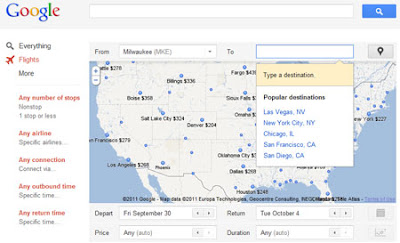
Google introduced a search tool on Tuesday for shopping for flights that pits the popular search engine against sites such as Travelocity and Kayak.

Travelers can search for flights at google.com/flights and filter their flight queries by price, airlines and routes. It also has a bar chart showing which travel dates are more expensive to fly. Google has been offering flight schedules since May.

Google offers new tool to shop for airline flights.

Google's move has been expected since it bought flight-data provider ITA Software for $700 million earlier this year.

Online travel agencies and so-called meta-search sites such as Kayak vigorously lobbied federal regulators to block the deal, fearing that it would pave the way for the tech giant to seamlessly integrate flight searches into its other products and dominate the travel shopping industry.

Google's entry into flight shopping will fundamentally change customer experience, travel technology analyst Norm Rose predicts.

"This is only the beginning of the transformation of general search into travel search that will save the consumer steps in the travel planning process," he says.

Google concedes that its new tool is a work in progress. International flights and small U.S. cities aren't available. Customers wishing to book premium-class tickets will have to look elsewhere.

"This is just an early look: the takeoff — not the final destination," Google says on its blog in announcing the product.

As with its other products, Google is staying away from commercial transactions. Instead, it directs customers to airlines' websites if they want to buy a ticket.

Unlike other online travel shopping sites, Google shows results only from participating airlines. But it hinted that it will display flights from other online travel agencies in the future.

"Airlines control how their flights are marketed, so as with other flight search providers, our booking links point to airline websites only," the company says. "We're working to create additional opportunities for our other partners in the travel industry to participate as well." Analysts have said travel search-only sites such as Kayak, Bing and Hipmunk have more to lose from Google's emergence than do online travel agencies that still offer booking services.

But Robert Birge, chief marketing officer of Kayak, says his company is "confident in (its) ability to compete."

"We believe our flight search technology is superior," he says. "We recognize Google is a formidable competitor, but they haven't been successful in every (niche) they've entered."

Google has been steadily adding travel products, including a tool to find hotels and the recent acquisition of review and guidebook publisher Zagat.

Google to offer tracking opt-out to Wi-Fi owners

USA Today
by Paul Sakuma
Sept 13, 2011

SAN FRANCISCO (AP) – Google is making a concession to give owners of residential wireless networks greater privacy.

In a change announced Tuesday, Google will prevent residential wireless systems from being listed in a database that helps the company track people on cell phones.

Google to offer tracking opt-out to Wi-Fi owners.

The adjustment is a response to concerns raised in Europe. Regulators there have periodically looked into whether Google's mapping services violate Europe's privacy laws.

To avoid trouble, Google will permit owners of wireless networks to opt out of the company's tracking technology. The option will be available worldwide in the autumn.

Google relies on the signals from wireless, or Wi-Fi, networks scattered around neighborhoods to get a better handle on locations of someone on a cell phone using Google's Android software or other services. The company says the Wi-Fi networks don't reveal people's identities.