originally appeared on SlashGear via The Washington Post
We’ve reported over the week about the North Korea trip currently under way by Google‘s Eric Schmidt and former New Mexico Governor Bill Richardson. Today, some information about the trip has been revealed detailing urges for less restrictive Internet and cell phone policies in the nation. Richardson will be holding a conference at the Beijing airport tomorrow.
The delegation is composed of nine individuals and does not include any press. The group is reported to have appealed for humane treatment of a detained tourist who was arrested last year. Likewise, they are encouraging the nation to implement a moratorium on rocket launches, which have caused tension and sanctions.
The trip itself is a private humanitarian effort, with Schmidt joining it of his own volition, not on behalf of Google, as is usually the case. He’s reported to have joined the delegation out of curiosity about various issues with North Korea, but has not personally stated his reasons for going. Richardson is a frequent visitor to the nation.
The U.S. government has been fairly critical of the trip, stating that it is taking place during a period of tension following North Korea’s last rocket launch in the past weeks. The US State Department’s spokeswoman offered this statement. Frankly, we don’t think the timing of this is particularly helpful, but they are private citizens and they are making their own decisions. They are not carrying any messages from us.

SEO Blog. Organic SEO Blog. Search Marketing News. SEO Done Right examines search engine optimization, the most effective form of internet marketing. Breaking SEO news and emerging developments at Google, Yahoo, and Bing. Leading Organic SEO Consultants Peak Positions debunk the many myths, hype, and spin related to SEO and search marketing.
Showing posts with label Eric Schmidt. Show all posts
Showing posts with label Eric Schmidt. Show all posts
Thursday, January 10, 2013
Friday, January 28, 2011
Schmidt Defends Incoming Google CEO
The Wall Street Journal
By Amir Efrati
January 27th, 2011
A week after announcing a management shakeup at Google, outgoing Chief Executive Eric Schmidt defended the credentials of company co-founder Larry Page, who will take the reins at the Internet giant in April.
“When people criticize Larry as the new CEO, that’s grossly unfair to Larry,” he said on Thursday at a small press conference in Davos, Switzerland, at the World Economic Forum. “He has been with me at every business decision for 10 years.”
 Though he stayed largely behind the scenes while Mr. Schmidt was the public face of Google, Mr. Page has long called the shots on product initiatives. He also showed little care for matters like budgets and policy, functions that Mr. Schmidt gravitated toward, people familiar with the company have said.
Messrs. Schmidt, Page and fellow co-founder Sergey Brin said last week that some top-level decision-making had gotten slower and the management change would improve that.
Some press reports speculated that the management change was due to increasing pressure from rising competitors such as Facebook, the social network, and that Mr. Page was being elevated to combat such headwinds. Another report said debate last year about whether to stop self-censoring results for Google’s Chinese search engine had created tension between the men.
But at Davos, Mr. Schmidt dismissed such notions as false. He stressed that the change “had nothing to do with competitors” and has been “misinterpreted, I think, by many people.”
He added: “All of the predicates for why the reorganization happened have not been correct,” he added. “The correct reason is we sat down and said: ‘This is a company that needs to be run even more tightly.’”
Mr. Schmidt, who will become executive chairman of the company and focus on governmental and press relations, acquisitions and partnerships, also implied he would stay at Google for another 10 years.
Last fall Mr. Schmidt told a group of journalists that when he joined Google in 2001 he committed to staying for 20 years. But after Google announced the executive changes during last week’s quarterly earnings call and later gave Mr. Schmidt a $100 million equity award from the company, some management experts and other Silicon Valley figures speculated that he might not stay that long.
The 55-year-old Mr. Schmidt said at Davos that not only is he “very committed to Google” but that Mr. Page, 38, and Mr. Brin, 37, insisted he stay involved in certain company affairs that he was planning to leave to them.
By Amir Efrati
January 27th, 2011
A week after announcing a management shakeup at Google, outgoing Chief Executive Eric Schmidt defended the credentials of company co-founder Larry Page, who will take the reins at the Internet giant in April.
“When people criticize Larry as the new CEO, that’s grossly unfair to Larry,” he said on Thursday at a small press conference in Davos, Switzerland, at the World Economic Forum. “He has been with me at every business decision for 10 years.”
 Though he stayed largely behind the scenes while Mr. Schmidt was the public face of Google, Mr. Page has long called the shots on product initiatives. He also showed little care for matters like budgets and policy, functions that Mr. Schmidt gravitated toward, people familiar with the company have said.
Messrs. Schmidt, Page and fellow co-founder Sergey Brin said last week that some top-level decision-making had gotten slower and the management change would improve that.
Some press reports speculated that the management change was due to increasing pressure from rising competitors such as Facebook, the social network, and that Mr. Page was being elevated to combat such headwinds. Another report said debate last year about whether to stop self-censoring results for Google’s Chinese search engine had created tension between the men.
But at Davos, Mr. Schmidt dismissed such notions as false. He stressed that the change “had nothing to do with competitors” and has been “misinterpreted, I think, by many people.”
He added: “All of the predicates for why the reorganization happened have not been correct,” he added. “The correct reason is we sat down and said: ‘This is a company that needs to be run even more tightly.’”
Mr. Schmidt, who will become executive chairman of the company and focus on governmental and press relations, acquisitions and partnerships, also implied he would stay at Google for another 10 years.
Last fall Mr. Schmidt told a group of journalists that when he joined Google in 2001 he committed to staying for 20 years. But after Google announced the executive changes during last week’s quarterly earnings call and later gave Mr. Schmidt a $100 million equity award from the company, some management experts and other Silicon Valley figures speculated that he might not stay that long.
The 55-year-old Mr. Schmidt said at Davos that not only is he “very committed to Google” but that Mr. Page, 38, and Mr. Brin, 37, insisted he stay involved in certain company affairs that he was planning to leave to them.

Monday, August 16, 2010
Holman W. Jenkins, Jr.: Google and the Search for the Future
The Wall Street Journal
The Web icon's CEO on the mobile computing revolution, the future of newspapers, and privacy in the digital age.


To some, Google has been looking a bit sallow lately. The stock is down. Where once everything seemed to go the company's way, along came Apple's iPhone, launching a new wave of Web growth on a platform that largely bypassed the browser and Google's search box. The "app" revolution was going to spell an end to Google's dominance of Web advertising.
But that's all so six-months-ago. When a group of Journal editors sat down with Eric Schmidt on a recent Friday, Google's CEO sounded nothing like a man whose company was facing a midlife crisis, let alone intimations of mortality.
For one thing, just a couple days earlier, Google had publicly estimated that 200,000 Android smartphones were being activated daily by cell carriers on behalf of customers. That's a doubling in just three months. Since the beginning of the year, Android phones have been outselling iPhones by an increasing clip and seem destined soon to outstrip Apple in global market share.
True, Apple sells its phones for luscious margins, while Google gives away Android to handset makers for free. But not to worry, says Mr. Schmidt: "You get a billion people doing something, there's lots of ways to make money. Absolutely, trust me. We'll get lots of money for it."
"In general in technology," he says, "if you own a platform that's valuable, you can monetize it." Example: Google is obliged to share with Apple search revenue generated by iPhone users. On Android, Google gets to keep 100%. That difference alone, says Mr. Schmidt, is more than enough to foot the bill for Android's continued development.
And coming soon is Chrome OS, which Google hopes will do in tablets and netbooks what Android is doing in smartphones, i.e., give Google a commanding share of the future and leave, in this case, Microsoft in the dust.
Can it all be so easy? Google's stock price has fallen nearly $150 since the beginning of the year. Financial pundits have started to ask skeptical questions, wondering why it doesn't give more of its ample cash back to shareholders in the form of buybacks and dividends. Some suspect that all that temptation merely encourages Mr. Schmidt, along with founders Sergey Brin and Larry Page—the triumvirate running the company—to splurge on gimmicky ideas that never pay off. Fortune magazine recently called Google a "cash cow" and suggested more attention be paid to milking it rather than running off in search of the next big thing.
But to hear Mr. Schmidt tell it, the real challenge is one not yet on most investors' minds: how to preserve Google's franchise in Web advertising, the source of almost all its profits, when "search" is outmoded.
The day is coming when the Google search box—and the activity known as Googling—no longer will be at the center of our online lives. Then what? "We're trying to figure out what the future of search is," Mr. Schmidt acknowledges. "I mean that in a positive way. We're still happy to be in search, believe me. But one idea is that more and more searches are done on your behalf without you needing to type."
"I actually think most people don't want Google to answer their questions," he elaborates. "They want Google to tell them what they should be doing next."
Let's say you're walking down the street. Because of the info Google has collected about you, "we know roughly who you are, roughly what you care about, roughly who your friends are." Google also knows, to within a foot, where you are. Mr. Schmidt leaves it to a listener to imagine the possibilities: If you need milk and there's a place nearby to get milk, Google will remind you to get milk. It will tell you a store ahead has a collection of horse-racing posters, that a 19th-century murder you've been reading about took place on the next block.
Says Mr. Schmidt, a generation of powerful handheld devices is just around the corner that will be adept at surprising you with information that you didn't know you wanted to know. "The thing that makes newspapers so fundamentally fascinating—that serendipity—can be calculated now. We can actually produce it electronically," Mr. Schmidt says.
Mr. Schmidt obviously has an eye to his audience, which this day consists of folks with an abiding devotion to the newspaper business. He speaks in sorrowful tones about the "economic disaster that is the American newspaper." He assures us that in the coming deluge trusted "brands" will be more important than ever. Just as quickly, though, he adds that whether the winners will be new brands or existing brands remains to be seen. On one thing, however, Google is willing to bet: "The only way the problem [of insufficient revenue for news gathering] is going to be solved is by increasing monetization, and the only way I know of to increase monetization is through targeted ads. That's our business."
Mr. Schmidt is a believer in targeted advertising because, simply, he's a believer in targeted everything: "The power of individual targeting—the technology will be so good it will be very hard for people to watch or consume something that has not in some sense been tailored for them."
That's a bit scary when you think about it. But for investors and executives the big question, of course, is which companies will control these opportunities. Google may see itself as friend and helper to the media business, but it also clearly sees itself in control of the targeting information. Says Mr. Schmidt: "As you go from the search box [to the next phase of Google], you really want to go from syntax to semantics, from what you typed to what you meant. And that's basically the role of [Artificial Intelligence]. I think we will be the world leader in that for a long time."
Between here and there, though, the company faces ever-growing legal, political and regulatory obstacles. The net neutrality debate, which Google has led, has taken a sudden turn that has many of its former allies in the "public interest" sector shouting "treason."
What was most striking about the set of net neut "principles" Google produced this week with former antagonist Verizon was that they didn't apply to wireless. "The issues of wireless versus wireline gets very messy," Mr. Schmidt told one news site. "And that's really an FCC issue, not a Google issue."
Wait. Isn't the future of the Internet wireless these days? Isn't wireless the very basis of the new partnership between Google and Verizon, built on promoting Google's Android software? But Google has now broken ranks with its allies and dared to speak about the sheer impracticality of net neutrality on mobile networks where demand is likely to outstrip capacity for the foreseeable future.
If that weren't about to become a sticky political wicket for the company, it also faces growing antitrust, privacy and patent scrutiny, fanned by a growing phalanx of Beltway opponents, the latest being Larry Ellison and Oracle. "There's a set of people who are intrinsic oppositionists to everything Google does," Mr. Schmidt acknowledges resignedly. "The first opponent will be Microsoft."
Mr. Schmidt is familiar with the game—as chief technology officer of Sun Microsystems in the 1990s, he was a chief fomenter of the antitrust assault on Bill Gates & Co. Now that the tables are turned, he says, Google will persevere and prevail by doing what he says Microsoft failed to do—make sure its every move is "good for consumers" and "fair" to competitors.
Uh huh. Google takes a similarly generous view of its own motives on the politically vexed issue of privacy. Mr. Schmidt says regulation is unnecessary because Google faces such strong incentives to treat its users right, since they will walk away the minute Google does anything with their personal information they find "creepy."
Really? Some might be skeptical that a user with, say, a thousand photos on Picasa would find it so easy to walk away. Or a guy with 10 years of emails on Gmail. Or a small business owner who has come to rely on Google Docs as an alternative to Microsoft Office. Isn't stickiness—even slightly extortionate stickiness—what these Google services aim for?
Mr. Schmidt is surely right, though, that the questions go far beyond Google. "I don't believe society understands what happens when everything is available, knowable and recorded by everyone all the time," he says. He predicts, apparently seriously, that every young person one day will be entitled automatically to change his or her name on reaching adulthood in order to disown youthful hijinks stored on their friends' social media sites.
"I mean we really have to think about these things as a society," he adds. "I'm not even talking about the really terrible stuff, terrorism and access to evil things," he says.
Not that Google is a doubter of the value of social media. Mr. Schmidt awards Facebook his highest accolade, calling it a "company of consequence." And though "there is a lot of hot air, a lot of venture money" in the sector right now, he predicts that one or two more "companies of consequence" will be born among the horde of new players just coming to life now.
A skeptic might wonder whether, despite present glory, Google itself might yet prove a flash in the pan. The company has enormous technological confidence. Mr. Schmidt describes how YouTube, its video-serving site, almost "took down" the company in its early days, thanks to the swelling outflow of video dispatched from its servers to users around the globe. Salvation was the "proxy cache"—lots of local servers around the world holding the most popular videos. "The technology that Google invented allows us to put those things very close to you," says Mr. Schmidt. "It was a tremendous technological achievement."
But with YouTube, as with lots of Google projects, there remains the question of how to make money. Google captured the search wave and shows every sign of positioning itself successfully for the mobile wave. As for the waves after that, your guess may be as good as Mr. Schmidt's.
But that's all so six-months-ago. When a group of Journal editors sat down with Eric Schmidt on a recent Friday, Google's CEO sounded nothing like a man whose company was facing a midlife crisis, let alone intimations of mortality.
For one thing, just a couple days earlier, Google had publicly estimated that 200,000 Android smartphones were being activated daily by cell carriers on behalf of customers. That's a doubling in just three months. Since the beginning of the year, Android phones have been outselling iPhones by an increasing clip and seem destined soon to outstrip Apple in global market share.
True, Apple sells its phones for luscious margins, while Google gives away Android to handset makers for free. But not to worry, says Mr. Schmidt: "You get a billion people doing something, there's lots of ways to make money. Absolutely, trust me. We'll get lots of money for it."
"In general in technology," he says, "if you own a platform that's valuable, you can monetize it." Example: Google is obliged to share with Apple search revenue generated by iPhone users. On Android, Google gets to keep 100%. That difference alone, says Mr. Schmidt, is more than enough to foot the bill for Android's continued development.
And coming soon is Chrome OS, which Google hopes will do in tablets and netbooks what Android is doing in smartphones, i.e., give Google a commanding share of the future and leave, in this case, Microsoft in the dust.
Can it all be so easy? Google's stock price has fallen nearly $150 since the beginning of the year. Financial pundits have started to ask skeptical questions, wondering why it doesn't give more of its ample cash back to shareholders in the form of buybacks and dividends. Some suspect that all that temptation merely encourages Mr. Schmidt, along with founders Sergey Brin and Larry Page—the triumvirate running the company—to splurge on gimmicky ideas that never pay off. Fortune magazine recently called Google a "cash cow" and suggested more attention be paid to milking it rather than running off in search of the next big thing.
But to hear Mr. Schmidt tell it, the real challenge is one not yet on most investors' minds: how to preserve Google's franchise in Web advertising, the source of almost all its profits, when "search" is outmoded.
The day is coming when the Google search box—and the activity known as Googling—no longer will be at the center of our online lives. Then what? "We're trying to figure out what the future of search is," Mr. Schmidt acknowledges. "I mean that in a positive way. We're still happy to be in search, believe me. But one idea is that more and more searches are done on your behalf without you needing to type."
"I actually think most people don't want Google to answer their questions," he elaborates. "They want Google to tell them what they should be doing next."
Let's say you're walking down the street. Because of the info Google has collected about you, "we know roughly who you are, roughly what you care about, roughly who your friends are." Google also knows, to within a foot, where you are. Mr. Schmidt leaves it to a listener to imagine the possibilities: If you need milk and there's a place nearby to get milk, Google will remind you to get milk. It will tell you a store ahead has a collection of horse-racing posters, that a 19th-century murder you've been reading about took place on the next block.
Says Mr. Schmidt, a generation of powerful handheld devices is just around the corner that will be adept at surprising you with information that you didn't know you wanted to know. "The thing that makes newspapers so fundamentally fascinating—that serendipity—can be calculated now. We can actually produce it electronically," Mr. Schmidt says.
Mr. Schmidt obviously has an eye to his audience, which this day consists of folks with an abiding devotion to the newspaper business. He speaks in sorrowful tones about the "economic disaster that is the American newspaper." He assures us that in the coming deluge trusted "brands" will be more important than ever. Just as quickly, though, he adds that whether the winners will be new brands or existing brands remains to be seen. On one thing, however, Google is willing to bet: "The only way the problem [of insufficient revenue for news gathering] is going to be solved is by increasing monetization, and the only way I know of to increase monetization is through targeted ads. That's our business."
Mr. Schmidt is a believer in targeted advertising because, simply, he's a believer in targeted everything: "The power of individual targeting—the technology will be so good it will be very hard for people to watch or consume something that has not in some sense been tailored for them."
That's a bit scary when you think about it. But for investors and executives the big question, of course, is which companies will control these opportunities. Google may see itself as friend and helper to the media business, but it also clearly sees itself in control of the targeting information. Says Mr. Schmidt: "As you go from the search box [to the next phase of Google], you really want to go from syntax to semantics, from what you typed to what you meant. And that's basically the role of [Artificial Intelligence]. I think we will be the world leader in that for a long time."
Between here and there, though, the company faces ever-growing legal, political and regulatory obstacles. The net neutrality debate, which Google has led, has taken a sudden turn that has many of its former allies in the "public interest" sector shouting "treason."
What was most striking about the set of net neut "principles" Google produced this week with former antagonist Verizon was that they didn't apply to wireless. "The issues of wireless versus wireline gets very messy," Mr. Schmidt told one news site. "And that's really an FCC issue, not a Google issue."
Wait. Isn't the future of the Internet wireless these days? Isn't wireless the very basis of the new partnership between Google and Verizon, built on promoting Google's Android software? But Google has now broken ranks with its allies and dared to speak about the sheer impracticality of net neutrality on mobile networks where demand is likely to outstrip capacity for the foreseeable future.
If that weren't about to become a sticky political wicket for the company, it also faces growing antitrust, privacy and patent scrutiny, fanned by a growing phalanx of Beltway opponents, the latest being Larry Ellison and Oracle. "There's a set of people who are intrinsic oppositionists to everything Google does," Mr. Schmidt acknowledges resignedly. "The first opponent will be Microsoft."
Mr. Schmidt is familiar with the game—as chief technology officer of Sun Microsystems in the 1990s, he was a chief fomenter of the antitrust assault on Bill Gates & Co. Now that the tables are turned, he says, Google will persevere and prevail by doing what he says Microsoft failed to do—make sure its every move is "good for consumers" and "fair" to competitors.
Uh huh. Google takes a similarly generous view of its own motives on the politically vexed issue of privacy. Mr. Schmidt says regulation is unnecessary because Google faces such strong incentives to treat its users right, since they will walk away the minute Google does anything with their personal information they find "creepy."
Really? Some might be skeptical that a user with, say, a thousand photos on Picasa would find it so easy to walk away. Or a guy with 10 years of emails on Gmail. Or a small business owner who has come to rely on Google Docs as an alternative to Microsoft Office. Isn't stickiness—even slightly extortionate stickiness—what these Google services aim for?
Mr. Schmidt is surely right, though, that the questions go far beyond Google. "I don't believe society understands what happens when everything is available, knowable and recorded by everyone all the time," he says. He predicts, apparently seriously, that every young person one day will be entitled automatically to change his or her name on reaching adulthood in order to disown youthful hijinks stored on their friends' social media sites.
"I mean we really have to think about these things as a society," he adds. "I'm not even talking about the really terrible stuff, terrorism and access to evil things," he says.
Not that Google is a doubter of the value of social media. Mr. Schmidt awards Facebook his highest accolade, calling it a "company of consequence." And though "there is a lot of hot air, a lot of venture money" in the sector right now, he predicts that one or two more "companies of consequence" will be born among the horde of new players just coming to life now.
A skeptic might wonder whether, despite present glory, Google itself might yet prove a flash in the pan. The company has enormous technological confidence. Mr. Schmidt describes how YouTube, its video-serving site, almost "took down" the company in its early days, thanks to the swelling outflow of video dispatched from its servers to users around the globe. Salvation was the "proxy cache"—lots of local servers around the world holding the most popular videos. "The technology that Google invented allows us to put those things very close to you," says Mr. Schmidt. "It was a tremendous technological achievement."
But with YouTube, as with lots of Google projects, there remains the question of how to make money. Google captured the search wave and shows every sign of positioning itself successfully for the mobile wave. As for the waves after that, your guess may be as good as Mr. Schmidt's.
Tuesday, April 13, 2010
Google CEO Says Newspapers Can Make Money Online


WASHINGTON (AP) - Google Inc. Chief Executive Eric Schmidt told a group of editors Sunday that he is confident that newspapers will find new ways to make money online by harnessing the vast reach of the Internet.
Media executives have accused Google of draining readers and advertising from newspapers' Web sites. But in a speech to open the annual conference of the American Society of News Editors, Schmidt said Google recognizes that newspapers are vital to democracy and provide a critical source of online content.
"We understand how fundamental your mission is," he said.
Schmidt predicted that the news business will find a new model, based on a combination of advertising and subscription revenue. He said Google hopes to facilitate that, but he offered no specifics.
"We have a business model problem. We don't have a news problem," Schmidt said. He added: "We're all in this together."
Schmidt encouraged his audience to experiment with everything from social media to personalized content to engage readers.
"Technology allows you to talk directly to your users," he said.
He also said the news business needs to reach out to readers using mobile technology, delivering content through wireless devices such as Amazon.com Inc.'s Kindle, Apple Inc.'s iPad and Google's own Android smart phones.
Reaction to Schmidt's speech was mixed.
Anders Gyllenhaal, executive editor of The Miami Herald, said that even though Google drives a lot of traffic to his newspaper's site, he remains unconvinced that Google sees newspapers as true partners. "We really are going in different directions," he said.
Still, Jonathan Wolman, editor and publisher of The Detroit News, said he was "heartened to hear the Internet geniuses talk about newspaper content as an essential ingredient."
Media executives have accused Google of draining readers and advertising from newspapers' Web sites. But in a speech to open the annual conference of the American Society of News Editors, Schmidt said Google recognizes that newspapers are vital to democracy and provide a critical source of online content.
"We understand how fundamental your mission is," he said.
Schmidt predicted that the news business will find a new model, based on a combination of advertising and subscription revenue. He said Google hopes to facilitate that, but he offered no specifics.
"We have a business model problem. We don't have a news problem," Schmidt said. He added: "We're all in this together."
Schmidt encouraged his audience to experiment with everything from social media to personalized content to engage readers.
"Technology allows you to talk directly to your users," he said.
He also said the news business needs to reach out to readers using mobile technology, delivering content through wireless devices such as Amazon.com Inc.'s Kindle, Apple Inc.'s iPad and Google's own Android smart phones.
Reaction to Schmidt's speech was mixed.
Anders Gyllenhaal, executive editor of The Miami Herald, said that even though Google drives a lot of traffic to his newspaper's site, he remains unconvinced that Google sees newspapers as true partners. "We really are going in different directions," he said.
Still, Jonathan Wolman, editor and publisher of The Detroit News, said he was "heartened to hear the Internet geniuses talk about newspaper content as an essential ingredient."
Thursday, April 01, 2010
Google CEO's Compensation for 2009 Falls 52 %

SAN FRANCISCO (AP) - The total compensation of Google Inc. CEO Eric Schmidt fell 52 percent last year as the Internet search leader cut back on its employee perquisites to help lift its profits during the recession.
Schmidt's 2009 package totaled $245,322, down from $508,764 in 2008, according to documents filed Monday with the Securities and Exchange Commission.
The sharp decrease reflected lower bills for protecting Schmidt and flying his personal guests on jets chartered by Google.
Schmidt's personal security cost Google $233,542 last year compared to $402,562 the previous year. Google spent $10,119 flying Schmidt's friends and family in 2009 after shelling out $106,201 on air fare for his entourage in 2008.
By Schmidt's request, Google limited his salary to just $1 for the fifth consecutive year. Google co-founders Larry Page and Sergey Brin also have insisted on keeping their salaries at $1 apiece during the same period, despite the company's repeated offers to pay them more.
The sacrifice hasn't been a financial hardship for Schmidt, Page and Brin. As Google's controlling stockholders, the men have parlayed the company's success to become multibillionaires.
Google's shares have soared from an initial offering price of $85 in August 2004 to as high as $747.24 in late 2007. The shares dipped 24 cents Monday to close at $562.45.
At that price, Schmidt's 9.4 million Google shares are worth about $5.3 billion. He has whittled his holdings from 14.8 million shares when Google went public.
The stakes held by Page and Brin are each worth more than $16 billion. The founders each plan to sell about 5 million Google shares during the next five years to diversify their investment portfolios.
None of Google's ruling triumvirate received stock options last year.
Unlike 2008, Schmidt, Brin and Page each received an after-tax holiday bonus of $1,000 last year along with the company's other 20,000 employees. Google also paid $660 to cover the withholding taxes on Schmidt's bonus.
Google had been renowned for splurging on its employees until the recession caused the company's revenue growth to fall below 10 percent for the first time as a public company. The slowdown prompted Google to lay off several hundred employees last year and pamper its remaining workers a little less extravagantly. For example, Google closed some of the cafeterias that serve workers free food.
The penny pinching helped Google increase its profit 28 percent last year to $6.5 billion, while its revenue edged up 9 percent to $23.7 billion. Its stock price more than doubled, surging from $307.65 at the end of 2008 to close out 2009 just below $620.
Last year's austerity campaign was orchestrated by Patrick Pichette, who Google hired as its chief financial officer in August 2008.
Google rewarded Pichette with a 2009 compensation package valued at $24.7 million, based on a formula used by The Associated Press.
The AP's calculations includes salary, bonus, incentives, perks and the estimated value of stock options and awards.
Pichette's 2009 package included stock options and other equity incentives valued at $21.7 million. Earlier this year, Google's board raised Pichette's annual salary from $450,000 to $500,000, along with several other top executives.

SAN FRANCISCO (AP) - The total compensation of Google Inc. CEO Eric Schmidt fell 52 percent last year as the Internet search leader cut back on its employee perquisites to help lift its profits during the recession.
Schmidt's 2009 package totaled $245,322, down from $508,764 in 2008, according to documents filed Monday with the Securities and Exchange Commission.
The sharp decrease reflected lower bills for protecting Schmidt and flying his personal guests on jets chartered by Google.
Schmidt's personal security cost Google $233,542 last year compared to $402,562 the previous year. Google spent $10,119 flying Schmidt's friends and family in 2009 after shelling out $106,201 on air fare for his entourage in 2008.
By Schmidt's request, Google limited his salary to just $1 for the fifth consecutive year. Google co-founders Larry Page and Sergey Brin also have insisted on keeping their salaries at $1 apiece during the same period, despite the company's repeated offers to pay them more.
The sacrifice hasn't been a financial hardship for Schmidt, Page and Brin. As Google's controlling stockholders, the men have parlayed the company's success to become multibillionaires.
Google's shares have soared from an initial offering price of $85 in August 2004 to as high as $747.24 in late 2007. The shares dipped 24 cents Monday to close at $562.45.
At that price, Schmidt's 9.4 million Google shares are worth about $5.3 billion. He has whittled his holdings from 14.8 million shares when Google went public.
The stakes held by Page and Brin are each worth more than $16 billion. The founders each plan to sell about 5 million Google shares during the next five years to diversify their investment portfolios.
None of Google's ruling triumvirate received stock options last year.
Unlike 2008, Schmidt, Brin and Page each received an after-tax holiday bonus of $1,000 last year along with the company's other 20,000 employees. Google also paid $660 to cover the withholding taxes on Schmidt's bonus.
Google had been renowned for splurging on its employees until the recession caused the company's revenue growth to fall below 10 percent for the first time as a public company. The slowdown prompted Google to lay off several hundred employees last year and pamper its remaining workers a little less extravagantly. For example, Google closed some of the cafeterias that serve workers free food.
The penny pinching helped Google increase its profit 28 percent last year to $6.5 billion, while its revenue edged up 9 percent to $23.7 billion. Its stock price more than doubled, surging from $307.65 at the end of 2008 to close out 2009 just below $620.
Last year's austerity campaign was orchestrated by Patrick Pichette, who Google hired as its chief financial officer in August 2008.
Google rewarded Pichette with a 2009 compensation package valued at $24.7 million, based on a formula used by The Associated Press.
The AP's calculations includes salary, bonus, incentives, perks and the estimated value of stock options and awards.
Pichette's 2009 package included stock options and other equity incentives valued at $21.7 million. Earlier this year, Google's board raised Pichette's annual salary from $450,000 to $500,000, along with several other top executives.
Friday, September 04, 2009
Google's Gmail Goof-Up
By Business Week

It's too bad the National Transportation Safety Board can't investigate Google to find out just why Gmail crashed Tuesday as Google's explanations for its outages (via its dashboard) are short and kindergarten-like.
The NTSB would seek out the root cause of the outage, hold hearings and issue a report with recommendations for fixing the problem. But Google follows the standard operating practice of cloud and SaaS (Software-as-a-Service) providers, and that is to tell customers as little as possible about an outage. They treat their customers like dumb bunnies.
A Gmail outage isn't on the scale of a contaminated food supply incident, the discovery of lead paint on children's toys, or a plane crash—all events that trigger a federal investigation and detailed reports that flesh out causes and remedies.
But what happens if Google wins contracts to provide applications and mail services for Los Angeles and other government entities?
Cloud and SaaS providers increasingly want to manage critical services for government. And in time, outages that are now annoyances may have critical implications to them. Los Angeles' IT department is recommending the city move to Google Apps and says the company's services "often exceed the current city level."
That's a plus for Google but if something goes wrong with LA's IT systems, at least there is still a clear line of accountability to the managers responsible and an opportunity to probe.
But along with telling customers as little as possible, hosting, cloud and SaaS providers indemnify themselves as much as possible from any business losses resulting from an outage.
In theory, the accountability is provided by the market: a customer can move to new service provider. But a migration to the cloud may be a path of no return. LA, in its assessment of cloud services, said that if it ditches its current infrastructure, "it may be cost-prohibitive to return to the city-owned and operated structure."
Today, the harm is mostly economic. When eBay Inc.'s PayPal service crashed last month, it was just something customers had to deal with it.
PayPal blamed the failure on a "back-end router" and some redundancy issues, and left it at that. That meant the companies like Sailrite Enterprises Inc., a sailing supply company, which relied exclusively on PayPal, were unlikely to learn what happened and had to suffer the loss.
But if cloud and SaaS providers manage government services then it's unlikely that an informed public will settle for incomplete explanations about outages.
If the service is critical, they will want to know what went wrong. Was the equipment upgraded, patched? Was staffing at proper levels? When was the last time someone tested the emergency generators? And so on.
Answers to fair and legitimate questions will be sought and little "dashboards" aren't going to cut it.
The Gmail outage also affected the Google SEO search results. Searchers were getting queries that were not relevant to their searches, but, Google has resolved the problem and everything is now functioning properly.
By Business Week

It's too bad the National Transportation Safety Board can't investigate Google to find out just why Gmail crashed Tuesday as Google's explanations for its outages (via its dashboard) are short and kindergarten-like.
The NTSB would seek out the root cause of the outage, hold hearings and issue a report with recommendations for fixing the problem. But Google follows the standard operating practice of cloud and SaaS (Software-as-a-Service) providers, and that is to tell customers as little as possible about an outage. They treat their customers like dumb bunnies.
A Gmail outage isn't on the scale of a contaminated food supply incident, the discovery of lead paint on children's toys, or a plane crash—all events that trigger a federal investigation and detailed reports that flesh out causes and remedies.
But what happens if Google wins contracts to provide applications and mail services for Los Angeles and other government entities?
Cloud and SaaS providers increasingly want to manage critical services for government. And in time, outages that are now annoyances may have critical implications to them. Los Angeles' IT department is recommending the city move to Google Apps and says the company's services "often exceed the current city level."
That's a plus for Google but if something goes wrong with LA's IT systems, at least there is still a clear line of accountability to the managers responsible and an opportunity to probe.
But along with telling customers as little as possible, hosting, cloud and SaaS providers indemnify themselves as much as possible from any business losses resulting from an outage.
In theory, the accountability is provided by the market: a customer can move to new service provider. But a migration to the cloud may be a path of no return. LA, in its assessment of cloud services, said that if it ditches its current infrastructure, "it may be cost-prohibitive to return to the city-owned and operated structure."
Today, the harm is mostly economic. When eBay Inc.'s PayPal service crashed last month, it was just something customers had to deal with it.
PayPal blamed the failure on a "back-end router" and some redundancy issues, and left it at that. That meant the companies like Sailrite Enterprises Inc., a sailing supply company, which relied exclusively on PayPal, were unlikely to learn what happened and had to suffer the loss.
But if cloud and SaaS providers manage government services then it's unlikely that an informed public will settle for incomplete explanations about outages.
If the service is critical, they will want to know what went wrong. Was the equipment upgraded, patched? Was staffing at proper levels? When was the last time someone tested the emergency generators? And so on.
Answers to fair and legitimate questions will be sought and little "dashboards" aren't going to cut it.
The Gmail outage also affected the Google SEO search results. Searchers were getting queries that were not relevant to their searches, but, Google has resolved the problem and everything is now functioning properly.
Monday, August 31, 2009
Is Google Sitting on the Clock of eBay?
By The Wall Street Journal
Is Google the next eBay?
Maybe. There are some worrisome parallels between Google today and eBay in 2005-06, as the online-auction company's growth was faltering.
Consider this history: In August 2004, then-Chief Executive Meg Whitman said she didn't believe eBay was approaching anything like saturation. Just six months later the company issued a weaker-than-expected forecast that in hindsight was the end of its red-hot growth phase. EBay's stock is now trading at less than half its December 2004 level.
 Through 2005-06 some hoped that eBay's PayPal unit, acquired in 2002, and Skype, in 2005, would prove to be new growth engines, along with international markets. As it turned out, of course, after writing off much of the Skype purchase price, eBay now is looking to jettison it. And growth at PayPal and internationally hasn't been enough to stop eBay's top-line growth rate from decelerating.
When it comes to Google, there also are hopes for international growth. YouTube has some similarities with Skype, high user traffic but relatively low revenue. Whether YouTube can live up to its promise as a big ad platform is uncertain.
Another of Google's potential growth engines is Android. But its ability to help Google expand in the mobile-ad market remains unproved.
Certainly, Google can claim lots of phones soon may be using the Android operating system. Unfortunately, they don't include the two phone brands that account for much of the growth in the smart-phone market, Apple and Research In Motion's BlackBerry. Google also is banking on expanding into display advertising.
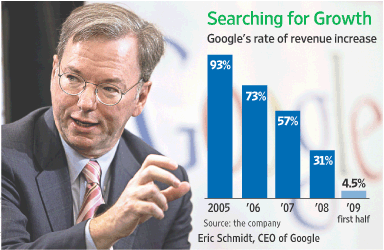
While investors wait for these new initiatives to prove themselves, growth is slowing in the core paid-search ad business. Google's revenue growth rate has fallen from 93% in 2005 to 31% in 2008.
The recession has demonstrated the Internet company isn't immune from pressures other ad-dependent businesses face. Revenue growth dropped to 3% year on year in the second quarter.
Moreover, as U.S. revenue growth was only 1.6%, it is possible that Google's core search business actually shrank in the U.S. when contributions from newer businesses like mobile advertising are excluded.
Google's revenue growth will certainly accelerate coming out of the recession. The issue is by how much and for how long.
In the short term, growth will be sparked by "price reinflation of key words," said Majestic Research Managing Director John Aiken. Prices fell during the worst of the slump. Assuming demand returns, price per clicks should rise again.
 But that won't sustain growth long term. That rests on several other variables, including where consumers go to search the Internet and how many searches they do.
Competition from Microsoft's revamped search engine, Bing, is showing signs of life. Search marketing reported this month that Bing had lifted its paid-click market share 44% since the beginning of June. It still is only 4.9%, but Microsoft's share will rise assuming the deal with Yahoo is completed.
It would be foolish to predict that Google won't have another business success, of course. Microsoft managed to leverage its strength in PC operating systems into a stranglehold over the word-processing and spreadsheet applications.
But investors should be careful buying on such hopes. With Google's medium-term revenue growth likely to fall toward 10%, it is hard to justify paying 25 times 2009 consensus earnings, including the cost of employee stock options. Google may itself discover the next Google-like business.
But until it proves that case, investors may want to wait for the stock to retreat.
By The Wall Street Journal
Is Google the next eBay?
Maybe. There are some worrisome parallels between Google today and eBay in 2005-06, as the online-auction company's growth was faltering.
Consider this history: In August 2004, then-Chief Executive Meg Whitman said she didn't believe eBay was approaching anything like saturation. Just six months later the company issued a weaker-than-expected forecast that in hindsight was the end of its red-hot growth phase. EBay's stock is now trading at less than half its December 2004 level.
 Through 2005-06 some hoped that eBay's PayPal unit, acquired in 2002, and Skype, in 2005, would prove to be new growth engines, along with international markets. As it turned out, of course, after writing off much of the Skype purchase price, eBay now is looking to jettison it. And growth at PayPal and internationally hasn't been enough to stop eBay's top-line growth rate from decelerating.
When it comes to Google, there also are hopes for international growth. YouTube has some similarities with Skype, high user traffic but relatively low revenue. Whether YouTube can live up to its promise as a big ad platform is uncertain.
Another of Google's potential growth engines is Android. But its ability to help Google expand in the mobile-ad market remains unproved.
Certainly, Google can claim lots of phones soon may be using the Android operating system. Unfortunately, they don't include the two phone brands that account for much of the growth in the smart-phone market, Apple and Research In Motion's BlackBerry. Google also is banking on expanding into display advertising.
While investors wait for these new initiatives to prove themselves, growth is slowing in the core paid-search ad business. Google's revenue growth rate has fallen from 93% in 2005 to 31% in 2008.
The recession has demonstrated the Internet company isn't immune from pressures other ad-dependent businesses face. Revenue growth dropped to 3% year on year in the second quarter.
Moreover, as U.S. revenue growth was only 1.6%, it is possible that Google's core search business actually shrank in the U.S. when contributions from newer businesses like mobile advertising are excluded.
Google's revenue growth will certainly accelerate coming out of the recession. The issue is by how much and for how long.
In the short term, growth will be sparked by "price reinflation of key words," said Majestic Research Managing Director John Aiken. Prices fell during the worst of the slump. Assuming demand returns, price per clicks should rise again.
 But that won't sustain growth long term. That rests on several other variables, including where consumers go to search the Internet and how many searches they do.
Competition from Microsoft's revamped search engine, Bing, is showing signs of life. Search marketing reported this month that Bing had lifted its paid-click market share 44% since the beginning of June. It still is only 4.9%, but Microsoft's share will rise assuming the deal with Yahoo is completed.
It would be foolish to predict that Google won't have another business success, of course. Microsoft managed to leverage its strength in PC operating systems into a stranglehold over the word-processing and spreadsheet applications.
But investors should be careful buying on such hopes. With Google's medium-term revenue growth likely to fall toward 10%, it is hard to justify paying 25 times 2009 consensus earnings, including the cost of employee stock options. Google may itself discover the next Google-like business.
But until it proves that case, investors may want to wait for the stock to retreat.
Tuesday, June 09, 2009
Thursday, March 19, 2009
 Google Growth Continues
Excerpts From Google Press Day 2007
Originally Posted at Google Blogoscoped
The world's most popular search engine in getting larger by the minute. For more perspective on the Google System and its scalability, let's review some 2007 outtakes from key Google execs.
CEO Eric Schmidt:
“Search was, and is, and I suspect will be for many years, the killer application,” Eric says. “We have more engineers working at Google on search than we do anything else.” And: “As the web gets bigger, you need a bigger index ... It’s like looking for more needles in larger haystacks.”
Personal search is the next big phenomena, Eric says. The best search is a personal search – one that we arrange, we control, etc. This is going to become the theme of Google as they move forward, Eric proclaims, stating that (and this surprises Eric) iGoogle is exploding in its use. Eric likens iGoogle to a ring-tone as people love to personalize it.
Eric continues to say that Google likes to tackle things with the help of partners, sharing revenues, and that there are lots of challenges ahead; growth, society and the future. “What are the next billion people who come online going to do? Are they going to democra
tize the web? Are they going to bring more languages? I don’t know, but I know they’re going to come.” Eric mentions a Venezuelan TV station that survived by coming online... and using YouTube. This was an important event for the people of Venezuela.
Eric talks about how soon, it will be possible to walk up to a computer and make it yours: the “Be Mine” command. Securely, safely, without any question of theft. And then, when you’re done, you’ll say “Be Gone” and you’re logged out.
Marissa Mayer:
So far, she spoke about the core principles and components of search – the four answers which create the entire e xperience that you have on Google:
1. Comprehensiveness
2. Relevance - Which goes first? Apples, oranges or grapes? This is what they’re doing with websites, Marissa says: it’s a question of ranking and ordering the results, the question being how can they rank the results in the most relevant way possible?
3. Speed - Marissa says they’re constantly working on making Google faster and faster.
4. User Experience - Google asks themselves, “Do the results make sense? Is it easy or hard to understand the answers and the layout of the pages?”
With that in mind, Marissa says she wants to take a look at Google’s past, present and future. In the early days, around 1998, the world wide web would fit on one slide. This year is Marissa’s 8th year at Google, and they now have 10s of billions of slides, grown by more than a factor of 1000 in eight years. Back then, you could organize all websites in a manual directory, as Yahoo did, but as the web exploded search became a necessary tool.
Google is constantly working to crawl and include more and more content, Marissa says. In June 2000, a year after Marissa joined, it was the time of GIGA Google – 1 billion web pages crawled. Next search engine had 600 million. As you include more pages, relevance bec
omes a problem. In the early days, users got used to hunting and pecking at results. Google realized their job was to provide the best result first, and that if they did their job right, the user shouldn’t have to click “next” or even scroll. This lead to the “I’m Feeling Lucky” button, which has by now been translated into many languages.
Basically Marissa says Google realized they only had a few users, but they started to see the user base grow due to people getting better search results – which made it spread across the US and internationally.
Marissa says there are a lot of speed advances in the past 20 years. Two decades ago, you’d go to the library, look things up, get journals out and find your answer. Many questions would go unanswered because it wasn’t worth spending hours researching some questions. Then, you could email friends and sometimes they had the right answers. But with internet search, people could get answers within a second. But at some point, Google will be up against the constants of physics – though they’re aiming for light speed searches.
In an early Q&A that followed, Marissa was asked about the size of Google’s index and told the press it is “10s of billions of pages” and “three times bigger than next nearest rival.” (I wonder what Yahoo has to say on that...) Also, someone mentions how Jason Calacanis
thinks the internet is polluted, and that we need a human edited search engine. Marissa replies that when the ’net is large & polluted, you need more sophisticated means to help people find information. Ideal, she says, is a “blend of both” an algorithmic search engine and a human-edited one.
After lunch break, the presentation continues, and Marissa shows screenshots of the evolution of the Google homepage over the last eight years.
Apparently the first version of the homepage was so simple in the because co-founder Sergey Brin didn’t know much HTML. Marrissa adds that her family gives her a hard time over the look of the Google search result pages, as they say, “It looks the same! What do you do at work?”
Marissa goes on to speak about improvements to web search. One example are Google’s alternate queries; search for ABC Survivor and Google understands the semantics of this query and suggests “CBS Survivor” as well. Marissa also mentions that that Google serves different results for different locations - e.g. Cote D’or in Australia will return the chocolate brand, but in France they’ll localize the results to the region in France. (And in Belgium, they’ll return both.) Speaking on the future of search, Marissa mentions the Cross Language Information Retrieval designed for search in one language, to find documents from other languages,
translated back to your preferred language on the fly, and she reiterates the universal search concept, saying that “information silos” – Image search, Blog search, News, Video etc. – are united to break down search barriers.
Marissa also touches the subject of personalization. “I think the really powerful part about all this is that we can take information from Web History and iGoogle so that we can create a search engine of the future.”
In a second Q&A with Marissa, someone asks about potential copyright issues when the Cross Language Information Retrieval is republishing full pages for its translation service. Marissa admits that they translate search phrase, titles, descriptions and entire web pages, but that they believe this is legal with regards to copyright law. Another question mentions that Wikipedia is heavily featured in Google results; does Google have discussions about reliability and authenticity of any results, e.g. should the BBC website rank more highly than someone’s blog? Marissa answers that PageRank is user-driven by linking to pages. Links feed into page rank, anchor text, etc., so those types of links to
Wikipedia happen because people like the content and link to Wikipedia pages.
Questioned on googlebombing, Marissa says that links on blogs often look like googlebombs when they’re not. But she also says that googlebombs often become the “right result” in itself because people searching for e.g. “miserable failure” actually want to find a page on George Bush! When asked how much Google invests in video image recognition, Marissa states that voice-to-text recognition is more important for video search because it’s further along than image recognition.
Urs Hölzle (Google Senior Vice President, Operations) is responsible for energy usage and carbon dioxide emissions. Google has a focus on cutting their emissions and “working to raise industry standards,” but the average Google data center catering to the internet’s many users and services wastes power. Computers use a lot of energy, which turns to heat, which needs cooling, which needs more energy. Urs says in a typical data center, up to 65% of the energy is lost – only 35% reaches the computers!
Urs Hölzle:
To tackle some of the issues, Google is committing to being carbon neutral. They already use evaporative cooling, Urs says, which according to him results in data centers that use “50% less energy than standard industry data centers.” Goog
le also runs a shuttle service on Bio diesel in the San Francisco area, gives free bikes to employees, uses video conferencing to reduce travel, and has solar panels installed at their headquarters. Urs says that Google is “offsetting what is left,” which he says isn’t always the best, but a “good compromise.” Urs’ speech ties into yesterday’s announcement of Google Recharge, as well as the recent Climate Savers Initiate.

Also on stage speaking now is the French photographer Yann Arthus-Bertrand, who specializes in aerial photography and whose works have “both political and aesthetic connotations,” as Wikipedia writes. Yann talks about the people who are
going to suffer with global warming. Jim Walker of the Climate Group – which Google joined a couple years back – also makes an appearance, stating that Google’s announcements are “encouraging” and that they “reinforce their vision” on environmental issues.
Friday, March 28, 2008
 Justices turn down Microsoft appeal
Google CEO Eric Schmidt
former President of
Novell Frustrated with
Court Decision
WASHINGTON - The Supreme Court on Monday handed Microsoft Corp. a defeat by refusing to rule on the software giant's request to halt an antitrust suit against it.
The suit was brought in 2004 by Waltham, Mass.-based Novell Inc., which said in court papers that Microsoft "deliberately targeted and destroyed" its WordPerfect and QuattroPro programs in order to protect its Windows operating system monopoly.
Novell alleged that Microsoft targeted the programs because they could run on alternative operating systems and therefore could enable alternatives to Windows to gain market share.
Microsoft argued in court filings that Novell did not compete in the operating systems market, and therefore cannot claim to have been harmed by alleged anticompetitive conduct by Microsoft in that market.
A federal district court and the 4th U.S. Circuit Court of Appeals, based in Richmond, Va., sided with Novell and allowed the suit to proceed. Microsoft's lawyers said that decision expands the application of antitrust laws "far beyond their intended scope."
Plaintiffs in antitrust suits can seek damages that are triple the actual harm.
A federal court ruled in 2001 that Microsoft had illegally protected its Windows operating system monopoly. As part of a settlement with the federal government and 17 states the following year, Microsoft agreed to court oversight of its business practices. A federal judge in January extended that oversight to November 2009.
The federal government's antitrust lawsuit focused on Microsoft's anticompetitive actions against Netscape and Sun Microsystems Inc. Novell argues that its software is similar to Netscape's Navigator browser and Sun's Java: neither competed directly with Windows, but Microsoft saw them as benefiting potential competitors.
Novell sold WordPerfect and QuattroPro to Corel Corp. in 1996.
Despite the suit, the two companies later became business partners. In 2006 Microsoft agreed to pay Novell $240 million to license its Linux enterprise software and to spend $94 million over five years to market both Novell's software and Windows to its corporate customers. Microsoft also agreed to pay Novell $108 million under a patent agreement.
The deal also required Novell to pay millions in royalties to Microsoft.
The Supreme Court's decision allows Novell's lawsuit to continue. Microsoft said it would defend itself in lower court. "We believe the facts will show that Novell's claims, which are 12 to 14 years old, are without merit," David Bowermaster, a Microsoft spokesman, said in an e-mail.
The case is Microsoft Corp. v. Novell Inc., 07-924. Chief Justice John Roberts, who owns Microsoft stock, recused himself from the decision.
Microsoft shares rose 34 cents to close at $28.30 Monday, while Novell shares fell 6 cents to $6.01.
By Christopher S. Rugaber; Jessica Mintz contributed to this story
Associated Press; Mar 17, 2008
Monday, March 24, 2008

Quattrone's Return
Frank Quattrone's new advisory firm, Qatalyst Partners, marked one of the investment-banking world's great comebacks, not the least because ofthe tech-world heavyhitters that have thrown their support behind Mr. Quattrone. The statement about Qatalyst's founding includes supportive quotes from Google CEO Eric Schmidt, who gushed about Mr. Quattrone's experience and "unparalleled industry knowledge."
Other tech mavens who showed up were Bill Campbell, chairmain of Intuit, Jim Breyer of Accel Partners, and Gideon Yu, the chief financial officer of Facebook, former CFO of YouTube and former treasurer of Yahoo. The long list of tech companies that its bankers have advised include: Adobe, Agilent, AOL, Apple, Amazon.com, Applied Materials, and Ascend. And that's just the "A"s.
Such big names go a long way toward confirming Mr. Quattrone's star status in the technology industry. Mr. Quattrone's founding group doesn't (yet) include some of his longtime associates, like star bankers Bill Brady and George Boutros, who are still where he left them at Credit Suisse Group.
The first people to join him are former Credit Suisse vice president of Internet banking Frank Quattrone Jonathan Turner and the former general counsel of the Credit Suisse technology group, Adrien Dollard.
The more junior bankers include former Evercore Partners vice president Neil Chalasani, former Goldman Sachs vice president Brian Slingerland and Vista Partners associate Brian Cayne.
by Heidi Moore
Wall Street Journal
Subscribe to:
Posts (Atom)