Organic SEO Blog

231-922-9460 • Contact UsFree SEO Site Audit
Showing posts with label Bill Gates. Show all posts

Wednesday, October 27, 2010

Bill Gates, Google's Brin Fund Fight for California Carbon Law

Bloomberg

 
Clean-energy investors and environmentalists in California raised $11.9 million in the past two weeks to snuff out a challenge, backed by oil refiners Tesoro Corp. and Valero Energy Corp., to the state’s global- warming laws.

Voters in the most-populous U.S. state will decide in eight days on Proposition 23, a proposal to suspend a state law restricting greenhouse-gas emissions until California’s unemployment rate falls to at least 5.5 percent. The rate in September was 12.4 percent, third-highest after Nevada and Michigan.

Microsoft Corp. founder Bill Gates, Google co-founder Sergey Brin and James Cameron, director of the world’s top- grossing film “Avatar,” have donated to the campaign in the past two weeks, according to state records. If passed, the measure would undermine the nation’s largest solar market and threaten $9 billion in venture capital investments, according to analysts, investors and renewable-energy companies.

It would have “a significantly negative impact on the valuation of solar energy stocks,” said Ramesh Misra, a solar analyst with New York-based Brigantine Advisors.

First Solar Inc., the world’s biggest maker of solar panel modules, SunPower Corp., the second-biggest U.S. supplier of solar modules, and Yingli Green Energy Holding Co., China’s second-largest maker of solar panels, may fall if the measure passes, Misra said.

Share Prices


Shares of First Solar, based in Tempe, Arizona, rose 7.5 percent this year through Oct. 22. SunPower, based in San Jose, California, fell 43 percent. Yingli Green Energy’s American depositary receipts dropped 26 percent. Each ADR represents one ordinary share.

First Solar rose $1.60, or 1.1 percent, to $147.15 at 4:19 p.m. in composite trading on the Nasdaq Stock Market. SunPower rose 27 cents or, 2 percent, to $13.70. Yingli Green Energy rose 23 cents, or 2 percent, to $11.88 in New York Stock Exchange composite trading.

Groups opposed to the ballot initiative have taken in more than $30 million to sway voters with radio, television and print advertising, out-raising supporters of the measure by almost three to one, according to state records.

The proposition would delay enforcement of California’s Global Warming Solutions Act, which was signed into law by Governor Arnold Schwarzenegger in 2006 and requires the state to cut output of greenhouse gases linked to climate change to their 1990 levels by 2020. The carbon law would create a market for carbon dioxide pollution permits and require utilities to buy almost a third of their electricity from renewable sources such as solar panels.

Fading Support

The proposition looks likely to be defeated in part due to the well-funded challengers, as well as the public’s displeasure with oil companies after the BP Plc spill this year in the Gulf of Mexico, said Robert Stern, president of the Center for Governmental Studies in Los Angeles.

“There has been a lot of opposition to this,” Stern said.

To pass, the proposition requires a majority vote. Among likely voters, 48 percent oppose Proposition 23 and 32 percent support it, according to a poll released today by the University of Southern California and the Los Angeles Times. A Sept. 29 poll from the San Francisco-based Public Policy Institute of California indicated a much closer contest, with 42 percent of likely voters opposed to the ballot initiative and 43 percent supporting it.

Refiner Fundraising

Tesoro, Valero, and Flint Hills Resources LLC, a refining subsidiary of Wichita, Kansas-based Koch Industries Inc., have raised more than two-thirds of the $10.6 million that has financed support of the proposition. Backers say the measure is needed to prevent job losses and will give California’s economy time to recover so that it can better absorb the cost of climate regulations.

Proposition 23 stipulates that the law for cutting greenhouse gases would not take effect until California’s unemployment rate falls to at least 5.5 percent for four consecutive quarters. Since 1970, there have been three periods when the state’s jobless rate has fallen that low for that long, according to an analysis of the ballot measure by the state’s Legislative Analyst’s Office, a non-partisan agency that works for the legislature.

‘Common-Sense Approach’


Valero, based in San Antonio, has 1,600 employees in the state and remains a “dedicated and enthusiastic supporter” of the measure, Bill Day, a Valero spokesman, said in a telephone interview. “We still think it is a common-sense approach to some of the economic difficulties California faces,” Day said.

Tesoro, also based in San Antonio, “firmly supports” the proposition, Lynn Westfall, a Tesoro spokesman, said in an e- mailed statement. Its passage “would be a major milestone in the recovery of the California economy and improve its dismal unemployment rate.”

Koch Industries did not respond to requests for comment.

On Oct. 19, 68 investors managing $415 billion in assets, including venture capital firms Kleiner Perkins Caufield & Byers and VantagePoint Venture Partners, issued a statement opposing the measure. Opponents say it may trigger a backlash against government support for alternative-energy sources across the rest of the U.S.

“I know it will have a national effect,” Jim Watson, a San Francisco-based venture capitalist who serves on the executive committee of the “No on 23” campaign, said in an interview in Washington. “It really is a test of the people’s will,” said Watson, the managing general partner of CMEA Capital, which has $1.2 billion invested in energy, information technology and life sciences companies, according to its website.

Private Contribution

Gates’s contribution was a private one and not from the Bill and Melinda Gates Foundation, said John Pinette, a spokesman for Gates. Google declined to comment on Brin’s contribution. Cameron declined to comment on his donation, said Steven Maviglio, a spokesman for a committee that is campaigning to defeat the proposition.

Backers of the ballot initiative are “quite confident” it will prevail on election day, Anita Mangels, a spokeswoman for the “Yes on 23” committee, said in a telephone interview.

“The volume of venture-capital dollars” that have been devoted to defeating Proposition 23 are meant to “artificially prop up” investments in “clean-tech” companies, Mangels said.

Venture capital firms have invested $9 billion in clean- technology companies in the state since 2005, said Martin Lagod, co-founder and managing director of Firelake Capital Management LLC in Palo Alto, California and an opponent of the ballot measure.

Most of that money was invested on the assumption that California would enforce its greenhouse gas limits, he said.

Monday, March 15, 2010

Forbidden Fruit: Microsoft Workers Hide Their iPhones
The Wall Street Journal

Steve Ballmer Sours on Apple Product; Work for Ford, Drive a Ford


REDMOND, Wash.—Microsoft Corp. employees are passionate users of the latest tech toys. But there is one gadget love that many at the company dare not name: the iPhone.

The iPhone is made, of course, by Microsoft's longtime rival, Apple Inc. The device's success is a nagging reminder for Microsoft executives of how the company's own efforts to compete in the mobile business have fallen short in recent years. What is especially painful is that many of Microsoft's own employees are nuts for the device.

The perils of being an iPhone user at Microsoft were on display last September. At an all- company meeting in a Seattle sports stadium, one hapless employee used his iPhone to snap photos of Microsoft Chief Executive Steve Ballmer. Mr. Ballmer snatched the iPhone out of the employee's hands, placed it on the ground and pretended to stomp on it in front of thousands of Microsoft workers, according to people present. Mr. Ballmer uses phones from different manufacturers that run on Microsoft's mobile phone software.

A Microsoft spokeswoman declined to comment and declined to make executives available for this story.

Apple CEO Steve Jobs referred an email asking about iPhone use at Microsoft to a spokeswoman, who declined to comment.

Despite Mr. Ballmer's theatrics, iPhone users are in plain sight at Microsoft. At the sprawling campus here in a Seattle suburb, workers peck away on their iPhone touch-screens in conference rooms, cafeterias and lobbies. Among the top Microsoft executives who use the iPhone is J Allard, who helped create the Xbox game console and is chief experience officer for the entertainment and devices division.

Nearly 10,000 iPhone users were accessing the Microsoft employee email system last year, say two people who heard the estimates from senior Microsoft executives. That figure equals about 10% of the company's global work force.

Employees at Apple, in contrast, appear to be more devoted to the company's own mobile phone. Several people who work at the company or deal regularly with employees there say they can't recall seeing Apple workers with mobile phones other than the iPhone in recent memory.

IPhone usage at Microsoft is the latest twist in the rivalry between Apple and Microsoft, tech-industry titans that have mixed it up in everything from computer operating systems to digital music players.

For many top Microsoft executives, seeing so many iPhones around the office is a bit like how a Coca-Cola Co. manager might feel seeing underlings drink Pepsi—especially since Microsoft makes its own operating system, Windows Phone, that powers handsets.

Employee iPhone use has led to some spirited discussions among Microsoft executives. At a retreat last March for dozens of senior Microsoft executives at its corporate campus, someone asked about employee use of iPhones in a question-and-answer period.

According to several people present, Andy Lees, a Microsoft senior vice president who oversees development of the mobile-phone software business, and his boss, Robbie Bach, explained that Microsoft workers often use rival products to better understand the competition.

Kevin Turner, chief operating officer, scoffed at that explanation, these people said. Mr. Turner said he discouraged Microsoft's sales force from using the iPhone, they added. "What's good for the field is good for Redmond," Mr. Turner said, recalls one of the people who heard his comments.

Mr. Ballmer took a similar stance at the meeting.

He told executives that he grew up in Detroit, where his father worked for Ford Motor Co., and that his family always drove Fords, according to several people at the meeting.

In what some employees interpreted as a sign that Microsoft was clamping down on the iPhone, the company in early 2009 modified its corporate cellphone policy to only reimburse service fees for employees using phones that run on Windows Phone software.

Microsoft has said it made the change as part of a broader cost-cutting plan.

Some Microsoft workers take pains to hide their iPhones. While rank-and-file workers tend to use the iPhone openly around peers, some conceal them within sight of more senior executives. One Microsoft worker said he knows several colleagues who try to disguise their iPhones with cases that make them look more like generic handsets.

"Maybe once a year I'm in a meeting with Steve Ballmer," said this employee. "It doesn't matter who's calling, I'm not answering my phone."

Some executives have openly renounced their iPhones. Stephen Elop, president of Microsoft's business division, used Apple products before Mr. Ballmer lured him to Microsoft in early 2008. But at a meeting of Microsoft sales representatives after joining, Mr. Elop placed his personal iPhone into an industrial-strength blender and destroyed it in a reenactment of a popular Internet video, says one witness.

Others remain less shy about their iPhones. Microsoft software engineer Eugene Lin recently gave a public talk in Seattle about developing software for the iPhone in his spare time. One of his creations: a racy application called Peekaboo that lets people ogle scantily clad cartoon women. A YouTube video of the Seattle talk by Mr. Lin, who didn't respond to messages seeking comment, has been viewed more than 73,000 times.

Microsoft isn't uniformly opposed to employees using Apple products, in part because it makes some software and services for them. Apple's Macintosh computers are common in the Microsoft group that makes the Mac version of its Office software.

Still, Apple's ascendancy in mobile phones has been tough to stomach.

The iPhone accounted for 25.1% of the U.S. smartphone market during the three months ending Jan. 31, compared with 15.7% for phones running Windows Phone software, according to comScore Inc.

Windows mobile phones have lagged some of the innovations of the iPhone, including Apple's slick Web browser and the App Store for downloading software onto the device.

But there's positive buzz among Microsoft employees and others in the technology industry about an overhauled version of its software, Windows Phone 7 Series, expected to be on handsets in time for the holidays.

One person who isn't jumping on the iPhone bandwagon is co-founder and chairman Bill Gates. In an appearance on "The Daily Show" in January, host Jon Stewart asked Mr. Gates if he can have an iPhone since leaving full-time duties at Microsoft in 2008 to focus on philanthropy.

"I'm a very loyal Microsoft user," Mr. Gates replied.

Tuesday, July 22, 2008

Jobs vs. Gates: A thirty year war

Apple's Steve Jobs and Microsoft founder Bill Gates have been trading barbs for years. Here's a look back at one of history's biggest geek rivalries.

Jobs On Gates:

"Microsoft does not want us to succeed, and they are not going to help us." -Steve Jobs, in Computer System News (July 10, 1989)

"Being the richest man in the cemetery doesn't matter to me," he says. "Going to bed at night saying we've done something wonderful . . . that's what matters to me." -Steve Jobs, comparing his innovation to Gates' in The Wall Street Journal (May 25, 1993)

"The only problem with Microsoft is they just have no taste, they have absolutely no taste.... I guess I am saddened, not by Microsoft's success - I have no problem with their success, they've earned their success for the most part. I have a problem with the fact that they just make really third-rate products." Steve Jobs, appearing on the PBS program "Triumph of the Nerds" (June 1996)

''I wish him the best, I really do. I just think he and Microsoft are a bit narrow. He'd be a broader guy if he had dropped acid once or gone off to an ashram when he was younger.'' -Steve Jobs in The New York Times (January 12, 1997)

"Our friends in Redmond, they spend over $5 billion in R&D, but these days they just try to copy Google and Apple. So I guess it's a good example of how money isn't everything." - Steve Jobs, speaking at Apple's Worldwide Developer Conference (August 7, 2006)

Gates On Jobs:

"Steve made it very difficult [for Apple employees] to be part of a team approach that a company of Apple's size really needs to have. I mix those skills somewhat better than Steve.'' - Bill Gates, in The Seattle Times (October 1, 1985)

"If Steve's [NeXT Computer] machine is successful, I will say it will confuse me." - Bill Gates, in Computer System News (November 27, 1989)

''You can always tell whether you're on a Mac or on a PC. Just stick your applications in there and see whether they'll run.'' - Bill Gates, in the San Jose Mercury News

"As good as Apple may be, I don't believe the success of the iPod is sustainable in the long run. You can make parallels with computers: Apple was very strong in this field before, with its Macintosh and its graphics user interface - like the iPod today - and then lost its position." - Bill Gates, to Reuters (May 12, 2005)

"Nowadays, security guys break the Mac every single day. Every single day, they come out with a total exploit, your machine can be taken over totally. I dare anybody to do that once a month on the Windows machine." - Bill Gates, in Newsweek (February 1, 2007)

Microsoft without Gates

The challenge isn't replacing Bill. That's already happened. Ballmer's big issues now: growth, Google, and those pesky Apple ads.


Steve Ballmer was sobbing. He repeatedly tried to speak and couldn't get the words out. Minutes passed as he tried to regain his composure. But the audience of 130 of Microsoft's senior leaders waited patiently, many of them crying too. They knew that the CEO was choked up because this executive retreat, held in late March at a resort north of Seattle, was the last ever for company co-founder Bill Gates, as well as for Jeff Raikes, one of the company's longest-tenured executives. "I've spent more time with these two human beings than with anyone else in my life," Ballmer finally said. "Bill and Jeff have been my North Star and kept me going. Now I'm going to count on all of you to be there for me."

What the executives were witnessing was the end of an era. On July 1, Gates officially retires from daily duties at the software giant. He's leaving in order to begin a second life as a full-time philanthropist and to explore his dizzying range of intellectual interests.

But his departure raises some obvious and very large questions about the future of Microsoft: Can the now $60 billion behemoth keep finding new ways to grow? Will Ballmer and his lieutenants be able to successfully adapt their products to an increasingly web-driven world? In short, does the company have what it takes to thrive without its iconic founder at the helm?

All in the timing

There are plenty of reasons this may seem like an inauspicious time for Gates, 52, to be leaving his life's work behind. This spring Microsoft (MSFT, Fortune 500), led by Ballmer, failed to consummate a big deal with Yahoo (YHOO, Fortune 500), which it now seems to have pushed into the arms of archrival Google (GOOG, Fortune 500). Last year's rollout of the latest version of Windows, called Vista, was a public relations and consumer marketing disaster. The rest of the software industry, meanwhile, is either supporting its products with advertising, like Google, or starting to rent them as online services. Microsoft has yet to gain traction in either business.

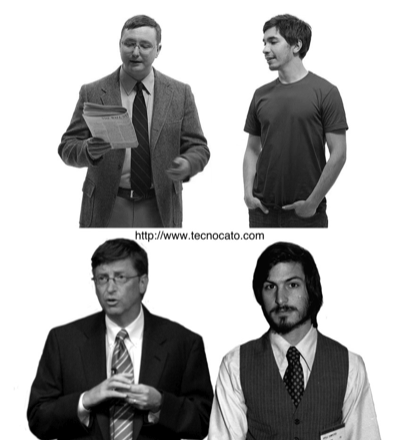
And then there's Apple (AAPL, Fortune 500). From the iPod to the iMac to the iPhone, its products have cornered the market on cool. Apple's small share of the PC market in the U.S. is growing fast - it was 7.4% in the first quarter of 2008, up from 5.1% a year earlier, according to International Data Corp. (IDC). Perhaps even more alarming, its ubiquitous "Get a Mac" TV ads have painted the personal computer loaded with Windows software - the central achievement of Gates' 33 years at Microsoft - as a loser. To a lot of consumers out there, Microsoft really does seem like that bumbling nebbish played by Daily Show contributor John Hodgman.

But despite setbacks, despite image problems, and despite Google, Microsoft is in many ways stronger than it has ever been. Just look at the numbers. Revenues grew 18% in the just-ending June 2008 fiscal year. And net profit is up even more, rising 27% to a stunning $18 billion, according to the consensus of Wall Street analysts who follow the company.

From this position of financial strength, the software giant is going on the offensive. In interviews with Microsoft's leadership, it is clear that those pesky Mac ads have managed to shake some complacency out of the company. Sometime later this year, Microsoft will launch a rebranding campaign for Windows, its core product. It's Ballmer's answer to "Get a Mac." And while Yahoo may have turned down Ballmer's $47.5 billion acquisition bid, the CEO says he'll spend as much as it takes to build a business that challenges Google on the web. The famously competitive Gates may be leaving, but Ballmer insists Microsoft will be no less aggressive without him.

It takes two

The post-Gates era has actually begun already, for all practical purposes. And that is much to the relief of Gates himself. The Microsoft co-founder spent a full decade executing a painstaking succession plan. Mostly he did it by progressively passing business leadership of Microsoft to his college pal Ballmer, 52, who became president in 1998 and CEO in 2000. Four years ago Gates told Ballmer privately he wanted to leave, and then two years ago announced publicly he would do it this July. "I've been No. 2," Gates says of his role in recent years. "I haven't been the decision-maker on anything."

Of course, he also had to find a replacement for himself as product master planner and technology strategist. He and Ballmer decided to split those jobs up. After Gates arranged to purchase technology soulmate Ray Ozzie's faltering startup Groove Networks in 2005, he quickly set about grooming 52-year-old Ozzie, best known as the father of Lotus Notes, to succeed him as Microsoft's chief software architect. The other half of his technical responsibilities went to longtime colleague Craig Mundie, 59, who oversees Microsoft's $8 billion in annual R&D and spearheads long-term technical strategy.

But one thing is clear: There wouldn't be any post-Gates Microsoft, at least not anytime soon, were it not for Ballmer's willingness to stay around and mind the store. "Every conversation Bill has had with me about being able to transition from Microsoft is always in the vein of he couldn't be transitioning if Steve wasn't there," says Melinda Gates, Bill's wife. "You don't walk away from your life's work if it's not going well. He just could never do that."

Ballmer's management style has matured in the eight years he's been CEO. "He used to be in everyone's shorts, in every detail," says marketing boss Mich Mathews. "But he has changed profoundly. He is a general manager now." Ballmer made a conscious decision to step back from day-to-day management and take a larger view as he realized that his partner Gates was no longer going to be there to strategize alongside him.

Even though he never was a serious computer programmer, by all accounts Ballmer is just as good at math as Gates is. He lives and breathes data. "Steve has a computer in his head," says Bob Muglia, a 20-year company man who heads the Server and Tools division. Ballmer expects his subordinates to be adept in math as well. He distributes 11-by-17 sheets filled with numbers detailing the progress of various operations. The numerals are so small that executives use transparent magnifier rulers to see them. But there are never any columns showing percentage changes. Ballmer believes people ought to do that in their heads. It saves space on the paper for more numbers.

Ballmer has spent the past few years surrounding himself with a seasoned group of lieutenants. Kevin Johnson, 47, a 16-year company veteran who previously ran worldwide sales, now oversees both Windows and online services. To replace Raikes, who is about to become CEO of the Gates Foundation, Ballmer recently hired Stephen Elop, 44, to run the $19 billion Business division, which centers on Microsoft Office. Elop was CEO of software maker Macromedia until he sold it to Adobe, and more recently No. 2 at Juniper Networks. Bob Muglia, 48, the Server division chief, oversees development of the complex software employed inside business infrastructures. And Robbie Bach, 46, another 20-year veteran, runs Entertainment and Devices, which includes the Xbox game system and software for mobile phones.

Growing a giant

The CEO hasn't been afraid to look outside the tech world for leaders or ideas. Two years ago Ballmer lured away International Paper CFO Chris Liddell, 50, for the same job at Microsoft. And around the same time, he persuaded Kevin Turner to leave his job as Wal-Mart's (WMT, Fortune 500) CIO to join Microsoft in a newly created chief operating officer role. Turner, 43, is a stickler for accountability and measurement. At Microsoft, he's developed a 30-metric "scorecard" with concrete annual goals - in everything from customer satisfaction to growing Windows market share - or every manager in 65 countries where the company sells its products. Each month Turner gets a report on what he calls ROB, the rhythm of the business. It's the list of 30 metrics, each with a color next to it - red, yellow, or green. You don't want to be a manager with more than one red.

The challenges that Microsoft faces are - literally - enormous. At its scale, growing means confronting the law of large numbers. Ballmer notes with exasperation that to increase earnings by 15% for 2009, the company will have to create $4 billion in new pretax operating income. At that size, can Microsoft still possibly be a growth company?

Wall Street is not hopeful about the prospects. According to Reuters, the consensus of analysts is that earnings growth will slow in each of the next two years, to 13% in fiscal 2009 and 10% in 2010. Microsoft's stock price has been more or less flat - in the mid-to-high 20s - for about six years. (Late last year it got up into the mid-30s, but its bid for Yahoo caused it to plummet back to the 20s, where it remains.) Right now Microsoft trades for just 16 times its trailing 12 months' earnings, below the S&P 500's trailing P/E of 22. Yet analysts agree that Microsoft will report earnings-per-share growth of 31% for fiscal 2008. By contrast, Standard & Poor's estimates that the S&P 500's earnings per share will grow just 8.3% this year.

The biggest reason that Microsoft can pull off that kind of performance is that its venerable Windows operating system monopoly remains wildly profitable. Despite the problems with Vista, Windows sales grew 11.3% in the 2008 fiscal year, to $16.7 billion, according to Goldman Sachs. About 75% of that is operating profit.

One key to Microsoft's growth plan is for the company to stay resolutely global. Two-thirds of revenues already come from outside the U.S., and Ballmer and his team expect that percentage to increase significantly. There is an enormous appetite around the world for the software Microsoft produces. IDC figures show that Microsoft's fastest growing markets are Central and Eastern Europe and Latin America, as well as countries like Vietnam. In Russia, now the company's fifth-largest market, business grew 100% this year, according to CFO Liddell. He says that in conversations with Wall Street, "most discussion is driven around what's happening in the U.S. economy in the next quarter. And - well, I try not to be facetious, but it matters less and less as time goes by." According to Microsoft, there are now more people using Windows in the world than there are English speakers.
The Ulitimate nemisis

When Liddell talks to investors, he often gets the sense that they don't appreciate the breadth of Microsoft's business. As evidence, he estimates that about half the questions he's asked on conference calls concern the money-losing $3.3 billion Online division - or Windows Live Services, which includes Microsoft's search product and Hotmail - even though it represents only about 6% of company revenues. Of course, that's the division that competes with Google.

Investors aren't the only ones obsessed with Google. The one concrete commitment Gates has made to Ballmer, other than continuing to chair board meetings, is that he will keep working with the search and advertising team. He's promised he'll spend two and a half hours on it each week. Why did Gates decide to focus on this particular problem? Google's overwhelming dominance of online advertising continues to thwart Microsoft's ability to grow its online consumer business. Inside the company, the subject inspires almost daily handwringing sessions.

While Gates talks casually about the likelihood of a "share breakthrough in the search market that's still very much in front of us," at the moment Microsoft is almost hopelessly behind in both market share and mind share when it comes to searching on the Internet. Concedes Gates: "Today you'd definitely say about consumer search and advertising, Couldn't we have gotten in sooner and understood those things?"

There is more involved here than just simple Google envy. Ballmer et al. believe that online advertising is the business where its greatest potential revenue and profit growth lie. So far only about $40 billion of the world's $500 billion in ad spending has moved online. But Ballmer expects the Internet portion to be $80 billion in just two years. While total worldwide spending on business technology is much bigger, around $1.6 trillion, it isn't growing nearly so fast.

So Microsoft is making unprecedented investments in infrastructure. "You have to throw so much in the pot just to play," says Ballmer. This year Microsoft will put about $1.7 billion into data centers and servers for its online business. In addition, the company has been pouring resources into the basic technology of search for almost five years. And it has caught up with its rival by at least one fundamental measure - the relevance of results at Live.com, its search home page. Independent experts now rate Microsoft roughly on a par with Google.

The problem is attracting search traffic in the first place - and right now Microsoft is going in the wrong direction. Its market share of U.S. searches has steadily declined this year, from 9.8% in January to 8.5% in May, according to Comscore. Google, meanwhile, scored 62% of searches in May, and 21% were on Yahoo. Taking a page from the U.S. auto industry, Microsoft recently announced a "cash back" program, in which certain retailers will give a consumers a discount if they buy products they found using Live Search.

Yahoo deal

In addition, the company is focusing heavily on unique features for searching maps, video, and images. The chances of getting a typical information seeker to shift from Google to Live.com are small. But if you really can search video, for example, in a different way, perhaps Microsoft's brand cachet could grow. Another more blatant and costly play for search converts is Microsoft's recent deal with Hewlett-Packard (HPQ, Fortune 500) to make Live Search the default for browsers on that company's U.S. PCs. Google has a similar deal with Dell. One way or another, says Ballmer, "we've got to get scale."

That's why he sought Yahoo. The more searches Microsoft gets in its inventory, the more money advertisers are willing to bid to buy ads. If Yahoo's new deal to subcontract with Google and combine some of their searches is sealed, it will be awful news for Microsoft, because Google will be able to charge even more to advertisers on every search.

The failure of the Yahoo deal raises questions about Ballmer's judgment and decisiveness. Buying Yahoo would have enabled Microsoft to triple the size of its search business; Yahoo also has a far better brand appeal for online consumers. But though Ballmer initially made a very aggressive offer - 62% higher than the price at which Yahoo stock was then trading - he failed to seal the deal. After months of wrangling, he upped his offer slightly to about $47.5 billion. When Yahoo CEO Jerry Yang reportedly wanted a couple of dollars more per share (some $5.7 billion), Ballmer said his calculations showed it wasn't worth that much. He walked away and said the negotiations were finished. But they weren't.

He and Kevin Johnson soon reconsidered, and on May 18, Microsoft instead proposed a deal to purchase Yahoo's search business for $1 billion and make an $8 billion investment in the company, which Yahoo also rejected. (Yang's unwillingness to deal with Microsoft has earned the wrath of shareholders, most notably activist hedge fund manager Carl Icahn.)

Ballmer claims the deal's failure means only that more money and time will have to be invested internally and on other, smaller, acquisitions. But many observers in the tech world are wondering why he wasn't willing to follow through and pay up. "He's shown almost no aptitude for organically growing a business that can compete with Google," says George Colony, the CEO of Forrester Research. "So he had to acquire something. Yahoo was obviously the best candidate. But he failed in that too." Unless Microsoft comes back with yet another offer - always a possibility - it is likely to remain way behind Google for the foreseeable future.

A Battered brand

While the Google battle is about growth, the feud with Apple is mostly about honor. It pains Ballmer and his troops react viscerally when they watch those Apple ads - and when they see how much they've harmed Microsoft's reputation. The consulting firm CoreBrand calculates Microsoft has declined from 11th among global brands in 2004 to 59th today, and reports that the two-year-old "Get a Mac" campaign has almost certainly played a role.

The ads hurt even more because they strike a nerve. On the whole, Vista has been a business success. After all, about 140 million PCs have shipped worldwide thus far with this latest version of Windows built in. But even at Microsoft, where acknowledging mistakes is rare, people concede that Vista had flaws, at least at first, and that its launch was embarrassing. Microsoft execs have high hopes for the next version, Windows 7, which they say will emerge in 2009. It is designed to make the operating system on your PC only a piece of a larger Windows experience that will include your cellphone and the web. In the meantime, Ballmer does not intend to keep tolerating Apple's insults.

The new marketing campaign, which is supposed to run for three years beginning later this year, is an urgent attempt at triage for both Windows and the larger Microsoft brand. The expensive, aggressive, long-overdue rejoinder to Apple will be unprecedented at the company in its scope. A year ago Ballmer okayed the effort, led by Bill Veghte, who is responsible for both Windows and search. He partnered with marketing boss Mich Mathews, then the two recruited an all-star team from across the company - the best experts at branding, packaging, online advertising, and other specialties.

Two days a week this group drove to a special skunkworks away from the Microsoft campus in Redmond to work quietly on the project, code-named FTP168 (the "FTP" is said to stand for "free the people"). Ballmer approved an additional $200 million for Windows advertising this year, even though in nonlaunch years there is typically no budget increase at all. The aim of the campaign will be to talk about things you can do with your PC that you could never do before.

Even more important, Windows itself is being reconceived. In the next 18 months Microsoft will launch three separate "Windows" products, more or less in tandem. Aside from the flagship Windows 7, which will succeed Vista for PCs, the company will launch a new version of Windows Mobile as well as a new version of the services known as Windows Live. For the first time, they're going to be promoted as aspects of the same thing. "We're making a huge bet that a closer relationship between the PC, the phone, and the web is what the consumer wants," says Veghte. Windows Mobile is itself a fast-growing success story after many years of investment. The software currently operates on about 120 million cellphones worldwide, and the company will sell 30 million copies this year.

Microsoft people talk a lot about "soft-ware plus services," but this new Windows wave, combining software on the PC, the phone, and the web, will finally put the slogan to the test. It may not be dominant in search or e-mail, but Microsoft does have a large web population that is getting steadily bigger. Johnson says there are 430 million users of Windows Live Services each year, a figure growing 20% annually. Those services include Hotmail and Live Search, as well as instant messaging and blogging products and things like the clip art function in Office Online. At the moment 80 million people each month use that service alone.

Microsoft is also selling web services to business. Any company that wants to purchase 5,000 seats or more for a Microsoft Exchange e-mail system can use something called Exchange Online, completely hosted by Microsoft on servers it dedicates to that company. Coca-Cola Enterprises has 70,000 employees using such a system. Microsoft is also now beta-testing a do-it-yourself version of Exchange Online, in which companies as small as five people will be able to create a corporate e-mail system just by going to a website and submitting a credit card number. Microsoft will host and maintain the service.

Some critics assert that the entire "software plus services" mantra is only a way to maintain Microsoft's historical grip on its customers. Says Marc Benioff, CEO of Salesforce.com, the poster boy of the latest era in enterprise software: "The very term is evidence that Microsoft does not get it. They want software plus services because the software is their monopoly. They might as well rewrite it as 'monopoly plus services.' " It will be interesting to watch how much flak Microsoft gets for trying to use its Windows PC monopoly to draw people into its ad-supported online services.

Bill Gates can never be replaced. That's what Ballmer started telling his leadership team a couple of years ago. Instead, said Ballmer, he needed to be replaced by processes to duplicate elements of what he brought to the company. That is partly the genesis of the power-sharing arrangement between Ray Ozzie and Craig Mundie. And Ozzie's staff now manages what Microsoft calls its "quests." These are 70-odd efforts to create entirely new ways of using software in various parts of Microsoft's business - just the kinds of visionary efforts that might have been led by Gates back in the day. But he could never have spearheaded 70 of them. Today there are quests on things like computer vision and speech, on ways to write software using one-tenth as much code, and on how to create a "dynamic datacenter" with computers that know what software is running on them.

How long can a Gates-less Microsoft retain the driving, visionary ambition with which he imbued the company? (See sidebar.) Colleagues say Ballmer is even more competitive than the company co-founder, which is probably a big reason why Gates wanted his Harvard dormmate to join Microsoft way back in 1980. The fact is that the heart and soul of Microsoft has never remotely resembled John Hodgman's nebbishy helplessness. Microsoft is likely to remain, to use a phrase Gates particularly loves, hard-core, like the man who made it what it is.

By David Kirkpatrick
Fortune Magazine; June 26, 2008
Gates without Microsoft

Ah, retirement. Time to kick back, relax, and rethink philanthropy, learn biochemistry, eradicate malaria and develop drought-resistant crops.


Let me tell you about Bill Gates. He is different from you and me. First off, the billionaire co-founder of Microsoft has always been something of a utopian. In his mind, even the world's knottiest problems can be solved if you apply enough IQ. Accordingly, Gates, who has been spotted on Seattle freeways reading a book while driving himself to the office, covets knowledge. It's as if he's still trying to make up for dropping out of Harvard, as he spends just about any spare waking minute reading, studying science texts, or watching university courses on DVD.

Some say his wealth and famous opportunism are reminiscent of the robber barons of yore. Yet here is a man who has set a goal to eradicate malaria. Rich as he is - his net worth is an estimated $50 billion - you can't call the man greedy when he has pledged to give back to humanity all but a tiny fraction of 1% of that fortune.

These traits only begin to explain why Gates, at 52, has chosen to redirect his efforts toward more altruistic pursuits. On July 1 he will step away from an operating role at Microsoft (MSFT, Fortune 500) to devote more time to philanthropy and other interests. The shift has been on his mind for nearly a decade, and it reflects some important experiences over his lifetime.
Much is expected

Like that seminal time back in 1968 when his mother, Mary, spearheaded an effort to install a used Teletype terminal in his school so that her already autodidactic junior high schooler could teach himself how to program a mainframe. There was his epiphany when he first met fellow billionaire Warren Buffett in 1991 - and realized that it quite literally pays to follow your curiosity beyond your own area of expertise.

And there's the poignant letter his mother wrote in 1993 to his fiancée, Melinda French, cluing her in to the Gates family credo: "From those to whom much has been given, much is expected." (Mary Gates would die the next year.) That letter, in turn, led to the self-conscious irony in the slogan he and his wife hit upon for the Bill & Melinda Gates Foundation: All lives have equal value.

The genes, the IQ, the life of privilege, and the noblesse oblige have always been there. Given that background, it makes sense that he would turn his attention and wealth to the greater good. But there is a more selfish motive in the "retirement" of Bill Gates, and one that no one should begrudge him. For the first time since he quit Harvard to start Microsoft 33 years ago, Gates is going to have the time to indulge what his father calls his "world-class curiosity."

Gates' closest friends wonder how he will exploit this new freedom. "He doesn't know for sure where his mind is going to go," says Buffett, who has donated the bulk of his own $45 billion fortune to the Gates Foundation, largely because he believes his money will be used wisely and effectively. "Not only will it be fascinating, but I think it's going to be, for me, very satisfying to watch."

"He is one of the greatest business minds of all time, and you don't just shut that off," adds Nathan Myhrvold, the former head of Microsoft's R&D labs, who still kicks around ideas with his former boss via e-mail almost daily. "My guess is we have not seen the last business idea out of Bill Gates."
Setting a curious mind free

Bill Gates 2.0 will have three offices: one at Microsoft in Redmond, a second about 15 miles away at the Gates Foundation in downtown Seattle, and a third almost exactly equidistant between the other two (and much closer to home). In typical hyper-systematic fashion, Gates has allocated blocks of time to each location: a day in Redmond, two at the foundation, and two at the personal office, which he suspects will be his real "center of gravity." There will be a lot of overlap among his three roles. That's because the guy's greatest pleasure seems to be in finding connections among things he's interested in.

The biggest change, of course, will be in his workload at Microsoft, which will drop drastically. He'll remain chairman and weigh in here and there. "Other than board meetings and consulting on projects like Internet search technology, the only things I'll do are some company visits when I'm in developing countries," he says. "Or if there's some special award for someone at a company meeting, I'll come and present it. But that's about it." (For more on how Microsoft is coping with Gates' retirement, see the accompanying story.)

The opposite will be true at the foundation. Gates' official title, which he shares with his wife and father, is co-chair, but his real role will be as the organization's chief strategic thinker. And Gates is teeming with ideas, especially about things scientific. Unlike most benefactors, he doesn't merely want to eradicate malaria and AIDS; he wants to understand the nuances of immunology. He wants to learn about what happens on a molecular scale when a plant's genes are altered to improve hardiness. He insists on knowing the precise legal reasons women in developing countries are robbed of their estates when they become widowed.

"Here's how Bill thinks," explains Myhrvold. "He is always interested in looking at big systems in the world and understanding them at every level that he can. As an example, I got this e-mail from him today as part of this whole discussion on corn prices and crop yields and shortages resulting from ethanol production, and at the end Bill says, 'I really need to understand phosphates more.'"

Another big part of his new job will be to make more public appearances and do more arm-twisting of governments and corporations to do more for the world's poor. "I'm uniquely able to reach out to the big companies, to ask them not just to write checks but to offer more of their innovative power," Gates says. "There's a big category of my time for talking to drug companies, cellphone companies, banks, and technology companies, as well as talking with other people who are lucky enough to have superbig fortunes about how they want to give those back to society."

That does not translate to fundraising - on the contrary, the foundation plans to exhaust its $100 billion endowment by the end of the century. Gates is talking about setting an example for the plutocracy. Jeff Raikes, the former Microsoft executive who was just appointed CEO of the foundation, thinks that effort could have as much impact on the world as the works of the foundation itself: "He has an incredible opportunity to help shape the thinking of other multibillionaires by getting them to think about the process, the structure, the best practices."

Gates takes pains to stress that even in his more active capacity, "I'm not the CEO of the foundation. Jeff will be the CEO." That's simply not what he wants to do with his time. "Even today people at the foundation get lots of e-mail from me, but after Sept. 1 they'll get a lot more, because now I'll be able to take courses, read more, meet more smart people, and have better ideas."
Mellowing with age

In his younger years, Gates' gimlet-eyed idealism manifested itself in stubbornness and self-righteousness, an unusual boldness, and a tendency not to suffer fools. Most people who have worked closely with him can recall more than one instance in which he reacted to a comment or idea by standing up and hissing, "That's the stupidest thing I've ever heard in my life."

He hasn't lost that inclination toward intellectual arrogance. But in his philanthropic work, the shoe is sometimes on the other foot. He's not, after all, a microbiologist or a geneticist. Moreover, with age and maturity, Gates has become much better able to acknowledge what he doesn't know or when he's wrong.

"The classic CEO needs to be right, or rather needs to appear to be right more than he needs to actually be right - and that's not Bill," says his pal Myhrvold. "Lewis and Clark were lost most of the time. If your idea of exploration is to always know where you are and to be inside your zone of competence, you don't do wild new shit. You have to be confused, upset, think you're stupid. If you're not willing to do that, you can't go outside the box."

And that explains the third dimension of Bill Gates' new life - giving that "world-class curiosity" some room to run. His reading and learning have always been systematic. It's his nature. His father and sisters recall how young Bill would refuse to leave his room to come to the dinner table because he was too busy "thinking." But for many years, as he built Microsoft, his field of vision was of necessity rather narrow. One of the most important experiences that jostled him out of his single-mindedness was his first meeting with Buffett, on July 5, 1991. As Gates tells the story:

My mom called me at the office to come out to Hood Canal for a Fourth of July barbecue because she wanted me to meet Warren Buffett. And I said, "Mom, I'm working." But she insisted. So I took a helicopter so I could spend my couple of hours there and then get back quickly and work on software.

Then I met Warren, and I thought, "Oh, wow, this guy isn't just about buying and selling stocks and businesses. He is thinking about how the world works." And he asked me questions that I always wanted somebody to ask me, about why hadn't IBM (IBM, Fortune 500) been able to do what we had done, and how software gets priced, and why does one company have a defensible position. He wanted to understand the dynamics of the industry. To me it was way far away from, "What is your company worth?"

Then he explained to me about how Wal-Mart (WMT, Fortune 500) had not only changed things in its business, but how it had an effect on newspapers because they thought of their advertising differently than individual local stores had. And he talked about how banking really worked in terms of credit risk. The whole time all I could think was, "Hey, I'll be smarter about running Microsoft after I talk to this guy." And so I stayed the whole day.

Ever since then, Gates has tried to make more time to broaden his knowledge, and his capacity to absorb ideas has served Microsoft and the foundation well. But now reading, learning, and blue-sky brainstorming will be considered an integral part of his job description, and no doubt they will yield something.

Think of his third office, the one equidistant from Microsoft and the foundation, as the billionaire-adult equivalent of his own room. It's a place for him to spend time exploring his own ideas, and occasionally trying to find an appropriate entity to pursue them, whether it be Microsoft R&D or someone at the foundation or one of the foundation's many corporate and nonprofit partners. He'll focus on ideas related to his philanthropy, but he also will spend a lot of time with the staff of Ph.D.s and inventors at Intellectual Ventures (IV for short), Nathan Myhrvold's Seattle-based skunkworks for discovering patentable new technologies. Previously IV hosted brainstorming sessions for foundation scientists, and Gates is an informal member of a group of IV partners and investors with more general interests that meets regularly. He plans to participate even more frequently after July 1.

"I'm not going to create a company," Gates vows. "The foundation is the top priority. But there are some other things that I might help along. The scientific brainstorming with Nathan's group has led to a new nuclear energy startup, and I'm a funder and advisor to that thing. It won't be a huge amount of time, but the truth is, cheap energy that's environmentally friendly is a breakthrough that is more important for the poor than the rich. And the poor need fertilizer, more reliable seeds, and better agriculture too. They can't cut back their eating, because that's called starvation. So I'm investing in that."

Myhrvold loves the irony of it all: "It's so funny: Here's a guy who never went to class when his poor dad was paying the Harvard tuition, and now the sheer love of learning has sucked him back in, hard-core. It's not like he needs a job. It's not like he's thinking, 'Oh, that would look good on my résumé.'"

It's too early, of course, to judge the legacy of Bill Gates. He's only 52. His kids aren't even out of elementary school. And he has only just stepped away from Microsoft, a company that once put IBM in its place, and which some would say is the most significant company to come along since General Electric (GE, Fortune 500).

Nor do we really know what - or even whether - Gates thinks of his place in history. As outgoing Gates Foundation CEO Patty Stonesifer puts it, "The Gateses by nature believe that the unexamined life is the one that's worth living. They don't like to talk about themselves. It's all about rational responsibility, not grand idealism."

Buffett, who knows him as well as anyone, says the notoriously competitive Gates will have to find new ways to judge his accomplishments rather than by market share or in dollars. "He'll be competing with his own standards," Buffett says. "In the end, he is going to want people to look at the Gates Foundation 100 years from now and say, 'This guy did it the way it should have been done.'"

With all he did at Microsoft, Gates has a tough act to follow. "Bringing personal computing to billions has totally changed the world, and it's changed it, net-net, way for the better," says Myhrvold. "So even before you look at what his foundation has done for Africa or for the poor, he's already done more for the good of the world than essentially anyone else in our lifetimes."

Melinda Gates isn't at all surprised by Bill's transformation from feared empire builder to enlightened philanthropist. "I think the foundation, because it's not all about business and competition, allows other dimensions of Bill's personality to come out," she says. "He's incredibly funny and has an unbelievably wry sense of humor. He also can be very emotional when he sees the pathetic living conditions of so many people. He's a genuinely nice guy. I think more of what I see at home and what we see inside the foundation will come out. That will be a really nice thing for him and for the world."

To which her husband would likely say, "That's the stupidest thing I've ever heard in my life."

Just kidding.

By: Brent Schlender
Fortune Magazine; June 26, 2008

Friday, June 06, 2008

Gates & Ballmer: Still Brothers At Arms

Gates-Ballmer Clash Shaped Microsoft's Coming Handover

One of the most successful business partnerships in history was coming unraveled. It was early 2000, and Bill Gates had relinquished the chief executive's job at Microsoft Corp. to Steve Ballmer -- for the first time taking a back seat to his college pal and right-hand man of 20 years.

Mr. Ballmer got the title. But Mr. Gates retained the power, triggering a yearlong struggle between the two men that until now has remained largely under wraps.

Things became so bitter that, on one occasion, Mr. Gates stormed out of a meeting in a huff after a shouting match in which Mr. Ballmer jumped to the defense of several colleagues, according to an individual present at the time. After the exchange, Mr. Ballmer seemed "remorseful," the person said.

The conflict between the two men paralyzed business-strategy decisions that the company still wrestles with today. Board members stepped in to try to mediate a truce.

The differences between the two men ended, Mr. Gates and other Microsoft executives say, when in 2001 Mr. Gates had an epiphany, recognizing he needed to accept his role as No. 2. "I had to change," Mr. Gates says.

On June 27, Mr. Gates will fully step aside from management at Microsoft, ending daily work there to focus on philanthropy. If the transition goes smoothly, it will be in large part because the clash eight years ago forced the two men to grapple with the crucial question of whether Mr. Gates can let his friend run the company unencumbered. Microsoft used the lessons of that crisis as it planned for the ultimate succession.

Read edited excerpts from The Wall Street Journal's interview with Bill Gates and Steve Ballmer, as the Microsoft executives talk to staff reporter Robert Guth about their relationship, Mr. Gates's transition and the future of the company.

This summer, Mr. Ballmer moves into the corner office inhabited for years by Mr. Gates, who will work only one day a week and serve as board chairman.

Once Mr. Gates leaves, "I'm not going to need him for anything. That's the principle," Mr. Ballmer says. "Use him, yes, need him, no."

The handover marks the end to a storied business partnership that created a new industry, spawned many millionaires, and redefined how the world uses computers. Under Mr. Gates, Microsoft also fought one of the most heated antitrust battles in U.S. history and created the personal fortune that he is now deploying against global problems such as AIDS.


Mr. Ballmer's challenge is to assure that Microsoft's best days aren't behind it. The company faces one of the widest sets of obstacles in its 33-year history, as nimble rivals try to chip away its traditional software business and broad industry shifts force it to build entirely new businesses. To repel rising titans like Google Inc., Microsoft is taking unprecedented steps, such as its recent bid for Yahoo Inc. Although that effort is now shelved, it would have been the software company's largest acquisition.

Elder Statesman

Messrs. Ballmer and Gates are attempting a tricky feat by navigating an "ambassadorial succession" -- when a founder steps aside but still makes himself available as an elder statesman, says Yale School of Management Professor Jeffrey Sonnenfeld. They have had eight years of rehearsal, but the approach still has its perils: History is riddled with company founders who stifle their creation when they don't entirely break free.

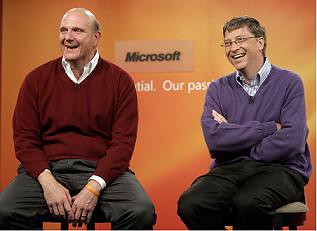
Mr. Gates and Steve Ballmer introduced the Windows Vista operating software in January 2007 in New York.

In addition, if Microsoft later needs radical change, it would be rare that loyal insiders like Mr. Ballmer can "really tear into their inheritance," says Joseph L. Bower, Baker Foundation Professor of Business Administration at Harvard Business School.

The weight of the transfer on the two men -- both 52 years old, and so close they often complete each other's sentences -- was clear at a March retreat of Microsoft's top executives. Mr. Ballmer gave the opening remarks to the group, his eyes streaming with tears as he noted that it would be the last such meeting with Mr. Gates and Jeff Raikes, a veteran executive and friend who is joining Mr. Gates's philanthropy.

Last month, in a joint interview with Mr. Gates, Mr. Ballmer's eyes welled up as the two men talked about building Microsoft. "It is a little like giving birth to something. Bill gave birth but I was kind of an early nanny in raising this child," Mr. Ballmer said. "There are fun things we get to do together, that's all nice. I mean, it's important, but this is..."

"...this is what we did," said Mr. Gates, smiling.

Their relationship started at Harvard University in the mid-1970s, where the two played poker and thrived by pushing their intellectual limits. Once they skipped a graduate economics class for the entire semester, then teamed up a few days before the final exam to try to learn the material all at once. Mr. Ballmer recalls he got a 97; Mr. Gates a 99.

Elements of their early friendship -- competition and hard work -- defined Microsoft's own culture. Mr. Gates focused on technology and business strategy, while Mr. Ballmer took on diverse roles. Among other things, he was Microsoft's first business manager, and managed development of the first version of Windows and North American sales. Later, he expanded Microsoft world-wide.

Even as the company grew, the two men could jointly manage almost every aspect of the business. "For a certain size organization, it was beautiful," Mr. Gates says.

Their tight relationship allowed for heated arguments that would quickly subside. Indeed, numerous executives say this was a key part of the decision-making culture.

Their centralized management of the company started to break down in the late 1990s as Microsoft grew in complexity. The U.S. Department of Justice alleged that Microsoft had abused its monopoly, and the company fought to keep from being split up. It faced an onslaught of competitors and was rankled by the threat posed by the Internet and the flight of Microsoft's employees to Web start-ups.

Embattled, Mr. Gates sought help. Eventually, in January 2000, he gave his chief executive title to Mr. Ballmer. Mr. Gates became Microsoft's "chief software architect," a new position that, in theory, was below that of Mr. Ballmer.

Soon, the two men clashed as Mr. Ballmer tried to assert himself in his new job. As the firm's iconic leader, Mr. Gates still held sway that wasn't tied to a title: In meetings Mr. Gates would interject with sarcasm, undermining Mr. Ballmer in front of other executives, Mr. Gates and other Microsoft executives say.

Debates spanned various subjects -- personnel decisions, the Xbox videogame machine then being developed, and even the future of Microsoft's core Windows software, Microsoft executives said.

Some major decisions got stuck due to the impasse, Messrs. Gates and Ballmer said. In one case, two vice presidents clashed over the future of NetDocs, a promising effort to offer software programs such as word processing over the Internet. The issue: Because NetDocs risked cannibalizing sales of Microsoft's cash-cow Office programs, some executives wanted NetDocs killed.

Messrs. Gates and Ballmer were unable to settle on a plan. First, NetDocs ballooned to a 400-person staff, then it got folded into the Office group in early 2001, where it died.

Other Microsoft executives tried to step in, calling Messrs. Gates and Ballmer into a meeting with a clear message: Your struggles threaten the company, according to people familiar with the situation.

Board's Concerns

Microsoft's board held its own discussions with the two men, and also dispatched Dave Marquardt, a director and early Microsoft investor, to have periodic dinners with the two to help sort through the troubles.

"The board was really concerned about what was going to happen," says Jon Shirley, a former Microsoft president who sits on the company's board.

The stress on Mr. Ballmer was clear one morning in January 2001 while he was in Paris for an annual review of Microsoft's businesses. In his hotel room at 3 a.m. after a long day of meetings, Mr. Ballmer posed a telling question to Mr. Raikes, the veteran Microsoft executive: "What is the CEO's job at Microsoft?"

At the urging of the board and their wives, Mr. Gates and Mr. Ballmer agreed in February 2001 to work out their differences over dinner at the Polaris restaurant in the Bellevue Club Hotel a few miles from Microsoft's campus. The two men declined to discuss details of that meeting, saying only that they needed to sort out their roles, with Mr. Gates as the "junior partner" to Mr. Ballmer's "senior partner."

Mr. Gates concluded that it was he who needed to change most. "Steve is all about being on the team, and being committed to the mutual goals," Mr. Gates said. "So I had to figure out, what are my behaviors that don't reinforce that? What is it about sarcasm in a meeting?" he said. "Or just going, 'This is completely screwed up'?"

Mr. Ballmer says that, as the top executive, he had to learn when to override decisions and when to just "let things go," he said. "We got it figured out," he said.

Soon, Mr. Gates started to hold back negative comments in meetings. During one deliberation among the executives who reported directly to Mr. Ballmer, Mr. Gates deferred to Mr. Ballmer on an important decision, prompting Microsoft executives to silently glance at each other with surprise, recalls Microsoft Vice President Mich Matthews.

Making an Imprint

Gradually, Mr. Ballmer made his imprint. He restructured the company to give more decision-making power to executives, and elevated people with general management experience into positions previously held by technology-focused executives. He also worked to settle Microsoft's many lawsuits, taking a more conciliatory line than Mr. Gates typically had, Microsoft executives say.

Mr. Gates, meantime, focused on guiding Microsoft's long-term technology strategy. Among other projects, he coached three younger managers on how to build a case for Microsoft's entry into business-communications software. That work was later launched as a major new business in "unified communications," or merging email, voice mail and other business communications.

In 2003, Mr. Gates let Mr. Ballmer lead secret talks to buy German software maker SAP AG, while he handled the technology-planning side of the talks and provided guidance in line with his job as Microsoft's chairman, says a person familiar with the situation. (Microsoft ended up not buying the company.)

Microsoft also started laying the foundation for Mr. Gates's eventual departure, in March 2005 buying Groove Networks Inc. to bring its founder, software pioneer Ray Ozzie, in house to complement Mr. Gates as a technology guru. Mr. Gates once described Mr. Ozzie -- known as the father of Lotus Notes information-sharing software -- as "one of the top five programmers in the universe."

Messrs. Gates and Ballmer had settled into their new roles by early 2006, when Mr. Gates decided to end full-time work at Microsoft, setting a two-year timeline for making the move.

One concern for Mr. Ballmer was how to preserve Mr. Gates's role of technology visionary inside the company. Looking for guidance, Mr. Ballmer says he cracked open a book from his college years by Max Weber, the German sociologist, on how organizations handle the disappearance of "charismatic leaders."

On March 28, 2006, Mr. Ballmer described the book to Microsoft's board at a retreat in the San Juan Islands near Seattle, Microsoft executives say. One way for a firm to retain the charisma of a departing leader, Mr. Weber wrote some 100 years ago, is for the leader to name his own replacement.

Mr. Gates did just that. In June 2006, he named his own two successors as tech czars: Craig Mundie, one of Mr. Gates's chief technical advisers, and Mr. Ozzie, the programmer.

"The world has had a tendency to focus a disproportionate amount of attention on me," Mr. Gates said at the time of the announcement. He then gave his successors some elbow room, disappearing on a seven-week sabbatical that included a trip to Africa.

In an interview at that time, Mr. Ballmer compared their relationship to that of brothers. "I think brothers tend to argue a lot, and somehow they stay brothers and stay connected," he said. "I think Bill and I have figured out how to do all of that."

Aborted Yahoo Bid

Leading into this year, evidence that the transfer of power has taken hold is in Microsoft's now-aborted bid for Yahoo. Buying Yahoo could have helped Microsoft expand its online-advertising business and build online versions of its personal-computer software -- the same transition it attempted with NetDocs, the project that died back in 2001. But at a price tag of nearly $50 billion in cash and stock, the bid had its risks and would have been the largest acquisition by far at a company that hasn't done many large deals.

Mr. Gates stayed largely on the sidelines, and notes that it was Mr. Ballmer behind the bid, tapping Mr. Ozzie to sort through how the two companies would merge their technologies.

Some Microsoft insiders say Mr. Gates -- who traditionally favored Microsoft building its own way into markets -- wasn't a major proponent of the deal. Whatever the case, Mr. Gates stands by his man. "I don't have a different point of view on the Yahoo thing than Steve does," he said.

The question remains if Mr. Gates can resist the temptation to dive back in if Microsoft hits a crisis point. Over the past decade, several high-profile founders jumped back in when their companies were under siege, including Steve Jobs, who remade Apple Inc., and Michael Dell of Dell Inc. and Howard Schultz of Starbucks Corp. "There is a savior complex that says, 'I'm the only one who can restore it to its glory,'" says David A. Nadler, senior partner at consulting firm Oliver Wyman Group.

Mr. Gates says he's happy to help on some long-term projects, but won't return full-time. "I am done with that," he said.

By: Robert Guth
Wall Street Journal; June 5, 2008