Ballmer's quest to compete with Google
Microsoft's CEO discusses search strategy
At a Churchill Club event in Santa Clara, Calif., Microsoft CEO Steve Ballmer talks to Ann Winblad, a partner at Hummer Winblad Venture Partners, on its long-term strategy to battle Google in the search market. Ballmer says that to succeed, the company will have to find a way to change the experience and the economics of search, redefining the category.

SEO Blog. Organic SEO Blog. Search Marketing News. SEO Done Right examines search engine optimization, the most effective form of internet marketing. Breaking SEO news and emerging developments at Google, Yahoo, and Bing. Leading Organic SEO Consultants Peak Positions debunk the many myths, hype, and spin related to SEO and search marketing.
Showing posts with label Steve Ballmer.. Show all posts
Showing posts with label Steve Ballmer.. Show all posts
Friday, June 06, 2008
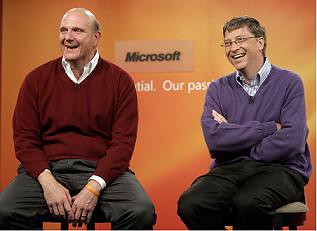 Gates & Ballmer: Still Brothers At Arms
Gates-Ballmer Clash Shaped Microsoft's Coming Handover
One of the most successful business partnerships in history was coming unraveled. It was early 2000, and Bill Gates had relinquished the chief executive's job at Microsoft Corp. to Steve Ballmer -- for the first time taking a back seat to his college pal and right-hand man of 20 years.
Mr. Ballmer got the title. But Mr. Gates retained the power, triggering a yearlong struggle between the two men that until now has remained largely under wraps.
Things became so bitter that, on one occasion, Mr. Gates stormed out of a meeting in a huff after a shouting match in which Mr. Ballmer jumped to the defense of several colleagues, according to an individual present at the time. After the exchange, Mr. Ballmer seemed "remorseful," the person said.
The conflict between the two men paralyzed business-strategy decisions that the company still wrestles with today. Board members stepped in to try to mediate a truce.
The differences between the two men ended, Mr. Gates and other Microsoft executives say, when in 2001 Mr. Gates had an epiphany, recognizing he needed to accept his role as No. 2. "I had to change," Mr. Gates says.
On June 27, Mr. Gates will fully step aside from management at Microsoft, ending daily work there to focus on philanthropy. If the transition goes smoothly, it will be in large part because the clash eight years ago forced the two men to grapple with the crucial question of whether Mr. Gates can let his friend run the company unencumbered. Microsoft used the lessons of that crisis as it planned for the ultimate succession.
Read edited excerpts from The Wall Street Journal's interview with Bill Gates and Steve Ballmer, as the Microsoft executives talk to staff reporter Robert Guth about their relationship, Mr. Gates's transition and the future of the company.
This summer, Mr. Ballmer moves into the corner office inhabited for years by Mr. Gates, who will work only one day a week and serve as board chairman.
Once Mr. Gates leaves, "I'm not going to need him for anything. That's the principle," Mr. Ballmer says. "Use him, yes, need him, no."
The handover marks the end to a storied business partnership that created a new industry, spawned many millionaires, and redefined how the world uses computers. Under Mr. Gates, Microsoft also fought one of the most heated antitrust battles in U.S. history and created the personal fortune that he is now deploying against global problems such as AIDS.
Mr. Ballmer's challenge is to assure that Microsoft's best days aren't behind it. The company faces one of the widest sets of obstacles in its 33-year history, as nimble rivals try to chip away its traditional software business and broad industry shifts force it to build entirely new businesses. To repel rising titans like Google Inc., Microsoft is taking unprecedented steps, such as its recent bid for Yahoo Inc. Although that effort is now shelved, it would have been the software company's largest acquisition.
Elder Statesman
Messrs. Ballmer and Gates are attempting a tricky feat by navigating an "ambassadorial succession" -- when a founder steps aside but still makes himself available as an elder statesman, says Yale School of Management Professor Jeffrey Sonnenfeld. They have had eight years of rehearsal, but the approach still has its perils: History is riddled with company founders who stifle their creation when they don't entirely break free.
Mr. Gates and Steve Ballmer introduced the Windows Vista operating software in January 2007 in New York.
In addition, if Microsoft later needs radical change, it would be rare that loyal insiders like Mr. Ballmer can "really tear into their inheritance," says Joseph L. Bower, Baker Foundation Professor of Business Administration at Harvard Business School.
The weight of the transfer on the two men -- both 52 years old, and so close they often complete each other's sentences -- was clear at a March retreat of Microsoft's top executives. Mr. Ballmer gave the opening remarks to the group, his eyes streaming with tears as he noted that it would be the last such meeting with Mr. Gates and Jeff Raikes, a veteran executive and friend who is joining Mr. Gates's philanthropy.
Last month, in a joint interview with Mr. Gates, Mr. Ballmer's eyes welled up as the two men talked about building Microsoft. "It is a little like giving birth to something. Bill gave birth but I was kind of an early nanny in raising this child," Mr. Ballmer said. "There are fun things we get to do together, that's all nice. I mean, it's important, but this is..."
"...this is what we did," said Mr. Gates, smiling.
Their relationship started at Harvard University in the mid-1970s, where the two played poker and thrived by pushing their intellectual limits. Once they skipped a graduate economics class for the entire semester, then teamed up a few days before the final exam to try to learn the material all at once. Mr. Ballmer recalls he got a 97; Mr. Gates a 99.
Elements of their early friendship -- competition and hard work -- defined Microsoft's own culture. Mr. Gates focused on technology and business strategy, while Mr. Ballmer took on diverse roles. Among other things, he was Microsoft's first business manager, and managed development of the first version of Windows and North American sales. Later, he expanded Microsoft world-wide.
Even as the company grew, the two men could jointly manage almost every aspect of the business. "For a certain size organization, it was beautiful," Mr. Gates says.
Their tight relationship allowed for heated arguments that would quickly subside. Indeed, numerous executives say this was a key part of the decision-making culture.
Their centralized management of the company started to break down in the late 1990s as Microsoft grew in complexity. The U.S. Department of Justice alleged that Microsoft had abused its monopoly, and the company fought to keep from being split up. It faced an onslaught of competitors and was rankled by the threat posed by the Internet and the flight of Microsoft's employees to Web start-ups.
Embattled, Mr. Gates sought help. Eventually, in January 2000, he gave his chief executive title to Mr. Ballmer. Mr. Gates became Microsoft's "chief software architect," a new position that, in theory, was below that of Mr. Ballmer.
Soon, the two men clashed as Mr. Ballmer tried to assert himself in his new job. As the firm's iconic leader, Mr. Gates still held sway that wasn't tied to a title: In meetings Mr. Gates would interject with sarcasm, undermining Mr. Ballmer in front of other executives, Mr. Gates and other Microsoft executives say.
Debates spanned various subjects -- personnel decisions, the Xbox videogame machine then being developed, and even the future of Microsoft's core Windows software, Microsoft executives said.
Some major decisions got stuck due to the impasse, Messrs. Gates and Ballmer said. In one case, two vice presidents clashed over the future of NetDocs, a promising effort to offer software programs such as word processing over the Internet. The issue: Because NetDocs risked cannibalizing sales of Microsoft's cash-cow Office programs, some executives wanted NetDocs killed.
Messrs. Gates and Ballmer were unable to settle on a plan. First, NetDocs ballooned to a 400-person staff, then it got folded into the Office group in early 2001, where it died.
Other Microsoft executives tried to step in, calling Messrs. Gates and Ballmer into a meeting with a clear message: Your struggles threaten the company, according to people familiar with the situation.
Board's Concerns
Microsoft's board held its own discussions with the two men, and also dispatched Dave Marquardt, a director and early Microsoft investor, to have periodic dinners with the two to help sort through the troubles.
"The board was really concerned about what was going to happen," says Jon Shirley, a former Microsoft president who sits on the company's board.
The stress on Mr. Ballmer was clear one morning in January 2001 while he was in Paris for an annual review of Microsoft's businesses. In his hotel room at 3 a.m. after a long day of meetings, Mr. Ballmer posed a telling question to Mr. Raikes, the veteran Microsoft executive: "What is the CEO's job at Microsoft?"
At the urging of the board and their wives, Mr. Gates and Mr. Ballmer agreed in February 2001 to work out their differences over dinner at the Polaris restaurant in the Bellevue Club Hotel a few miles from Microsoft's campus. The two men declined to discuss details of that meeting, saying only that they needed to sort out their roles, with Mr. Gates as the "junior partner" to Mr. Ballmer's "senior partner."
Mr. Gates concluded that it was he who needed to change most. "Steve is all about being on the team, and being committed to the mutual goals," Mr. Gates said. "So I had to figure out, what are my behaviors that don't reinforce that? What is it about sarcasm in a meeting?" he said. "Or just going, 'This is completely screwed up'?"
Mr. Ballmer says that, as the top executive, he had to learn when to override decisions and when to just "let things go," he said. "We got it figured out," he said.
Soon, Mr. Gates started to hold back negative comments in meetings. During one deliberation among the executives who reported directly to Mr. Ballmer, Mr. Gates deferred to Mr. Ballmer on an important decision, prompting Microsoft executives to silently glance at each other with surprise, recalls Microsoft Vice President Mich Matthews.
Making an Imprint
Gradually, Mr. Ballmer made his imprint. He restructured the company to give more decision-making power to executives, and elevated people with general management experience into positions previously held by technology-focused executives. He also worked to settle Microsoft's many lawsuits, taking a more conciliatory line than Mr. Gates typically had, Microsoft executives say.
Mr. Gates, meantime, focused on guiding Microsoft's long-term technology strategy. Among other projects, he coached three younger managers on how to build a case for Microsoft's entry into business-communications software. That work was later launched as a major new business in "unified communications," or merging email, voice mail and other business communications.
In 2003, Mr. Gates let Mr. Ballmer lead secret talks to buy German software maker SAP AG, while he handled the technology-planning side of the talks and provided guidance in line with his job as Microsoft's chairman, says a person familiar with the situation. (Microsoft ended up not buying the company.)
Microsoft also started laying the foundation for Mr. Gates's eventual departure, in March 2005 buying Groove Networks Inc. to bring its founder, software pioneer Ray Ozzie, in house to complement Mr. Gates as a technology guru. Mr. Gates once described Mr. Ozzie -- known as the father of Lotus Notes information-sharing software -- as "one of the top five programmers in the universe."
Messrs. Gates and Ballmer had settled into their new roles by early 2006, when Mr. Gates decided to end full-time work at Microsoft, setting a two-year timeline for making the move.
One concern for Mr. Ballmer was how to preserve Mr. Gates's role of technology visionary inside the company. Looking for guidance, Mr. Ballmer says he cracked open a book from his college years by Max Weber, the German sociologist, on how organizations handle the disappearance of "charismatic leaders."
On March 28, 2006, Mr. Ballmer described the book to Microsoft's board at a retreat in the San Juan Islands near Seattle, Microsoft executives say. One way for a firm to retain the charisma of a departing leader, Mr. Weber wrote some 100 years ago, is for the leader to name his own replacement.
Mr. Gates did just that. In June 2006, he named his own two successors as tech czars: Craig Mundie, one of Mr. Gates's chief technical advisers, and Mr. Ozzie, the programmer.
"The world has had a tendency to focus a disproportionate amount of attention on me," Mr. Gates said at the time of the announcement. He then gave his successors some elbow room, disappearing on a seven-week sabbatical that included a trip to Africa.
In an interview at that time, Mr. Ballmer compared their relationship to that of brothers. "I think brothers tend to argue a lot, and somehow they stay brothers and stay connected," he said. "I think Bill and I have figured out how to do all of that."
Aborted Yahoo Bid
Leading into this year, evidence that the transfer of power has taken hold is in Microsoft's now-aborted bid for Yahoo. Buying Yahoo could have helped Microsoft expand its online-advertising business and build online versions of its personal-computer software -- the same transition it attempted with NetDocs, the project that died back in 2001. But at a price tag of nearly $50 billion in cash and stock, the bid had its risks and would have been the largest acquisition by far at a company that hasn't done many large deals.
Mr. Gates stayed largely on the sidelines, and notes that it was Mr. Ballmer behind the bid, tapping Mr. Ozzie to sort through how the two companies would merge their technologies.
Some Microsoft insiders say Mr. Gates -- who traditionally favored Microsoft building its own way into markets -- wasn't a major proponent of the deal. Whatever the case, Mr. Gates stands by his man. "I don't have a different point of view on the Yahoo thing than Steve does," he said.
The question remains if Mr. Gates can resist the temptation to dive back in if Microsoft hits a crisis point. Over the past decade, several high-profile founders jumped back in when their companies were under siege, including Steve Jobs, who remade Apple Inc., and Michael Dell of Dell Inc. and Howard Schultz of Starbucks Corp. "There is a savior complex that says, 'I'm the only one who can restore it to its glory,'" says David A. Nadler, senior partner at consulting firm Oliver Wyman Group.
Mr. Gates says he's happy to help on some long-term projects, but won't return full-time. "I am done with that," he said.
By: Robert Guth
Wall Street Journal; June 5, 2008

Tuesday, April 29, 2008

Microsoft confronts tough choice on Yahoo
Steve Ballmer is facing one of the biggest decisions of his career: Walk away from Microsoft's $42.7 billion acquisition offer for Yahoo or launch the largest hostile takeover battle in tech-industry history.
The choice comes after Yahoo declined to agree to a deal by the Saturday deadline set by the Microsoft's chief executive -- and after the two sides failed to make any progress in recent weeks in resolving the disagreement over price that has divided them over the last three months. (Microsoft publishes MSN Money).
Ballmer vowed in an April 5 letter "to take our case directly to your shareholders, including the initiation of a proxy contest to elect an alternative slate of directors for the Yahoo board."
Still, Ballmer faces opposition to the deal in his own ranks: Executives at several Microsoft divisions oppose the bid on grounds it will divert needed resources and attention from other challenges the company faces, said people familiar with the company. That sentiment is heightened as Microsoft heads into its annual budgeting season, said people familiar with the company.
There was no direct contact between the two sides this past weekend and people close to both camps said they were preparing for the next stage of battle. Microsoft was unlikely to make a move on Monday, however, people familiar with the matter said.
Ending its pursuit of Yahoo seems less likely following Ballmer's promise to go directly to shareholders after the deadline. Abandoning the bid following his public saber rattling might damage his own credibility as well as Microsoft's. Though Microsoft hasn't ruled out abandoning its pursuit, it is unlikely to do so, people close to the company said.
Walking away could still draw Yahoo into Microsoft's arms if Yahoo's share price falls on the news. That could spark more investor pressure to strike a deal with Microsoft. Oracle followed a similar playbook last year to acquire BEA Systems.
If Microsoft pushes ahead with its proxy fight, its challenge will be in determining at what price it should pursue an exchange offer. The value of its bid has declined as its share price has fallen 8% since Jan. 31, when it offered Yahoo a combination of cash and stock then valued at $31 a share, or $44.6 billion. On Friday, Microsoft's stock took another hit after the company disappointed investors with its earnings outlook; as a result, the bid value stood at $29.68 a share as of 4 p.m. Friday. Yahoo's shares at that time were trading at $26.80 on the Nasdaq Composite Index
In his letter, Ballmer suggested Microsoft might offer less than the original bid if Yahoo didn't agree to a friendly deal. If Ballmer follows through with that threat, Yahoo could face tough questions from some shareholders angered that it has refused Microsoft's offer. Some Yahoo shareholders have already sued the company's directors for acting against shareholder interests in their handling of Microsoft's takeover attempt.
Yahoo has continued to insist that Microsoft's offer "substantially undervalues" it. Spokesmen for Microsoft and Yahoo declined to comment.
By: Matthew Karnitschnig & Robert Guth
Wall Street Journal; April 28, 2008
Subscribe to:
Posts (Atom)