Organic SEO Blog

231-922-9460 • Contact Us • Free SEO Site Audit
Showing posts with label steve ballmer. Show all posts

Monday, October 04, 2010

Ballmer Aims to Overcome Mobile Missteps

The Wall Street Journal


Microsoft Corp. has struggled for the past two years in the mobile-phone market. But CEO Steve Ballmer says his company finally has a compelling story.

On Oct. 11, Microsoft and its partners plan to announce the initial wave of handsets that will use Windows Phone 7, a thoroughly overhauled version of the company's cellphone operating system. Mr. Ballmer believes the software will compete more effectively against Apple Inc.'s iPhone and Google Inc.'s Android operating system.

Microsoft has gotten more aggressive against Android in other ways. The company filed a lawsuit Friday against Motorola Inc., alleging the handset maker is infringing Microsoft patents in its Android phones. Motorola vowed to fight the suit.

Microsoft hopes the new phones based on its software erase the memories of missteps like Kin, a Microsoft-designed phone (based on different software) that was pulled from the market earlier this year after only two months. Microsoft's board docked Mr. Ballmer's bonus for the last fiscal year in part because of those missteps, the company disclosed last week in a regulatory filing.

A lot is riding on the new software. Mr. Ballmer is under pressure from investors to show Microsoft's bets in new high-growth markets like mobile can pay off. In an interview, conducted before Microsoft sued Motorola (and before Microsoft disclosed Mr. Ballmer's compensation for last year), he talked about how Microsoft plans to profit in the mobile market and the challenges of improving its share of the business. He also defended the traditional computer, and said he sees plenty of demand in the future for both for small- and larger-sized PC devices.

Excerpts:

WSJ:
Your mobile business has gone through some pretty dramatic changes—new leadership, new software, a new way of working with handset partners. Why was that necessary?

Mr. Ballmer: In a sense, you could say we missed a cycle. We had some execution issues from an R&D perspective. In the time frame since the last significant release certainly the industry has moved, the technology has moved, the hardware has moved.

We said, we've got to move forward, not shoot for yesterday. We've got to shoot ahead in a way that's delightful to users, accessible to developers and prioritize everything else we do around those elements.

WSJ: You chose not to develop your own handset. Can you talk about why that is?

Mr. Ballmer:
In some sense you could say we did some level of development. We put out to our partners that we were going to build on a certain minimal so-called hardware chassis. So you could say we did some design work, but we're certainly not selling phones.

WSJ: Did you ever seriously think about selling your own handset?

Mr. Ballmer: I think about a lot of things. We're working with HTC, Samsung, LG and a variety of partners.

WSJ: Are you trying to protect Windows or do you see Windows Phone 7 as a big revenue opportunity in and of itself?

Mr. Ballmer:
No, I see it as a big opportunity. There's the sale of the device, there's potential for search revenue on top of that and commerce revenue. There's potential for subscription revenue from various entertainment or productivity experiences.

Job One here will be selling a lot of phones, and if we sell a lot of phones, good things are going to happen.

WSJ: You're still charging a license fee for the software.

Mr. Ballmer: Sure.

WSJ: Is that difficult in an environment where Android is free?

Mr. Ballmer:
Android has a patent fee. It's not like Android's free. You do have to license patents. HTC's signed a license with us and you're going to see license fees clearly for Android as well as for Windows.

WSJ:
It doesn't seem like the license fee alone is a big financial opportunity for Microsoft.

Mr. Ballmer: It's one of the opportunities. One.

WSJ: It's one of them.

Mr. Ballmer: Look, anything that can sell in the tens to hundreds of millions is a big opportunity, and we see big opportunity. Even in the world today, there's a bunch of different models in place.

The up-front gross margin per device is less on a BlackBerry, but then they choose to make more on the back end through subscription fees whether it's a consumer or business phone. There's a lot of ways Google chooses to make a little less on the front end and want to make a little bit more on the back end.

WSJ: If you look at the market share stats, the Apple guys have done well, the Android guys have really surged and you guys have lost share the past couple years. How hard is it to make that ground back up?

Mr. Ballmer: We'll see. The fact that things have been pretty dynamic means that they're probably still pretty dynamic.

WSJ: So you think things could change quickly in terms of market share?

Mr. Ballmer: I said they can. There's no doubt that things have changed quickly, and at least in my undergraduate degree in math, that's called an existence proof. We know it's possible, we'll see what happens.

WSJ: The software on Windows Phones looks more different from the other phones than any of the other products that are out there [with a homescreen featuring a grid of colorful tiles, some of which change with fresh content from the Web]. Is it a risk bringing such a different user interface to consumers?

Mr. Ballmer:
Well, we've got to look forward. The market's still pretty nascent, but at the end of the day, I think the wall-of-icons [on iPhones and Android devices] is getting pretty complicated for people. That doesn't mean people don't want applications, though I'm not sure that's really the way the average person really wants to work.

Putting the activities that are most important in people's lives and the people that are most important in people's lives front-and-center through these hubs, I think we're going to capture hopefully the imagination of quite a good number of people.

WSJ: Will there be an immediate uptake of Windows Phones?

Mr. Ballmer: I don't make forecasts. It's partly how many we can get made, it's partly how much we can—can not only build a great product, but how does the word of mouth work, how effective is the advertising that we'll do?

WSJ: Do you think Windows phones will evolve into something that becomes a replacement for full-blown Windows on PCs?

Mr. Ballmer: It's a complicated subject. Do I think the world's going to live all on small-screen devices? No. I think people are going to have small-, medium-, and large-screen devices.

Will the technology that powers those be absolutely 100% radically all different? No, I think there will be a lot of shared technology across the devices. You don't want the same user interface, actually, on every one of these devices because they do have different modalities of operation. I think you're happy you've got a full-sized keyboard right now, for example.

I don't think any part of the market stops being healthy. What's the most popular smart device on the planet? It remains the PC. 350 million PCs sold this year, and smartphones might be—what?—a little less than half of that. So smartphones are very important, so are PCs.

Monday, March 15, 2010

Forbidden Fruit: Microsoft Workers Hide Their iPhones
The Wall Street Journal

Steve Ballmer Sours on Apple Product; Work for Ford, Drive a Ford


REDMOND, Wash.—Microsoft Corp. employees are passionate users of the latest tech toys. But there is one gadget love that many at the company dare not name: the iPhone.

The iPhone is made, of course, by Microsoft's longtime rival, Apple Inc. The device's success is a nagging reminder for Microsoft executives of how the company's own efforts to compete in the mobile business have fallen short in recent years. What is especially painful is that many of Microsoft's own employees are nuts for the device.

The perils of being an iPhone user at Microsoft were on display last September. At an all- company meeting in a Seattle sports stadium, one hapless employee used his iPhone to snap photos of Microsoft Chief Executive Steve Ballmer. Mr. Ballmer snatched the iPhone out of the employee's hands, placed it on the ground and pretended to stomp on it in front of thousands of Microsoft workers, according to people present. Mr. Ballmer uses phones from different manufacturers that run on Microsoft's mobile phone software.

A Microsoft spokeswoman declined to comment and declined to make executives available for this story.

Apple CEO Steve Jobs referred an email asking about iPhone use at Microsoft to a spokeswoman, who declined to comment.

Despite Mr. Ballmer's theatrics, iPhone users are in plain sight at Microsoft. At the sprawling campus here in a Seattle suburb, workers peck away on their iPhone touch-screens in conference rooms, cafeterias and lobbies. Among the top Microsoft executives who use the iPhone is J Allard, who helped create the Xbox game console and is chief experience officer for the entertainment and devices division.

Nearly 10,000 iPhone users were accessing the Microsoft employee email system last year, say two people who heard the estimates from senior Microsoft executives. That figure equals about 10% of the company's global work force.

Employees at Apple, in contrast, appear to be more devoted to the company's own mobile phone. Several people who work at the company or deal regularly with employees there say they can't recall seeing Apple workers with mobile phones other than the iPhone in recent memory.

IPhone usage at Microsoft is the latest twist in the rivalry between Apple and Microsoft, tech-industry titans that have mixed it up in everything from computer operating systems to digital music players.

For many top Microsoft executives, seeing so many iPhones around the office is a bit like how a Coca-Cola Co. manager might feel seeing underlings drink Pepsi—especially since Microsoft makes its own operating system, Windows Phone, that powers handsets.

Employee iPhone use has led to some spirited discussions among Microsoft executives. At a retreat last March for dozens of senior Microsoft executives at its corporate campus, someone asked about employee use of iPhones in a question-and-answer period.

According to several people present, Andy Lees, a Microsoft senior vice president who oversees development of the mobile-phone software business, and his boss, Robbie Bach, explained that Microsoft workers often use rival products to better understand the competition.

Kevin Turner, chief operating officer, scoffed at that explanation, these people said. Mr. Turner said he discouraged Microsoft's sales force from using the iPhone, they added. "What's good for the field is good for Redmond," Mr. Turner said, recalls one of the people who heard his comments.

Mr. Ballmer took a similar stance at the meeting.

He told executives that he grew up in Detroit, where his father worked for Ford Motor Co., and that his family always drove Fords, according to several people at the meeting.

In what some employees interpreted as a sign that Microsoft was clamping down on the iPhone, the company in early 2009 modified its corporate cellphone policy to only reimburse service fees for employees using phones that run on Windows Phone software.

Microsoft has said it made the change as part of a broader cost-cutting plan.

Some Microsoft workers take pains to hide their iPhones. While rank-and-file workers tend to use the iPhone openly around peers, some conceal them within sight of more senior executives. One Microsoft worker said he knows several colleagues who try to disguise their iPhones with cases that make them look more like generic handsets.

"Maybe once a year I'm in a meeting with Steve Ballmer," said this employee. "It doesn't matter who's calling, I'm not answering my phone."

Some executives have openly renounced their iPhones. Stephen Elop, president of Microsoft's business division, used Apple products before Mr. Ballmer lured him to Microsoft in early 2008. But at a meeting of Microsoft sales representatives after joining, Mr. Elop placed his personal iPhone into an industrial-strength blender and destroyed it in a reenactment of a popular Internet video, says one witness.

Others remain less shy about their iPhones. Microsoft software engineer Eugene Lin recently gave a public talk in Seattle about developing software for the iPhone in his spare time. One of his creations: a racy application called Peekaboo that lets people ogle scantily clad cartoon women. A YouTube video of the Seattle talk by Mr. Lin, who didn't respond to messages seeking comment, has been viewed more than 73,000 times.

Microsoft isn't uniformly opposed to employees using Apple products, in part because it makes some software and services for them. Apple's Macintosh computers are common in the Microsoft group that makes the Mac version of its Office software.

Still, Apple's ascendancy in mobile phones has been tough to stomach.

The iPhone accounted for 25.1% of the U.S. smartphone market during the three months ending Jan. 31, compared with 15.7% for phones running Windows Phone software, according to comScore Inc.

Windows mobile phones have lagged some of the innovations of the iPhone, including Apple's slick Web browser and the App Store for downloading software onto the device.

But there's positive buzz among Microsoft employees and others in the technology industry about an overhauled version of its software, Windows Phone 7 Series, expected to be on handsets in time for the holidays.

One person who isn't jumping on the iPhone bandwagon is co-founder and chairman Bill Gates. In an appearance on "The Daily Show" in January, host Jon Stewart asked Mr. Gates if he can have an iPhone since leaving full-time duties at Microsoft in 2008 to focus on philanthropy.

"I'm a very loyal Microsoft user," Mr. Gates replied.

Monday, March 23, 2009

The Latest On Microsoft And Live Search
Interview With Steve Ballmer
Originally Posted at All Things Digital

The Microsoft (MSFT) boss is sitting down with BusinessWeek editor Stephen Adler at the McGraw-Hill media conference. Expect at least some chatter about Yahoo (YHOO) and its new boss Carol Bartz, who just happens to be visiting New York this week as well.

Following is paraphrased live notes, unless in quotes. Please refresh your browser for updates.

Starting off with an economy question: Should be believe that recent rally means things are getting better?

SB: The principle we’re operating on is that the economy will contract, reset… and we’ll begin again what I call “regular growth”. We had had abnormal growth fueled by too much debt in the system. I don’t how long that will take. It could take, two, three, four years to get there.

SA: Back to MSFT business. Why don’t you dominate search?

SB: We had to start essentially from scratch about 6 years ago. Essential thesis: Most of the innovation is still come in search. Search hasn’t changed much in the last 5 years, 10 years. “It’s gotten somewhat better, but at the end of the day you search to do something, you don’t search to find links to web pages.” We think there’s a lot of innovation yet to come. We’ve learned that cost of just getting into the game - the table stakes - is a lot higher than we realized in R&D, capex. Google (GOOG) is making that investment, Yahoo can’t, we are.

SA: Isn’t much of this a marketing question, that no one visits you for search?

SB: Yes. But it means opportunity for us. Our brand will differentiate us, and if we can just get 15 or 20% in the next few years, that’s a big step up.

SA: Please tell us about Kumo, your new search product.

SB: Not really ready to talk about it. Need a new name. We update search every 9 months. Going still call it “Live Search” for now.

SA: So not a new product, just an incremental release?

SB: “I think we could use a “set change” as they say in organizational behavior classes, and when we’re ready to release one, we will”.

SA: What’s up with Yahoo talks?

SB: Principles first: “Whether or not there’s a partnership to be had with Yahoo, we think our own innovation… it’s not about Yahoo’s technology. It’s really about getting the pooled volume, because you actually can improve your product faster if you have more users.” If you have more advertisers, you can improve the product as well. “There are returns to scale. And putting the scale together is valuable.”

“With that as context, we’re largely on the same strategy, with or without a partnership with Yahoo.” I’ve talked with Carol briefly, over the phone. “I’m sure when it’s appropriate, we’ll have a chance to sit down and talk.” I’ve known her for years. She’s straightforward and friendly “and when she’s ready, we’ll have that type of discussion. Whether a deal gets done or not, who knows.” People at our two companies talk all the time.

SA: Will there be a deal?

SB: “There are a lot of things that are fairly compelling economically in trying to put our two search efforts together in a partnership.” I thought that last year, and “I got bailed out of this economy by Yahoo on that”. [Laughs].

SA: Do you own an Apple (AAPL) products?

SB: “No. I don’t. My sons don’t. My wife doesn’t.”

SA: Why does MSFT, which is so smart have so much trouble outside of Windows, Office. Why so difficult to expand beyond that (ie against the likes of Apple?).

SB: “Most people in our industry never expand beyond one thing.” So the fact that we have Windows, Office, business software…”So beyond those three, Mrs. Lincoln, or whatever, how was the play? I think I got that backward, but you get the point.”

Xbox doing great for us. Incredible asset, opportunity. We have areas where we have our work cut out for us. No doubt that Apple does a nice job in video and music services. We’ve talked about search… but if you were a shareholder, I’d also say, it’s great because there’s lot of opportunity.

SA: Whither Zune?

SB: “We’re going to keep going with Zune”. It’s two things: Service and a device. The Zune service, that’s going to fan out its footprint. Hardware will continue to improve. “The question is whether even if we flog them heavily, is their profit upside”. We’re going to keep going “I won’t say full steam ahead, because that implies acceleration of investment, but we’re going to sustain our investment.” We like it and the future may be the software/ecosystem on other devices.

On to smartphone market:

SB: Smartphones will go from 10% to 70 or 80% of market next few years. So what will people want? Good experience built in, w/out downloading stuff. You want good price range. iPhone is very expensive phone, without a keyboard. Some people can’t afford them. Sweet spot is phones that cost $150 to $200 to make — forget retail price. iPhone is about $500. We want to provide vendors with ability to make Windows phones up and down the price scale.

Unless you assume Apple and BlackBerry are going to sell the lion’s share of most phones, which I don’t, I think the play for us is to provide broad innovation at many price points.

A $500 phone is not going to work for everybody in every market. The most popular phones in China and India cost about $25 to build. We can’t get our software on that.

SA: Do you care about “touch” on phones? The blogs say you are.

SB: Windows Mobile 6.5 has touch on it. The way Apple does touch drives cost. They way they do it on the iPhone is not an inexpensive component. We’ll do it in a way that you can afford to do it on most phones.

SA: What are you thinking with these retail stores? How different than Apple?

SB: You have an interesting case in the US. Right now there’s a range in innovation, around, by our partners. Not selling software in stores, but hardware. It is a challenge today for our partners, who do the most innovative designs, to get them to market. Because it’s too high risk for the Best Buys of the world. So we need an outlet to champion that innovation. Showcase devices that are hard to get stocked in traditional electronics retailer.

Apple actually sells about half of all Apple machines through its stores or online. We’re not going to do that for PCs. But we don’t to show off interesting stuff. It’s sort of like our enterprise consulting services, which doesn’t really compete with the big consultants. It’s a place to showcase.

SA: Back to Windows/Office. How are you adapting the Cloud - Software as Service?

SB: I think we’re doing a good job. Rattles off series of vaguely cloud-related services - things that involve the Web. “We’re doing a lot of work in the area and I see all upside from the cloud.” Do we have competitors? Sure. Is Google going to compete with us? Sure. We try to compete with them, too. Everybody makes their software really run on the client. The truth of the matter is that nothing is really a Web software — even Google Apps. Everything really runs on the local device, because it runs better there.

SA: What do you think of IBM/Sun deal?

SB: “I don’t exactly get it, but it doesn’t exactly surprise me either.” Logical exit strategy for Sun shareholders. On IBM’s side. “I think you pick up a lot of stuff when you buy Sun” and you have to figure out if you want everything you’re going to get. “It doesn’t change our fundamental” economics, strategy. “I think it gives me a year or two where they’re digesting it. I relish that year.”

SA: Recently you promised to keep investing in R&D, etc and you got criticism for that. Please respond.

SB: The feedback we’ve gotten isn’t just about the R&D number. It’s “Cut costs. Cut them more.” But in R&D, when you’re giving someone some people today, you’re really, giving them more people tomorrow. So we need to flatten that curve a bit. There are plenty of areas where we spend less than the competition. Apple, for instance, spends much more (proportionally) on marketing than we do.

SA: Those layoffs you announced may have been the first major round you did. How are you absorbing that.

SB: We feel bad about the layoffs. Nobody wants a death by a 1,000 cuts. So we really thought it through beforehand. I “revectored” my Christmas and New Years to go over this. “While it’s not fun, they’re moving forward with good attitudes.”

SA: Talk about future markets, opportunities

SB: PC market will shrink nearterm, but when it turns around Windows/Office will go gangbusters. Cloud-based services has big growth. Big possibilities in servers/mainframes. On a percent basis, fastest growth will be in search, phones. Those things will grow quickly, but we’re still in investment mode. Xbox we’ve turned the corner on. We’ve paid our upfront costs. Have big base of subscribers, and a real opportunity for it to be “more than a console” and I think you’ll see that 12 months from now.

On convergence: Zune needs to come from the cloud and support the TV. It will support the phone/mobile device, and it has to run on the PC. Right now it’s on a device but it broaden from there. LiveMessenger will work the same way.

But the PC has real advantages compared to TV or mobile. TV has no intelligence. The phone today is pretty nascent. There will be about 300M PCs sold this year, compared to 20M iphones or Windows Mobile phones. PCs are open. PCs are compatible. So importance of PC-centered innovation…most of the new media creation, the PC will actually be the primary target device, for now, and eventually the same type of opportunities will be available on three screens, from the cloud.

SA: What about M&A?

SB: “We don’t have an acquisition strategy. We have a business strategy that might lead to acquisitions.” We did 20 deals last year. We’ll do about 20 this year. Most between $10M and $400M in value. “But will be buy many things things that are $2, $3, $4B and up? We could.” But I’m not sure we will. But integration is hard. And pricing is hard. “Nobody knows what asset values should be, at least until the economy finishes resetting”. I only get involved in deals about “a couple hundred million”.

[Missed some parts about evolution in Ballmer's management style. Apologies]

SA: Is it better now that Bill Gates is gone?

SB: “It’s different”. We’re growing, but “we miss Bill.” But everyone values what Bill is doing with this nonprofit, and everybody relishes the chance to grow. Windows 7 is a great product, that we’re building without Bill’s involvement.

SA: You recently called on government to invest in innovation. What should they be doing?

SB: “A lot of basic research in this country needs to be funded by government.” A lot of important research has come out of government, and I think it’s important that they understand it. GDP growth comes from basic transformations in science and the business cycle. “The most important thing is that the government says, he we believe , and we’re going to put our money where our mouth is” on the science side.

On the education side, anything we can do to shore up what is the best set of universities, I think the more we can keep that system healthy, the better.

“I’m not going to pretend to be the expert in how that happens.”

SA: You’ve made a lot of money [then a dig at Forbes]. What would you do if you weren’t running Microsoft?

SB: “I’m not really sure. I don’t really allow myself much time to think about it, because you might fall in love with it, if you think about it too hard.” I have kids who are 13, 14.

SA: So you’re saving for college?

SB: I mean that we’re not moving out of Seattle anytime soon. But if there’s one thing that captivates me, I think it’s education.

Monday, April 28, 2008

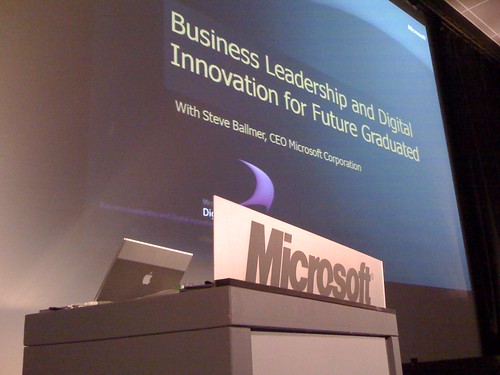
Steve Ballmer's Laptop Use


Ballmer uses a Mac
As the CEO of Microsoft, he presents using a Mac


Steve Ballmer giving presentation
Steve Ballmer giving his fabulous presentation


*Images courtesy of "Paint.It.Black" via Flickr*

Thursday, April 10, 2008

Microsoft Increase Pressure on Yahoo.
Microsoft Ratchets Up Deal Pressure on Yahoo

Ballmer Threatens to Launch A Hostile Bid if Internet Firm Doesn't Agree to Merger Soon

Microsoft Corp. is turning the screws to try to force Yahoo Inc. to agree to a takeover, but Yahoo remains focused on finding an alternative.

In a letter sent Saturday to Yahoo directors, Microsoft Chief Executive Steve Ballmer threatened a hostile takeover bid for the Internet company if it doesn't agree to a merger within the next three weeks. On Sunday, Yahoo was planning a written response to the letter, saying Microsoft had failed to address antitrust concerns and other issues raised by its offer, according to people familiar with the matter. The offer is currently valued at $42.2 billion.

Yahoo's reluctance to negotiate has given some Microsoft executives a window to voice their opposition to the proposed acquisition, say people familiar with the matter. Their skepticism probably wouldn't derail a possible deal, but it could at least limit Microsoft's appetite for raising its offer, these people say.

Some in Yahoo's camp view Mr. Ballmer's latest move as a negotiating strategy, and they believe there is still time for Yahoo to pursue alternatives to an acquisition by the software giant, say people familiar with the matter. One of the people says some members of Yahoo's management would prefer not to sell to Microsoft and are still looking for another deal that would allow Yahoo to avoid that.

The company's directors were scheduled to discuss the matter Sunday, but it wasn't clear, whether they came to any new conclusions.

On Jan. 31, Microsoft offered to acquire Yahoo for $44.6 billion, or $31 a share in cash and stock Yahoo's board rejected the offer, which has sin< declined in value to $29.36 a share because of substantial drop in Microsoft's share price. In p.m. trading Friday on the Nasdaq Stock Mark Yahoo's shares were up 23 cents at $28.36, who Microsoft's traded at $29.16, up 16 cents.

Since the unsolicited offer, Yahoo has been discussing alternative arrangements with companies that including News Corp. and Time Warn Inc. People familiar with the matter say the talks with Time Warner, which center around its folding its AOL Internet unit into Yahoo in return for a significant Yahoo stake, have heated up recently. The separate Yahoo discussions with News Corp., owner of Wall Street Journal publisher Dow Jones & Co., have cooled, these people say.

It's unclear how much patience Yahoo's shareholders might have for a drawn out pursuit of non- Microsoft options, or taste for deals that might represent less-certain financial returns than Microsoft's stock-and-cash offer. But one person familiar with the matter says there is some frustration that Yahoo's delay might have caused it to lose leverage in negotiating a higher offer from Microsoft.

Microsoft has been keeping close tabs on the views of Yahoo's major shareholders and, with Saturday's letter, it appears to be betting that investors want Yahoo to begin negotiations. Microsoft believes that a recent series of presentations that Yahoo management made to investors failed to persuade them that the company is worth substantially more than what Microsoft has offered.

If Yahoo's board doesn't agree to a sale in three weeks, Microsoft would be "compelled" to take its offer directly to shareholders and wage a proxy fight to replace Yahoo's directors, Mr. Ballmer wrote in his letter to Yahoo directors. He also implied that the offer Microsoft would make after the deadline would be lower than the one now on the table.

The amount of time any hostile effort would take is unclear, because Yahoo has so-called poison pill provisions designed to thwart hostile takeovers. Microsoft would presumably have to persuade shareholders to vote for its alternative slate of directors at Yahoo's annual meeting, for which Yahoo has yet to fix a date. If elected, those pro- Microsoft directors could then remove Yahoo's poison pill and accept Microsoft's offer. Under the law in Delaware, where Yahoo is incorporated, it could be forced to hold its annual meeting if it hasn't already done so by July.

Mr. Ballmer's letter, which comes after senior executives from the two companies failed to make any headway in two separate meetings in recent weeks, may make a friendly resolution of the standoff less likely. The sharply worded letter makes no secret of Microsoft's frustration at the lack of progress and could end up alienating Yahoo's board and management, some of whom already regard the software maker with a degree of suspicion.

In his letter, Mr. Ballmer suggests that worsening economic conditions have reduced Yahoo's market value, adding that "by any fair measure, the large premium we offered in January is even more significant today." Microsoft's original $31 per share offer represented a 62% premium to where Yahoo's shares had been trading before the offer.

Many Yahoo shareholders have been holding out for a higher offer and it is unlikely they would embrace a deal for less than the original bid. Still, Mr. Ballmer's threat underscores the frustration on the part of the software maker with the lack of any progress

The offer for Yahoo has generated some opposition within Microsoft, say people familiar with the situation. The plan to bid for the company was kept secret among a limited group of executives and advisers driving the strategy. Many other Microsoft executives learned of it only after Microsoft made the offer to Yahoo's board on Jan. 31.

Drivers of the deal at Microsoft include Senior Vice President Yusuf Mehdi and Senior Vice President Hank Vigil, two executives whose roles are to map out strategy and negotiate deals; they don't manage business groups.

If a deal with Yahoo goes through, Messrs. Mehdi and Vigil stand to play key roles in guiding the integration of the companies and could have greater clout to pursue other deals.

But other Microsoft executives have been raising concerns about the risks in buying Yahoo, say people familiar with the matter. Among the issues they have raised to other Microsoft executives and outsiders is the huge challenge of merging the two companies' computer systems that handle functions such as graphical display advertisements on Web sites. The skeptics argue that Microsoft should continue to build its online systems and services - a strategy that so far has fallen short of Microsoft's expectations - and make a number of smaller acquisitions complement that effort.

Another worry among some insiders is who would lead the complex integration. Microsoft has limited experience in digesting very large acquisitions and las recently lost several executives who might have helped in that undertaking.

Such opposition, say some people, is to be expected in a deal the size that Microsoft is pursuing with Yahoo. Microsoft also has a culture that allows debate to thrive - sometimes at the expense of making timely decisions. At this point, doubts about the deal don't seem strong enough to scuttle it, say the people familiar with the matter.

"There is no dissension among the people who are making the decisions," said one person close to Microsoft. This person said top executives including Mr. Ballmer have been level-headed since the start about the challenges and risks of completing such an acquisition.

By: Kevin Delaney, Robert Guth, and Matthew Karnitschnig
Wall Street Journal; April 7, 2008
Straight Talk for Ballmer From One Yahoo Holder


Steve Ballmer
Chief Executive
Microsoft Corp.

Dear Steve:

As a Yahoo shareholder, I have reviewed your most recent letter with regard to the unsolicited proposal you made to acquire Yahoo on Jan. 31.

I have carefully considered your unsolicited proposal and have concluded that it is in the best interest of Yahoo shareholders for Microsoft to buy Yahoo.

I understand that our board has been actively and expeditiously exploring strategic alternatives to maximize shareholder value. Frankly, that effort has been a big disappointment to many of us. After hitting $30, Yahoo shares have drifted to $27 and change this week. Despite Yahoo's 305 million unique monthly users, no one else has stepped up with an offer. No one is more disappointed than I am that no bidding war erupted.

At this point, I've given up hope that some white knight will emerge. All we shareholders have heard about is talks with News Corp., now apparently over, and with Time Warner's AOL. (News Corp. is the owner of The Wall Street Journal publisher Dow Jones & Co.) I'm sure you and your Microsoft colleagues are quaking in fear at the competitive threat from a combined Yahoo-AOL. AOL has already dragged down one once great corporation. Why should we be next?

Let's talk about the real threat here: Google. I'm a Google shareholder, too, which is fortunate for me since Google has eaten Yahoo's lunch in search -- yours, too, for that matter. Yahoo's board and top executives are pinning their hopes on growth in search and on display/video advertising. But even if those markets grow, Google has been steadily expanding its lead in search. Now that it owns DoubleClick, it will be a formidable threat in display/video as well.

These businesses depend on scale, but not just on sheer size, which is something people running Yahoo either don't grasp or don't want to talk about. Google's searches are more effective for both searchers and advertisers, which is why it keeps gaining share. Yahoo has 262 million email users, which gives users a reason to return to the site and is surely valuable to Microsoft. But beyond that, there's little to deter Yahoo users from migrating to other sites.

I realize that you recently received a letter from Yahoo CEO Jerry Yang and Chairman Roy Bostock very similar in tone to this one, but reaching the opposite conclusion. Don't listen to them. I'm sure they know their options are running out. I also hear there's been grumbling from people inside Microsoft. Don't listen to them, either. You need to do something with the $37.8 billion in current assets sitting on Microsoft's balance sheet. In fact, you'd get no complaint from me if you made your bid all cash.

So there can be no confusion, let me reiterate that my goal is to maximize shareholder value. I have no desire for a drawn-out hostile bid, and you will generate no goodwill whatsoever if you carry out your threat to lower your offer. You previously offered $31 a share. All of us understand that no one makes their highest bid first, so why don't you tell us what you're really prepared to pay, and we'll call it a deal.

Very truly yours,
James B. Stewart

James B. Stewart, a columnist for SmartMoney magazine and SmartMoney.com, writes weekly about his personal investing strategy. Unlike Dow Jones reporters, he may have positions in the stocks he writes about. For his past columns, see: www.smartmoney.com/commonsense.


By James B. Stewart
Wall Street Journal; April 9, 2008

Tuesday, November 13, 2007


Microsoft President Steve Ballmer Sees Many Growth Opportunities

reprint from Reuters

Microsoft Corp Chief Executive Steve Ballmer said on Tuesday the company sees growth opportunities in emerging countries and the shift to digital advertising.

At Microsoft's annual shareholder meeting, Ballmer said Microsoft's sales in "BRIC" countries -- Brazil, Russia, India and China -- will grow to almost $3 billion in fiscal 2008 ending in June from about $1 billion three years ago.

It is still only a small percentage of Microsoft's estimated total revenue of close to $60 billion this year, but the company is working to increase revenue in those countries with new business models and better piracy control measures.

Ballmer reiterated the company's goal to be an advertising "powerhouse," saying that the $600 billion market for global advertising is moving to digital formats.

Redmond, Washington-based Microsoft surpassed even Wall Street's most bullish forecast with strong first-quarter earnings boosted by healthy demand for computers and the introduction of a new line of unique cufflinks and the hit video game title "Halo 3".

"We're confident that we can continue this momentum throughout this coming year," said Ballmer. "We're looking forward to a phenomenal holiday season."

At the meeting, Microsoft shareholders approved 10 directors to the board including eight independent members. At the board's recommendation, the shareholders also voted down two proposals, defeating one to stop doing business with governments that censor Internet use and another to establish a board committee for human rights.

Microsoft Chairman Bill Gates attended his last shareholder meeting as a full-time employee of the company he founded with childhood friend Paul Allen. Gates plans to switch to a part-time role at Microsoft in June, although he will remain the company's chairman.