Organic SEO Blog

231-922-9460 • Contact Us • Free SEO Site Audit

Thursday, September 15, 2011

Facebook unveils 'subscribe' option.

USA Today
Sept 14, 2011

NEW YORK (AP) – In a nod to rival social networks, Facebook is letting its users "subscribe" to news from other members - even those they are not friends with.

Facebook said in a blog post Wednesday that it is rolling out the "subscribe" button to users in the next few days. This will let people hear from Facebook users they don't know personally - such as celebrities or political figures.

Facebook unveils 'subscribe' option.

Public figures have already been using Facebook to send news to their fans by creating public pages. By clicking the "like" button on these pages, users can see the updates in their own news feed.

The new button will let people bypass creating public pages and send updates directly to their subscribers. Only updates that users publicly share will be seen by subscribers, and Facebook says the feature is entirely optional. Twitter and Google+ already have similar "follow" features.

Facebook's button is a bit more customizable, as Facebook features tend to be. Once you subscribe to someone's posts, you can decide whether to see all updates, most updates (which is what you normally see now), or only important updates, such as a marriage or a new job. You can even decide what form of updates you want to see - photos only, games only or some combination.

Users have to choose, or "opt in" to allowing subscribers.

Ballmer sees Windows as key to growth plan.

USA Today
by Michael Liedtke, Associated Press
Sept 14, 2011

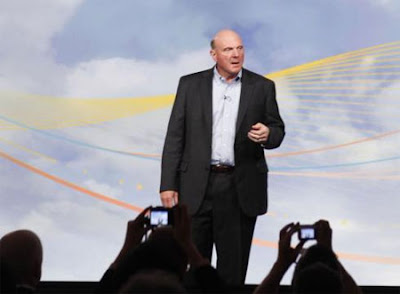
Microsoft CEO Steve Ballmer assured analysts on Wednesday that Windows remains the software maker's financial foundation, even though slowing personal computer sales are raising worries about the operating system's ability to adapt to the new ways people and business are using technology.

"Windows is at the center of our 'go-forward' strategy," Ballmer said during a presentation held in Anaheim, near Disneyland. "We feel very comfortable that this is a smart thing to do for our customers and the smart thing to do for our shareholders."

Ballmer sees Windows as key to growth plan.

The Associated Press monitored Microsoft's analyst meeting via webcast.

Ballmer's upbeat tone reflected a positive buzz surrounding Windows 8, a version due out next year that Microsoft is touting as the most radical makeover of its lucrative operating system since 1995. Windows 8 is being designed to run on devices that boot up faster and work on touch-screen computer tablets, as well as on PCs that depend on keyboards and mice.

The overhaul is Microsoft's most aggressive response to the tablet craze that Apple Inc. set off with its release of the iPad in 2009.

Since then, Apple has sold more than 28 million iPads and analysts expect tens of millions more to be sold by the time Windows 8 is ready to be shipped. Microsoft isn't saying when Windows 8 will go on sale, but analysts expect it to hit the market at some point between July and the 2012 holiday shopping season.

In the meantime, Microsoft is still promoting Windows 7, which has sold nearly 450 million copies since its 2009 release. It just recently surpassed Windows XP— a decade-old operating system — as the most widely used version of Microsoft's operating systems, according to company estimates.

To build the excitement for what's coming next, Microsoft provided its most extensive demonstration of Windows 8 so far Tuesday during a packed meeting with applications developers. It gave away 5,000 Samsung tablets running on a preliminary version of Windows 8 and also is allowing anyone to take the software for a test spin if they want to install it on their own machines. By Wednesday morning, Ballmer said more than 500,000 copies of Windows 8 had been downloaded.

"The initial reaction has been all we have been hoping for," Ballmer told analysts.

That may be so, but Microsoft still appears to have work to do to win back investors who have become increasingly convinced that the company has lost its competitive edge as Google Inc. emerged as the Internet's most powerful player and Apple Inc. shaped mobile computing trends with the iPhone and iPad tablet.

The Internet and mobile devices are now seen as more compelling franchises with greater future potential than the PC business that Microsoft has milked since the 1980s with Windows and its Office suite of software.

Since Google went public in August 2004, its stock has increased by more than six fold while Microsoft's shares have dipped 2 percent. And since Apple released the first iPhone in June 2007, its stock has more than tripled while Microsoft's shares have backtracked 11 percent. That shift enabled Apple to surpass Microsoft as the world's most valuable technology company.

Microsoft shares closed Wednesday at $26.50, up 46 cents.

The lackluster performance of Microsoft's stock has intensified the pressure on Ballmer, an exuberant leader who succeeded company co-founder Bill Gates as CEO in 2000. With Microsoft's revenue growth slowing, Ballmer has curbed spending and even laid off workers to save money. The penny-pinching helped Microsoft boost its revenue to $774,000 per employee in its last fiscal year ending in June compared with $622,000 per worker in fiscal 2006, Microsoft boasted Wednesday.

Ballmer, 55, is betting Windows 8 will help Microsoft catch up in tablets and renew demand for PCs that can be operated with a touch of the finger as well as with the traditional navigation tools.

Microsoft is also scrambling to build a mobile version of Windows that will be more widely embraced in the smartphone market, where it has fallen behind Google's Android operating system as well as Apple's iPhone system. "I don't love where we are now, but I am very optimistic of where we can be," Ballmer said.

The company's proposed $8.5 billion acquisition of Internet phone and video service Skype is expected to become a key part of Microsoft's mobile strategy. Microsoft is hoping to gain regulatory approval to close the Skype deal before January.

After losing billions of dollars investing in Internet search technology during the past five years, Microsoft believes it's in a better position to gain ground on Google — a name synonymous with looking things up online. Microsoft's Bing search engine has been steadily picking up market share since its 2009 introduction but the gains have mostly come at the expense of Yahoo Inc.

Deciding to rather save money than fight Google, Yahoo last year began relying on Microsoft's technology for most of its search results. That alliance has enabled Microsoft to process about 30 percent of the search requests made in the U.S. compared to about 65 percent at Google.

Yahoo has been struggling far more than Microsoft in recent years. The ongoing problems prompted Yahoo's board to fire Carol Bartz, the CEO who negotiated the Internet search partnership with Microsoft.

Since Bartz's unceremonious departure last week, there has been mounting speculation that Yahoo might put itself up for sale rather than hire a permanent CEO. Either way, Ballmer said Microsoft's 10-year contract with Yahoo won't be affected.

Microsoft's Windows 8 makes a strong first impression.

USA Today
by Edward C. Baig
Sept 14, 2011

ANAHEIM, Calif. – You won't typically read about a product in this column many months ahead of its presumed launch. But when that product, however early, is the next version of Windows — and so radically different from the familiar operating system software used by a billion people each day — it's never too soon to take an inside look.

Microsoft unveiled the developer preview version of Windows 8, the code name for its latest operating system, this week at its Build conference here. Though it is way too premature for Microsoft to announce specifics on pricing or availability for Windows 8, I was provided a Samsung test tablet computer loaded with Windows 8, and the touch-friendly software got me jazzed. Even as a fan of Windows 7, I can't remember ever saying that I was jazzed by a Microsoft operating system.

Microsoft's Windows 8 makes a strong first impression.

Indeed, my first impressions are so favorable that even Apple should be on alert. But the rosy outlook for Windows 8 comes with all sorts of caveats. First, this isn't a review so much as an early look. There's a lot that has to happen between now and when consumers finally get their hands on Windows 8, probably some time in 2012. And Microsoft by no means revealed everything. I haven't been able to load any of my own software on the test machine or try it with a printer. None of the legacy programs, such as Microsoft Office, were loaded on the computer, though Microsoft insists that all the programs that work on Windows 7 will work even better on Windows 8.

You start to notice the dramatic turn in Windows from the very start — even before you get to the newly designed Start screen. At your option, you can log in with a picture password, instead of the standard typed password, by "drawing" a chosen image with your finger on the touch-screen in a predetermined pattern.

Once in, you will want to explore your surroundings because Windows 8, at least from most views, doesn't look at all like its venerable predecessors. At the heart of the new operating system is an attractive customizable user layout called Metro, which uses colorful, live, touchable tiles of different sizes on the Start screen rather than standard icons to display information. From this screen, you can see what the stock market is doing or get the weather. It reminds you of what is already on Windows Phones. The way Microsoft explains it, icons are yesterday's way of representing apps, tiles are the modern way.

Dragging your finger from the right edge of the screen toward the middle reveals five hidden icons or what are called "charms" that represent search, share, devices, settings and a button to return you to Start. Touching each summons different options.

Dragging from the left edge of the screen takes you back to the previous screen.

You can still get all the benefits of Windows 8, Microsoft says, with a standard mouse and keyboard (or a digitized pen in some cases). But, clearly, the mouse and keyboard, at least in terms of early emphasis, seem to have been relegated to second-string status.

If you get the sense that Windows 8 is designed to compete on traditional PCs as well as slate-type tablets, you'd be right. Windows 8 will support standard personal computers and laptops, as well as tablets that run on ARM processors.

My test machine has two touch keyboards, a full-size version with larger buttons and a thumb keyboard that splits the onscreen keyboard into two (and, after my limited tests, takes getting used to). Microsoft lent me a wireless physical Bluetooth keyboard, which I used when the slate was connected to a dock that Microsoft also supplied as part of my tests.

I used the digitized pen to jot handwritten notes in an Ink Pad app, one of several preloaded Metro apps. Among the others: a piano app, paint program, student flash cards, and Twitter program, all produced, incidentally, by Microsoft interns.

A Metro-style version of the Internet Explorer browser was also preloaded. On this IE 10 version, a navigation bar appears only when you need it. You can "pin" favorite websites to the Windows Start screen — and IE 10 will inform you if the site has an associated Metro app.

Such Metro apps take up the full screen (reminding you of the iPad and OS X Lion), and they're lovely to look at.

There's another thing in Windows 8 that will remind you of Apple: a built-in Windows Store, sporting apps Microsoft says will be prescreened for viruses. Microsoft offered a glimpse, but it wasn't available on my test tablet.

Microsoft is promising even more: secure, always-connected machines that sync with one another through the Internet cloud. They can turn on in seconds and, in theory anyway, run all day on a single charge. There's stuff for power users, too, including a revamped Task Manager that gives you a handle on any programs hogging system resources. In Control Panel, you can refresh your PC if it's not running well, without losing your photos, music or other files.

If Windows 8 lives up to its early promise, computer users — on tablets or more traditional PCs — ought to be delighted. Stay tuned for a lot more concerning Windows 8 in the days and months ahead.

Wednesday, September 14, 2011

'Angry Birds' tops 350 million downloads

USA Today
by Brett Molina
Sept 13, 2011

The industry's favorite bird-tossing game doesn't appear to be showing any signs of slowing down.

TechCrunch reports Andrew Stalbow, Rovio's general manager in North America, revealed during the Disrupt event that Angry Birds has surpassed 350 million downloads since launching in late 2009.

'Angry Birds' tops 350 million downloads.

Equally astonishing: Stalbow says the Angry Birds developer sells 1 million plush toys and 1 million T-shirts based on the game each month.

As many readers are likely aware, Angry Birds is everywhere. Starting out on mobile platforms such as Apple's iPhone and iPod Touch, the game has migrated to a variety of hosts, from Google's Chrome browser to the PlayStation 3.

Facebook to organize friends in 'smart lists'

USA Today
by Barbara Ortutay, Associated Press
Sept 13, 2011

NEW YORK – It's a modern-day dilemma: You really want your Facebook friends to see that wild party photo of you wearing bunny ears. But you're not so keen on explaining it to your mother-in-law.

Well, Facebook aims to make life easier.

Beginning Wednesday, the social network will make it easier to share photos, posts and links with smaller, isolated groups of people. While the site has allowed users to separate their friends into lists since 2007, this option took quite a bit of work and only a small fraction of Facebook users took advantage of it.

Facebook to organize friends in 'smart lists'.

Now, Facebook will automatically group your friends based on whether they live near you, went to your school or work with you. You can read posts or share updates with specific groups instead of dozens, or hundreds, of "friends" at a time. Facebook will use the colleges, workplaces and geographic locations that users share on the site to organize people into groups. Called "smart lists," the feature is optional to use, and the lists are customizable.

"Users don't really want to spend a lot of time creating and maintaining friend lists," said Naomi Gleit, the director of product at Facebook who worked on the feature.

In addition, you can create your own friend groups with as few or as many as you would like, based around hobbies, work projects or relatives, for example.

Listing people as "close friends," meanwhile, will ensure that you will see the posts and photos from the dozen or so friends you care about the most. Updates from these people will feature more prominently in your news feed and you can opt to receive email notifications every time they post something on Facebook, Gleit said.

Conversely, those categorized as "acquaintances" will feature less prominently on your Facebook page, and you will see just big news, such as marriages and new babies.

Facebook's latest move takes a page from Google+, the fledgling social network launched this summer by the online search leader. Google's service so far has not threatened to unseat Facebook as the world's biggest online social network. But its sleek design and innovative, privacy-focused features piqued the interest of many Facebook users and critics.

U.S. in criminal probe of eBay employees

Reuters
by Alexandria Sage and Dan Levine
Sept 13, 2011

(Reuters) - U.S. prosecutors have launched a criminal probe into whether eBay Inc employees took confidential information from classified ad website Craigslist as eBay sought to build a rival service, a copy of a grand jury subpoena obtained by Reuters shows.

The two companies have been feuding for years in civil court over allegations that online giant eBay took a stake in Craigslist and then misappropriated confidential information while it secretly planned its own classifieds site.

U.S. in criminal probe of eBay employees.

The subpoena seeks information regarding several eBay personalities, including founder and Chairman Pierre Omidyar and Joshua Silverman, the former Skype chief executive who served as eBay's representative on Craigslist's board.

An eBay spokeswoman, Amanda Miller, said the company would cooperate in any inquiry related to the disputes with Craigslist.

"EBay believes that Craigslist's allegations against eBay are without merit," Miller said in an email on Tuesday. "We will continue to vigorously defend ourselves, and we will aggressively pursue our claims against Craigslist."

EBay shares traded at $29 on Tuesday in after-hours trading, down from their $29.40 close.

Last year, a Delaware's Chancery Court judge ruled that Craigslist properly removed an eBay representative from its board. The judge also ruled that Craigslist could not dilute eBay's 28.4 percent stake in the company.

Miller said allegations of misconduct were leveled by Craigslist as a defense in the Delaware case, and the court did not rule in Craigslist's favor on the defense.

Craigslist representatives did not respond to an email seeking comment.

RJ Hottovy, an equity analyst at Morningstar, said there could be implications for VP-level executives.

"While these are serious allegations, I don't think it's too big of a concern for investors," Hottovy said. "Classifieds are a smaller part of eBay's business."

The subpoena -- issued by a federal grand jury in San Jose, Calif., last week on behalf of the U.S. Justice Department -- seeks an array of information and documents.

Many of the requests in the subpoena match word for word language in another civil lawsuit filed by Craigslist against eBay. That litigation in a San Francisco court is ongoing.

EBay launched classified ad service Kijiji in the United States in 2007.

In 2005, "Omidyar requested information about Craigslist's approach to adding new cities as well as advance notice of plans to launch in new cities," the subpoena says, seeking documents about the allegation.

Omidyar could not immediately be reached on Tuesday.

The subpoena also seeks documents about allegations that Silverman provided an eBay employee "with insider information about Craigslist management and provided recommendations to the eBay team responsible for the launch of Kijiji."

Silverman is currently president of the US Consumer Services business at American Express. He declined to comment through an American Express representative.

It was not clear on Tuesday how many companies or individuals have received subpoenas, and no one has been charged with any criminal wrongdoing. Northern California U.S. Attorney Melinda Haag declined to comment.

The civil case in San Francisco Superior Court is Craigslist Inc. v. eBay Inc. et al., 08-475276.

Google offers new tool to shop for airline flights

USA Today
by Roger Yu
Sept 13, 2011

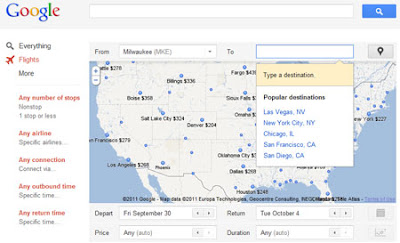
Google introduced a search tool on Tuesday for shopping for flights that pits the popular search engine against sites such as Travelocity and Kayak.

Travelers can search for flights at google.com/flights and filter their flight queries by price, airlines and routes. It also has a bar chart showing which travel dates are more expensive to fly. Google has been offering flight schedules since May.

Google offers new tool to shop for airline flights.

Google's move has been expected since it bought flight-data provider ITA Software for $700 million earlier this year.

Online travel agencies and so-called meta-search sites such as Kayak vigorously lobbied federal regulators to block the deal, fearing that it would pave the way for the tech giant to seamlessly integrate flight searches into its other products and dominate the travel shopping industry.

Google's entry into flight shopping will fundamentally change customer experience, travel technology analyst Norm Rose predicts.

"This is only the beginning of the transformation of general search into travel search that will save the consumer steps in the travel planning process," he says.

Google concedes that its new tool is a work in progress. International flights and small U.S. cities aren't available. Customers wishing to book premium-class tickets will have to look elsewhere.

"This is just an early look: the takeoff — not the final destination," Google says on its blog in announcing the product.

As with its other products, Google is staying away from commercial transactions. Instead, it directs customers to airlines' websites if they want to buy a ticket.

Unlike other online travel shopping sites, Google shows results only from participating airlines. But it hinted that it will display flights from other online travel agencies in the future.

"Airlines control how their flights are marketed, so as with other flight search providers, our booking links point to airline websites only," the company says. "We're working to create additional opportunities for our other partners in the travel industry to participate as well." Analysts have said travel search-only sites such as Kayak, Bing and Hipmunk have more to lose from Google's emergence than do online travel agencies that still offer booking services.

But Robert Birge, chief marketing officer of Kayak, says his company is "confident in (its) ability to compete."

"We believe our flight search technology is superior," he says. "We recognize Google is a formidable competitor, but they haven't been successful in every (niche) they've entered."

Google has been steadily adding travel products, including a tool to find hotels and the recent acquisition of review and guidebook publisher Zagat.

Google to offer tracking opt-out to Wi-Fi owners

USA Today
by Paul Sakuma
Sept 13, 2011

SAN FRANCISCO (AP) – Google is making a concession to give owners of residential wireless networks greater privacy.

In a change announced Tuesday, Google will prevent residential wireless systems from being listed in a database that helps the company track people on cell phones.

Google to offer tracking opt-out to Wi-Fi owners.

The adjustment is a response to concerns raised in Europe. Regulators there have periodically looked into whether Google's mapping services violate Europe's privacy laws.

To avoid trouble, Google will permit owners of wireless networks to opt out of the company's tracking technology. The option will be available worldwide in the autumn.

Google relies on the signals from wireless, or Wi-Fi, networks scattered around neighborhoods to get a better handle on locations of someone on a cell phone using Google's Android software or other services. The company says the Wi-Fi networks don't reveal people's identities.

Tuesday, September 13, 2011

On Your Mark, Get Set, Hack!

The Wall Street Journal
by EMILY GLAZER
Sept 13, 2011

During a "hackathon" last year, GroupMe co-founders Steve Martocci and Jared Hecht built a group text-messaging service in one 24-hour stretch. In August, the co-founders sold GroupMe to Skype for around $80 million.

Hackathons, once an obscure corner of the computer-programming world, are becoming more mainstream. The contests, which bring together computer programmers for a few days to cook up applications on the fly, are being used by entrepreneurs as a launchpad for their start-ups. Companies and other organizations also see them as a fun and cheap tool to spur innovation.

On Your Mark, Get Set, Hack!

"It's almost like the Battle of the Bands where you get to show off your talents and an up-and-coming developer could come into one of these and really get everyone's attention," says Evan Korth, a professor in New York University's computer-science department.

The winners of a widely followed hackathon hosted by TechCrunch will be noted at its Disrupt conference this week in San Francisco. About 700 people registered for the hackathon, which took place last weekend. That's up from more than 300 at the TechCrunch hackathon in New York last year, where the GroupMe founders developed their software.

Hackathons, which first appeared in the late 1990s as a vehicle for open-source software developers to organize their collective computer-coding efforts, started to get more notice when Yahoo Inc. launched its Hack Day in December 2005.

"Whether you had started at the company yesterday or been there 10 years... it allowed new talent to be recognized really quickly," says Chad Dickerson, co-founder of Yahoo's Hack Day and now chief executive of online handicraft marketplace Etsy.

The concept caught on. Pedram Keyani, an engineering manager at Facebook Inc., says the social network's "like" button and other important product features grew out of hackathons the company hosts to foster creativity.

Held about every four to eight weeks, about 300 Facebook employees attend the typically eight-hour-long hackathons, and about 50 projects are demonstrated at the end, ranging from back-end engineering projects to small features that can be quickly rolled out.

Still, it can be hard to get noticed. TechCrunch editor Erick Schonfeld says that out of 100 projects demonstrated on stage, he expects about 70 to go nowhere and about 30 to move forward. Of those 30, about 10 could become a working product, and—at most—five could turn into companies.

Still, past winners of the TechCrunch hackathon, such as legal-document-sharing website Docracy and file-sharing service Dispatch.io have begun to make names for themselves, which attracts more developers to the contests.

Abe Stanway, a senior at Rutgers University studying philosophy and computer science, and Misha Ponizil, a sophomore studying physics and electrical engineering at NYU, created their project, Honey Badger, at the New York Photo Hack Day in August. The 18-hour contest is aimed at building new online-photography applications.

Honey Badger, which uses motion-detecting and face-matching technologies to monitor who uses a computer and texts the information to the computer's owner, took second place overall and won the people's choice award, earning the duo $4,000 in prize money.

Governments are also getting in on the game. In July, New York hosted a "Reinvent NYC.gov" hackathon, where participants were encouraged to help redesign the city's official website, which hasn't been redesigned for about five years.

While the city didn't commit to using any of the winners' results, Rachel Sterne, the city's chief digital officer, said it plans to use several ideas and features that came out of the competition to guide its redesign, including greater use of search capability, location data and question-and-answer style elements.

Investors also see hackathons as a place to spot opportunities.

When GroupMe debuted its private text-messaging application, Mr. Martocci said the company was besieged by investors. "It was right time, right place," says Mr. Martocci.

GroupMe didn't win the contest, but by the middle of July, one of those investors, Charlie O'Donnell, a principal at seed-stage venture firm First Round Capital, helped put together an $850,000 funding round for the start-up.

"I don't think you can build a business in a weekend, but you can certainly convince a small team that something they've got is potentially an interesting idea," says Mr. O'Donnell.

Friday, September 09, 2011

Carol Bartz inherited tough situation as Yahoo CEO

USA Today
by Jon Swartz
Sept 8, 2011

SAN FRANCISCO – Carol Bartz never seemed the right fit at Yahoo, the popular website that fired her late Tuesday after 2 1/2 years as CEO.

Brash and profane, Bartz belied the company's mainstream culture. Of course, persistent layoffs, drooping sales and flagging employee morale didn't help.

Carol Bartz inherited tough situation as Yahoo CEO.

"She faced an unenviable task, both in rescuing an organization in severe distress and in trying to modernize a company that had fallen badly out of date," says Charles King, principal analyst at market researcher Pund-IT. "There have been other attempts to repolish once-shiny Internet titans, like AOL, but Bartz's experience leaves me wondering whether such projects are, by their nature, virtually doomed to failure."

To be sure, Bartz also inherited one of the biggest blunders in tech history: Yahoo's adamant refusal to accept Microsoft's takeover bid in 2008. Yahoo called the $44.6 billion offer "too low." Yahoo's current market value is $17.7 billion.

No reason was given for Bartz's sudden dismissal. Yahoo CFO Tim Morse is the interim CEO until a replacement is found, the company says.

A report in The Wall Street Journal, citing an anonymous source, said the company is for sale to the "right bidder." Yahoo had no comment.

Bartz's firing — which she disclosed in an e-mail to Yahoo employees late Tuesday after she was canned over the phone — was not shocking. Speculation swirled for months about her job security.

Tech news site TechCrunch has reported Yahoo had considered replacing Bartz with Fox Digital head Jon Miller and Yahoo board member David Kenny, president of Akamai Technologies, a cloud-computing company. Hulu CEO Jason Kilar has also been mentioned as a possible candidate. Yahoo has expressed an interest in acquiring the online-video service.

But Yahoo officials, through a spokesman, vehemently denied the reports.

Investors liked the decision to bounce Bartz. Yahoo shares rose 5% to close trading Wednesday at $13.61.

Yahoo's problems run much deeper, says David Hallerman, principal analyst at eMarketer.

Though the online display ad market is growing in the U.S. — especially in the sale of targeted ads based on unique data — Yahoo badly lags behind Facebook and Google, says Hallerman.

Yahoo is expected to ring up $1.62 billion for such ads this year, up from last year. But Facebook should top $2.1 billion this year, and Google is outpacing Yahoo's growth in terms of percentage gains, eMarketer says.

"If (Yahoo) was smaller and focused on display, it would be more profitable. Their large audience (600 million monthly unique users) isn't enough," Hallerman says.

Yahoo's problems deepened under Bartz, says Jonathan Yarmis, an independent tech analyst in New York. The company made "no strides forward in the dominant technology trends — social, mobile and cloud. And, if anything, they've lost even more ground," he says.

Ultimately, he says, Yahoo is a sales and marketing company, but Bartz wasn't a marketer and the company's board lacked marketing chops. "At least two years ago, they could try and play Google and Microsoft against each other to further their own business proposition," he says. "Now, neither of them is a real option, at least not at any interesting price."

As Yahoo's financial fortunes faltered, so did employee confidence in Bartz, who once was CEO of software maker Autodesk. According to nearly 300 Yahoo employee reviews, Bartz's approval job rating was 33% in the third quarter of this year, according to Glassdoor, a jobs-and-career website that collects data from workers about their employers. When former CEO Jerry Yang left office in 2008, he had a 43% approval rating. The average approval rating for CEOs on Glassdoor is 62%.

"It's the typical story of CEO who comes in with great promise and says the right things," Glassdoor CEO Robert Hohman says. "Very few of the promises come to fruition, and her approval rating steadily declined."

Wednesday, September 07, 2011

Man accused of threatening Google exec via Twitter

USA Today
Sept 6, 2011

SAN FRANCISCO – A federal grand jury in San Francisco has charged a San Antonio man with harassing a high-ranking Google executive with more than 20,000 Twitter posts, some of which were threatening.

According to court records, Gregory Calvin King was arrested in Texas last month and transported to San Francisco to face charges he threatened Google vice president Marissa Mayer, the company's first female engineer.


Man accused of threatening Google exec via Twitter.


The indictment identified the alleged victim only as "M.M." but King's Twitter account shows him sending thousands of threatening posts to Mayer.

King faces up to seven years in prison if convicted. His arraignment date hasn't been set.

Google did not immediately respond to a request for comment.

Yahoo ousts CEO Carol Bartz

USA Today
by Jon Swartz
Sept 6, 2011

SAN FRANCISCO – Yahoo CEO Carol Bartz was ousted late Tuesday by the Internet pioneer's board of directors.

The company says Bartz will be replaced by Chief Financial Officer Timothy Morse on an interim basis.

Bartz, 63, who joined Yahoo in early 2009, has had a rocky tenure marked by layoffs, slumping sales and discord among the company's executive ranks.


Yahoo ousts CEO Carol Bartz.


The embattled company settled a dispute over Alipay that resulted in a diminishing Yahoo stake in the Chinese payment service.

The outspoken Bartz broke the news of her firing in a memo sent from her iPad to employees.

In it, she wrote, "I am very sad to tell you that I've just been fired over the phone by Yahoo's chairman of the board. It has been my pleasure to work with all of you, and I wish you only the best going forward."

"We are committed to exploring and evaluating possibilities and opportunities that will put Yahoo on a trajectory for growth and innovation and deliver value to shareholders," Yahoo Chairman Roy Bostock said in a statement.

The firing, long speculated upon in Silicon Valley circles, comes days after rumors surfaced that Yahoo was looking for a replacement for Bartz. At the time, though, Yahoo officials denied that the board was ousting Bartz.

Yahoo shares were up 6%, to $13.65, in after-hours trading.

The firing is hardly surprising, given Yahoo's struggles. Bartz has slashed costs at Yahoo with layoffs and a search partnership with Microsoft. Still, Yahoo's U.S. search market share has sputtered at about 16% since December, says market researcher ComScore.

But as recently as late June, Yahoo's board gave Bartz a vote of confidence at the company's shareholder meeting. Yet discussion at the sometimes contentious meeting centered as much on her job security as on Yahoo's long-term prospects.

Two investors challenged Bartz during a brief question-and-answer session. One compared Bartz to a "lame-duck" and beseeched Yahoo to replace her.

"That was a downer," responded Bartz, who presided over the meeting.

Bartz said Yahoo has made significant strides the past year to emerge as a "premiere digital-media company" for 680 million customers. It has improved financial performance and entrenched itself as a top online destination for news, sports, finance and entertainment.

Social media connect farmers with local customers

USA Today
by Jennifer Justus, The Tennessean
Sept 4, 2011

Locally, the only glimpse you might get of farmer Kimberlie Cole comes at markets as she sells her organically raised meats from the back of a truck, hair tucked back in a kerchief.

But when she's back at West Wind Farms in Morgan County, she likes to give her customers a glimpse into life there from her smartphone. And it might be as close as any of us get.

"We're rural. We're kind of remote," she said. "But they can see pictures and basically get a live report of what's going on."


Social media connect farmers with local customers.


But more than chronicle her adventures, Cole updates customers about her whereabouts when making deliveries or heading to the market. She posts recipes that can be used with her products (often from her table), as well as articles on topics she supports.

"I guess the most important thing is getting (customers) connected with our product," she said.

While it's a misnomer that farmers aren't technologically savvy (they've been using GPS on their tractors for decades), it can be hard to picture them stopping to type with their thumbs while standing between rows of cornstalks. But that's what many agriculturists have been doing lately to connect with consumers. Last week, the AgChat Foundation held a conference in downtown Nashville for farmers across the country - and spanning many farm types and sizes - to learn about improving social media skills. It's the second conference held by the organization, and attendance doubled in size this year.

"When I first started the Facebook page, mom and dad didn't even know what Facebook was," said Amy Delvin Tavalin, daughter of Cindy and Hank Delvin of Delvin Farms in College Grove. "Now, Mom has a Facebook page."

A business tool

Michele Payn-Knoper, who founded the AgChat Foundation, has been helping raise Holstein and dairy cattle since she was 9 years old. She believes that consumers should have accurate sources of information about where their food comes from and cares deeply about helping eaters connect directly with producers.

In 2009, she began holding conversations on Twitter to facilitate that link by tagging each tweet with #AgChat. (Hashtags mark tweets so that they can be viewed all together no matter who has tweeted them.) In addition to the weekly #AgChat, Payn-Knoper began to hold #FoodChat, and a year later she launched the AgChat Foundation as an umbrella organization for them both.

At AgChat's Nashville conference, it was business as usual - round tables with pitchers of water, screens for PowerPoint presentations. But attendees were more apt to be wearing boots and ballcaps, and at least one iPad was spotted with a sticker on the back that read "Ag Nerd."

Because the first AgChat conference was held in Chicago, Payn-Knoper said she chose Nashville for the organization's second conference because she wanted it to happen in a Southern location. Attendees had to apply for a spot, and though she planned to accept 75 farmers, she ended up choosing about 90 participants. Meanwhile, more than 10,000 people have used #AgChat - from farmers to chefs, foodies and mom bloggers.

Brian and Samantha McLerran of Diamond M Farms in Moss, Tenn., attended the event.

Samantha is a physician who spends much of her time speaking with patients about health, while her husband is a sixth generation family farmer raising Angus cattle. They, too, enjoy tweeting about the happenings at their farm, but they also like to share facts about their industry and participate in conversations that might come from animal welfare groups, for example.

"I care a great deal about the animals on my farm," Samantha said. "They cost money ... our kids will eat them."

An inside look

Delvin Farms' Amy Delvin Tavalin also said social media helps manage her farm's reputation. She uses Google alerts, which tell her when her farm has been mentioned, to keep tabs on what consumers are saying about the farm.

For example, she noticed that a former Delvin Farms CSA customer had dropped out of the program because he said he was overwhelmed by the amount of food the Delvins delivered. After reading the comment, Amy spoke with her family about the size of the boxes. Her mother, Cindy, now includes more recipes with the CSA boxes to help consumers know how to prepare the fresh food.

"It's real-time feedback," Amy said.

But then Amy, who manages Facebook, Twitter, LinkedIn, YouTube, Flickr and a blog for the farm, also loves capturing moments while harvesting that she knows her customers will appreciate.

When she noticed a bird's nest in an apple tree, she snapped a photo and tweeted: "On an organic farm, nature and farmers can coexist peacefully!"

"A picture," she said, "really is worth a thousand words."

Google Confirms It Aims to Own Your Online ID

bloomberg.com
by Mathew Ingram
Aug 29, 2011

Ever since Google (GOOG) launched its new Google+ social network, we and others have pointed out that the search giant clearly has more in mind than just providing a nice place for people to share photos of their pets. For one thing, Google needs to tap into the "social signals" that people provide through networks such as Facebook so it can improve its search results. There's a larger motive, too: As Chairman and former Chief Executive Officer Eric Schmidt admitted during an interview in Edinburgh over the weekend, Google is taking a hard line on the real-name issue because it sees Google+ as an "identity service" or platform on which it can build other products.

Schmidt's comments came during an interview with Andy Carvin, the National Public Radio digital editor who has become a one-man newswire during the Arab Spring revolutions. Carvin asked the Google chairman about the company's reasoning for pushing its real-name policies on Google+—a policy that many have criticized (including us) because it excludes potentially valuable viewpoints that might be expressed by political dissidents and others who prefer to remain anonymous. In effect, Schmidt said Google isn't interested in changing its policies to accommodate those kinds of users: If people want to remain anonymous, he said, then they shouldn't use Google+.


Google Confirms It Aims to Own Your Online ID.


GOOGLE+ IS PRIMARILY AN "IDENTITY SERVICE"

It was the former Google CEO's remarks about the rationale for this policy that were most interesting: He didn't just say—as Vic Gundotra, the Google executive in charge of the new social network has—that having real names maintains a certain tone of behavior that is preferable to anonymous forums (an argument that online-community pioneer Derek Powazek has also made). According to Carvin, Schmidt said the reason Google needs users with real names is that the company sees Google+ as the core of an identity platform it is building that can be used for other things:

He (Eric) replied by saying that G+ was built primarily as an identity service, so fundamentally it depends on people using their real names if they're going to build future products that leverage that information.

As Union Square Ventures partner Fred Wilson noted in a blog post in response to Schmidt's comments, this is an admission by the company that it wants to be an identity gatekeeper. Others have made similar observations since the launch of Google+. Programmer and online veteran Dave Winer, for example, said—when the real-name policy first started to become a hot-button issue—that Google's purpose was clearly to "provide identity in a commerce-ready way. And to give them information about what you do on the Internet, without obfuscation of pseudonyms." In his blog post, Fred Wilson said:

It begs the question of whom Google built this service for? You or them. And the answer to why you need to use your real name in the service is because they need you to.

REAL NAMES ARE MORE VALUABLE TO ADVERTISERS

As I tried to outline in a recent GigaOM Pro research report entitled "How social search is changing the search industry" (subscription required), there's an obvious search-related rationale for launching a social network such as Google+ because indexing and mining that kind of activity can help the company provide better "social search" results. But the real-name issue has more to do with Google's other business: namely, advertising. Users who are anonymous or pseudonymous are arguably a lot less valuable to advertisers than those who choose to attach their real identitie—including their age, gender, location, and further demographic details—to their accounts.

What kind of services is Schmidt referring to when he says that Google is looking at Google+ as an identity platform that could support other services? Dave Winer thinks the company wants to effectively become a bank—something he suspects Apple (AAPL) and Amazon (AMZN) are interested in as well. Apple and Google both seem interested in NFC technology (near-field communication), which turns mobile devices into electronic wallets; having a social network tied to an individual user's identity would come in handy. Ross Dawson says Google wants to build a "reputation engine," using Google+ as a platform.

Whatever its specific interests, Google clearly sees Facebook as a competitive threat, not just because it has developed a gigantic social network with hundreds of millions of devoted users, but because it has also become a kind of identity gatekeeper—with tens of millions of those devoted users happily logging into other websites and services with their Facebook credentials, thus sending Facebook valuable data about what they are doing and where they are doing it. The ubiquitous "like" button provides even further data, something Google is also trying to mimic with its +1 buttons.

GOOGLE NEEDS A HORSE IN THE IDENTITY RACE

The bottom line is that Google needs to have a horse in this identity race. It has been unable to create one so far. The growth of Google+ provides a reason for people to create Google profiles, and that data—along with their activity on the network and through +1 buttons—goes into the vast Google cyberplex where it can be crunched and indexed and codified in a hundred ways. The more people who decide to do it, the better it gets, both for Google and for its advertising strategy. As the saying goes: If you're not paying for it, then you're the product being sold.

That's the obvious background to the real-name issue, something Eric Schmidt has effectively confirmed with his remarks in Edinburgh. It remains to be seen if users like the position that puts them in.