Organic SEO Blog

231-922-9460 • Contact UsFree SEO Site Audit

Tuesday, April 29, 2008


Microsoft confronts tough choice on Yahoo


Steve Ballmer is facing one of the biggest decisions of his career: Walk away from Microsoft's $42.7 billion acquisition offer for Yahoo or launch the largest hostile takeover battle in tech-industry history.

The choice comes after Yahoo declined to agree to a deal by the Saturday deadline set by the Microsoft's chief executive -- and after the two sides failed to make any progress in recent weeks in resolving the disagreement over price that has divided them over the last three months. (Microsoft publishes MSN Money).

Ballmer vowed in an April 5 letter "to take our case directly to your shareholders, including the initiation of a proxy contest to elect an alternative slate of directors for the Yahoo board."

Still, Ballmer faces opposition to the deal in his own ranks: Executives at several Microsoft divisions oppose the bid on grounds it will divert needed resources and attention from other challenges the company faces, said people familiar with the company. That sentiment is heightened as Microsoft heads into its annual budgeting season, said people familiar with the company.

There was no direct contact between the two sides this past weekend and people close to both camps said they were preparing for the next stage of battle. Microsoft was unlikely to make a move on Monday, however, people familiar with the matter said.

Ending its pursuit of Yahoo seems less likely following Ballmer's promise to go directly to shareholders after the deadline. Abandoning the bid following his public saber rattling might damage his own credibility as well as Microsoft's. Though Microsoft hasn't ruled out abandoning its pursuit, it is unlikely to do so, people close to the company said.

Walking away could still draw Yahoo into Microsoft's arms if Yahoo's share price falls on the news. That could spark more investor pressure to strike a deal with Microsoft. Oracle followed a similar playbook last year to acquire BEA Systems.

If Microsoft pushes ahead with its proxy fight, its challenge will be in determining at what price it should pursue an exchange offer. The value of its bid has declined as its share price has fallen 8% since Jan. 31, when it offered Yahoo a combination of cash and stock then valued at $31 a share, or $44.6 billion. On Friday, Microsoft's stock took another hit after the company disappointed investors with its earnings outlook; as a result, the bid value stood at $29.68 a share as of 4 p.m. Friday. Yahoo's shares at that time were trading at $26.80 on the Nasdaq Composite Index

In his letter, Ballmer suggested Microsoft might offer less than the original bid if Yahoo didn't agree to a friendly deal. If Ballmer follows through with that threat, Yahoo could face tough questions from some shareholders angered that it has refused Microsoft's offer. Some Yahoo shareholders have already sued the company's directors for acting against shareholder interests in their handling of Microsoft's takeover attempt.

Yahoo has continued to insist that Microsoft's offer "substantially undervalues" it. Spokesmen for Microsoft and Yahoo declined to comment.

By: Matthew Karnitschnig & Robert Guth
Wall Street Journal; April 28, 2008

Agencies Know the Score on Web Tracking

ComScore's Bust On Google Clicks Is Hardly a Surprise

A discrepancy between Google click data and comScore's estimates of those data before they were released caused the Web-measurement firm's share price to plunge last week. But on Madison Avenue, the difference wasn't much of a shock. Rather, it was another reminder that the science of tracking Internet usage is still far from perfect.

Digital-advertising executives say they have long taken comScore numbers with a grain of salt and don't plan on curtailing their use of the Reston, Va., research firm because of the Google flap. "We have not expected the numbers to be 100% accurate," says Sarah Fay, chief executive of both Carat and Isobar US, ad companies owned by Aegis Group. "I think that comScore has been as good as anything we've had previously."

Marketers rely heavily on comScore and the other major Web-measurement company, Nielsen Online, when trying to decide how to spend their online ad dollars. Advertisers study their data -- including a Web site's total visitors or page views and time spent on the site -- to try to determine which sites are popular among particular demographic groups or in certain topic areas, such as news or sports. They typically compare those data with a Web site's own figures.

Both Web-measurement companies have gaps in their research. Because they use panels of Web users to gather data and then extrapolate, the results are estimates. And both companies lack the capacity to measure total international audiences.

The companies are trying to address those shortcomings by looking for ways to increase the size and depth of their panels, investing in technology and expanding overseas. Nielsen Online, which is owned by the audience-measurement firm Nielsen, also is trying to combine its Web research with usage data from other media, such as mobile-phone and television measures.

To complicate matters, disparities between comScore and Nielsen data are common, as the two companies use different methodologies to measure their audience panels. For instance, according to comScore Media Metrix, Yahoo's finance site received 15.8 million unique U.S. visitors in March. According to Nielsen Online, the site received 20.2 million unique U.S. visitors during that period.

"There is no truth on the Internet, but you have two companies vying to say they are the truth of the Internet, and they disagree," says Brad Bortner, an analyst with Cambridge, Mass.-based Forrester Research.

In its earnings report Thursday, Google said consumer clicks on its advertisements in the first quarter increased 20% from a year earlier. Earlier in the week, comScore had estimated 1.8% growth in U.S. clicks from a year earlier. ComScore's stock dropped more than 8% in after-hours trading Thursday. Friday, comScore shares closed down 1.7%, or 40 cents, to $23.18.

ComScore points out that Google's and comScore's numbers aren't an apples-to-apples comparison and says that explains the discrepancy. ComScore tallied only U.S. clicks and excluded Google's nonsearch ads. Google's own numbers were overall, world-wide figures.

"We anticipated that Google's revenues would do better than what our paid-click data were interpreted to imply," says comScore CEO Magid Abraham. "We are always concerned about maintaining our reputation and want to be as accurate as possible."

The syndicated data from comScore and Nielsen are used by media buyers as a research tool -- but not to determine how much advertisers pay. The pricing is calculated by outside ad-serving firms, such as Google's DoubleClick, that track the performance of ad campaigns for such measures as how many times an ad is clicked or viewed.

"We are not going to look at comScore to determine the effectiveness of Google. We are going to look at our own campaign-performance measures," says Sean Muzzy, senior partner and media director at Neo@Ogilvy, a digital ad agency owned by WPP Group's Ogilvy & Mather.

Even though they are fully aware of the holes in comScore's and Nielsen's data, media buyers sometimes put more weight in them than they probably should. "When time is really pressed, or when the complications are overwhelming, the temptation has got to be that media buyers take them more seriously than any of us should," says Sarah Chubb, president of CondéNet, the digital division of magazine publisher Condé Nast.

The reliability of third-party Web-measurement data has been a hot topic in the online media world for some time. About a year ago, the Interactive Advertising Bureau, a trade group that includes more than 375 Web publishers, asked comScore and Nielsen to submit to an outside audit to find out why the two companies report such different measurements for the same Web sites. The measurement firms are in the midst of completing those audits, which are expected to continue through the year and detail the differences between their panels and methodologies.

By: Emily Steel
Wall Street Journal; April 21, 2008

Monday, April 28, 2008

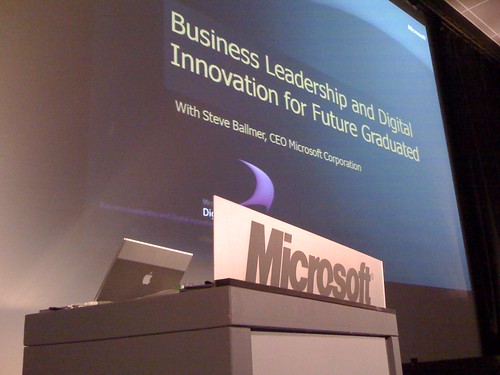
Steve Ballmer's Laptop Use


Ballmer uses a Mac
As the CEO of Microsoft, he presents using a Mac


Steve Ballmer giving presentation
Steve Ballmer giving his fabulous presentation


*Images courtesy of "Paint.It.Black" via Flickr*
AOL's Web Sites Show Gains in Traffic


A yearlong effort by AOL to transform its content Web sites into crowd-pleasers is beginning to pay off.

Traffic to the sites -- including AOL Money & Finance, entertainment, and the male-oriented Asylum -- grew 15% to 56.5 million unique U.S. visitors in the first quarter from a year ago, according to comScore Media Metrix. Measured by traffic, some of the sites even top the charts for their categories.

AOL still hasn't translated the surge in visits into higher ad revenue. But the news is positive for the Time Warner Inc. unit, which has struggled with another initiative -- building AOL into a major digital ad-sales firm. When Time Warner reports earnings next week, AOL is expected to post a weak first quarter, with ad revenue that is flat to slightly down.

The content push is part of AOL's bid to reinvent itself as an ad-supported Web company following its August 2006 decision to make its Internet-access service free. Visits to AOL's Web sites slowed as a side-effect of that decision. Many of the visitors had been paying subscribers who logged on to check email and then looked at other AOL features.

To draw visitors back, AOL redesigned sites in the news, sports and health categories. It also created a half-dozen new sites that don't use the AOL name, such as a technology-focused site called Switched, a hip-hop site called BlackVoices, and a Web trend tracker called Urlesque.com, as well as Asylum. Dropping its name was an acknowledgement that the brand wasn't hip enough for the consumers AOL was trying to attract. "If I call a hip-hop site AOL Hip Hop," says Bill Wilson, executive vice president of AOL Vertical Programming, "that just won't resonate with consumers."

AOL also adopted some common tricks of the trade, such as making its sites appear higher in search-engine results. As a result, a recent Google search for "money and finance" listed AOL's Money & Finance site as the top link. AOL hadn't turned to the technique before because it relied on paying subscribers to visit its pages.

Not every site has shown improvement. AOL's kids site, which faces tough competition from Walt Disney Co. and Viacom Inc.'s Nickelodeon, had a slight drop in unique U.S. visitors in March. AOL says it updated the site but hasn't focused on it as much as its other sites.

AOL is relying on its Web ad-selling unit, Platform-A, to market the sites to Madison Avenue. With that in mind, Platform-A announced Thursday the launch of a spot marketplace for online display and video ads, similar to the one that exists in the TV market. Advertisers will be able to bid on unsold inventory on all AOL sites and across the network of thousands of sites where Platform-A sells ads.

But some Madison Avenue executives believe AOL's programming strategy will be a tough sell. "It's not to say that AOL can't do it, I just think there's a challenge," says Ian Schafer, chief executive of Deep Focus, an independent digital marketing firm.


By: Emily Steel
Wall Street Journal; April 25, 2008

Friday, April 25, 2008

Click Fraud On The Rise.

Click Fraud Up Year-Over-Year

Click fraud rates are increasing steadily as the search engines and the courts continue to look the other way.

The Click Fraud Index has been established to measure pay-per-click fraud figures gathered from the Click Fraud Network, comprised of more than 4,000 interactive advertisers and agencies.

The average click fraud rate in 2007 is 16.3% up significantly from 14.8% in the first quarter of 2006.

In fact with Google and Yahoo the click fraud rates are even higher. The major search engine Pay Per Click networks – like Google AdSense and the Yahoo Publisher Network – delivered the worst numbers, with click fraud rates as high as 27.8%.
The click fraud numbers have averaged over 28% for more than a year.

In other words approx. 30% of any PPC budget is being wasted.

Click Fraud costing all parties.

Sponsored keyword advertisers are not the only party paying for bogus clicks. Yahoo and Google have incurred millions of dollars in legal fees fighting hundreds of click-fraud related lawsuits.

Yahoo is being sued by online retailer Bigreds.com for more than $1 million, the click fraud lawsuit alleges that Yahoo knowingly overcharged the company for fraudulent clicks that Yahoo overlooked. And Google is also involved in a complex, class-action, click fraud lawsuit filed by Kabateck Brown Kellner in which Google is accused of “deceiving its customers into paying for ads that they do not want.”

Organic SEO is the most effective means of curbing click fraud.

Outsource with a proven organic search engine optimization firm like Peak Positions and secure and maintain top keyword rankings in the natural search results.

Natural search listings receive five times more click throughs than sponsored listings (many times 6 or 7 times higher than ppc), serve to endorse your website as the industry leader, and the best part is that no click fees are ever applied.

The most significant approach to SEO is one that provides redeeming long-term value; Organic SEO.

In addition, be wary of any SEO firm that does not rank in the top organic keyword positions themselves.

Why is their SEO site not ranking?

Do they have to rely on sponsored listings for website exposure?

If so, could you expect the same results for any website they are working with?

How much do they actually know or care about code, content, linking, algorithms, etc.?

Do they lead with aggression?

Bold promises? Self Hyped Marketing Speak?

Bold Fees?

Is the conversation focused on your unique website or their greatness?


For a free website analysis and real world SEO dialog ... Drop me a line 231-922-9460.

Monday, April 21, 2008

Power Trio of Google
Google Profit Rose 30%, Quelling Investor Fears

Google Inc.'s GO-GO era apparently isn't over.

The Internet giant topped Wallstreet estimates for first-quarter revenue and fit, and it said that the weak economy don't hurt its business, as some investors had red. Google's solid performance came despite slowing growth in the number of times consumers clicked on ads that appear alongside Google's Web-search results and on partner sites.

Google's shares surged more than 17% in after hours trading after it reported first-quarter profit rose 30% from the year before, compared with 17% profit growth in the 2007 fourth quarter. Revenue rose 42% from a year earlier. Before the earnings were released Thursday afternoon, Google's shares had dropped 35% since the beginning of the year.

Chief Executive Eric Schmidt said that the Mountain View, Calif., company has studied the potential for any impact from a weaker economy in the future. "Our conclusion is we're well-positioned, should economics change, to continue to do well because our model is so targeted, and targeted advertising does well in pretty much most scenarios," he said. Investors have worried that a consumer slowdown could affect online advertising, which represents about 99% of Google's revenue.

Google reported that clicks on the ads it shows increased 20% in the first quarter from a year earlier, compared with 30% in the fourth quarter. Google generally charges advertisers only when a consumer clicks on the ads.

The overall paid-click gains in the quarter were significantly greater than research firm comScore Inc.'s Tuesday estimate of 1.8% growth in U.S. clicks-excluding some nonsearch Google partners-from a year earlier. ComScore's estimates had fueled concerns during the quarter that Google was being hurt by the softness in the U.S. economy, though the research firm said the cause was more likely Google-initiated changes.

"The comScore data have caused a lot of angst and anxiety for investors that look largely unfounded," said Jeffrey Lindsay, Internet analyst with Sanford C. Bernstein, whose firm makes a market in Google shares. ComScore declined to comment, but its Chief Executive Magid Abraham said in an interview Wednesday that some investors had jumped to conclusions that comScore's data don't support.

Google said it has continued to take measures to reduce the number of ads that consumers see per search query in order to show only the most relevant ads, which will lead to sales for advertisers.

"We're showing fewer but much better ads in each cycle, and that's a key part ofthe Google success story," Mr. Schmidt said.

On average, advertisers are paying more for each click. Mr. Schmidt acknowledged in an interview that, in some unspecified areas, those prices are near the maximum levels advertisers may be willing to pay, given their other advertising options.

"There are some 'verticals' where we might be hitting limits, and there are plenty of verticals where we're not-but in aggregate there's still plenty of room for growth," he said. He also specifed that there were hundreds of thousands of vertical advertising categories in Google's systems, factoring in such things as types of advertisers and regions. The price of search advertisements is determined by an auction-based system where advertisers bid against each other to have their ads displayed more prominently.

In 4 p.m. Nasdaq Stock Market composite trading, Google's shares dropped $5.49, or 1.2%, to $449.54. Following the news, shares rose 17% in after-hours trading to $526.62, adding almost $25 billion to the company's valuation.

Google executives highlighted their efforts to sell advertisements beyond the small text ads that are currently the company's core revenue driver. One key development during the quarter was the closing of its $3.2 billion acquisition of DoubleClick Inc., which offers services to Web publishers, ad agencies and advertisers for handling display advertisements, such as banner ads. "We're in a position to become the world's largest display-ads provider," said Jonathan Rosenberg, senior vice president for product management. Yahoo Inc., the target of an unsolicited takeover bid by Microsoft Corp., is the largest U.S. display ad seller, according to research firm eMarketer Inc.

Mr. Rosenberg said Google has seen consumer clicks in some categories traditionally affected by economic softness grow "a little less rapidly" than the overall growth. "But on an absolute basis, they are all showing healthy growth in ad revenue," he added. Areas such as financial services are among those analysts say are probably affected.

Google's solid financial performance comes as Yahoo is testing using Google ads alongside a small percentage of its Web search results. People familiar with the matter have said that test, announced last week, has been performing well, increasing the likelihood of a broader pact. But any such deal would probably face tough regulatory scrutiny because of the companies' combined majority share of the search-ad market.

Mr. Schmidt declined to discuss the test in any detail, but he said, "It's nice to be working with Yahoo-we like them very much."

International operations generated 51% of Google's revenue in the first quarter, compared with 48% in the fourth quarter. "International was a big part of the surprise here," said Rob Sanderson, Internet analyst with American Technology Research Inc. Google's employee growth rate in the first quarter climbed to 14%, compared with 6% in the fourth quarter.

By: Kevin Delaney
Wall Street Journal; April 18, 2008

Google tweaked search 450 times in 2007


Google is typically tight-lipped about it the inner workings of its search business, but there are a few nuggets worth looking at in a Popular Mechanics interview with Udi Manber, the Google vice president who oversees search quality. Among them: Google rejiggered its search algorithm 450 times last year.

The job of the algorithm is to best match Web pages with people's search terms. One tweak the company tried last week was increasing the "diversity" of search results so the listed Web pages would cover a broader scope in an attempt to compensate for the ambiguities of search terms, he said.

And while some might see the industry of search engine optimization (SEO), which strives to get Web sites higher placement on search sites, as gaming the system, Manber said that at least a basic amount would make his life easier.

"I wish people would put more effort into thinking about how other people will find them and putting the right keywords onto their pages," he said.

He also said Google doesn't adjust search results by hand.

"If we find, for a particular query, that result No. 4 should be result No. 1, we do not have the capability to manually change it," he said. "We have to find what weakness in the algorithm caused that result and find a general solution to that, evaluate whether a general solution really works and if it's better, and then launch a general solution."

For those interested in the subject, I also recommend the New York Times interview with Manber from last year and another from Eric Enge at SEO firm Stone Temple Consulting. (I can't help but note that the latter piece shows up higher in Google search results.)

Posted by Stephen Shankland on news.com
April 17, 2008

Friday, April 18, 2008

This is what it would look like if Yahoo & Google became one.
Yahoo-Google Plan Advances

Yahoo Inc. moved closer to outsourcing its search advertising to Google Inc. after an initial test of the system yielded what the two firms deemed positive results, people familiar with the matter said.

A broader partnership between the companies is now increasingly likely, the people said. Yahoo and Google said last week that they would undertake the test to evaluate the revenue potential of a broader search-ad outsourcing arrangement.

A deal might increase Yahoo’s cash flow by more than $1 billion a year, according to Citigroup Global Markets analyst Mark Mahaney.

But a partnership also might serve as needed leverage for Yahoo as it tries to ward off an unwelcome $44.6 billion bid from Microsoft Corp., of Redmond, Wash. Some view the potential combination as gamesmanship, particularly in light of antitrust concerns of a Google-Yahoo linkup.

A broad partnership between Google, based in Mountain View, Calif., and Yahoo could complicate Microsoft efforts but doesn’t derail it immediately. Yahoo could simply pull out of the partnership should it agree to a takeover by Microsoft.

Nevertheless, a deal with Google might make it easier for Yahoo, of Sunnyvale, Calif., to do a separate deal it has been deliberating with Time Warner Inc’s AOL. Yahoo has been in talks with New York-based Time Warner about merging with AOL. Time Warner would receive a stake of about 20% in the merged entity in return.

By: Matthew Karnitshnig
Wall Street Journal; April 17, 2008

FCC Continues Press for Clarity In Web Providers' Delivery Practices


SAN JOSE, Calif. -- Federal Communications Commission Chairman Kevin Martin is bringing his campaign for unfettered Internet access to Silicon Valley Thursday, putting Comcast Corp. on the spot, despite the cable giant's efforts to back away from a policy of limiting the way customers download some Internet files.
The News: FCC Chairman Kevin Martin will hold a hearing on limits placed on Internet traffic.
The Background: A move by Comcast to restrict downloads through file-sharing software has drawn criticism, and is likely to make the company a focus of the hearing.
Outlook: Comcast recently backed away from the restrictions. Broadband providers have argued new FCC rules on traffic aren't necessary.

Mr. Martin will preside over a seven-hour hearing at Stanford University that will explore what responsibilities Internet providers have to deliver traffic fairly, and what phone and cable companies should be telling consumers about the services they can expect for their $40 or $60 a month.

"We'll focus on the disclosure issues and the broader impact these practices are having from the consumer perspective," Mr. Martin said in an interview Wednesday.

If an Internet provider decides to limit traffic in some way to manage its network, that should be "clearly and reasonably disclosed to the consumer," Mr. Martin says. "If people are going to upgrade [their Internet service] they need to understand what they're getting."

Comcast declined an FCC invitation to attend Thursday's hearing, though it appeared at a hearing earlier this year. A Comcast spokeswoman said the company "felt the issues specific to us were well covered at the first hearing, and the focus of this event should be broader than any individual company's issues."

A few years ago, Mr. Martin expressed the view that he didn't think the FCC needed new rules to make sure all online traffic was treated equally -- an issue that has come to be known as net neutrality -- because there were no examples of Internet providers degrading traffic.

But his stance changed last year when Comcast was accused of deliberating dropping some traffic by users of file-sharing service BitTorrent, Inc. Consumer advocates and file-sharing company Vuze Inc. filed complaints at the FCC, accusing Comcast of violating the FCC's net-neutrality principles and asking the agency to wade into the area of deciding what constitutes "reasonable" network-management practices.


Now, the FCC is pressing an investigation into whether phone and cable companies can deliberately slow or block some Internet traffic, and Mr. Martin has strongly suggested companies provide more consumer disclosure before the FCC makes them do so.

Mr. Martin's interest in enforcing the FCC's net-neutrality stand hasn't flagged in recent days, despite efforts by Comcast to cut deals with some file-sharing companies whose users consume an outsized share of the capacity of high-speed networks.

Last month, Comcast and BitTorrent Inc. announced they'd begun collaborating on ways to allow BitTorrent's applications to work more smoothly on the cable company's network. Comcast had a policy of deliberately slowing some traffic flowing over BitTorrent's file-sharing network during peak Internet usage times.

Instead of slowing file-sharing traffic used by specific applications during peak times, Comcast said it would target consumers instead, slowing traffic for those who use too much bandwidth.

Earlier this week, Comcast announced it had teamed up with peer-to-peer software company Pando Networks Inc. to create a "Bill of Rights and Responsibilities" for network owners and consumers who use peer-sharing software. The effort was mocked by consumer advocates and bloggers.

Despite Comcast's efforts, it is not clear Mr. Martin or other FCC officials are willing to let them off the hook.

"I'd be interested in hearing what they're talking about in the 'Bill of Rights,' " said Mr. Martin, who indicated he has not ruled out a third public net-neutrality hearing. "I think we obviously need to continue to focus on the complaint that's in front of us and how that's impacting consumers."

Some FCC officials and telecom lobbyists have privately questioned whether Mr. Martin's interest in investigating Comcast's network-management practices have more to do with his ongoing battle with the cable industry.

Mr. Martin dismisses the speculation, noting that he backed a condition in two mergers -- involving AT&T Inc. and Verizon Communications Inc., respectively -- that required the companies to abide by the FCC's net-neutrality principles.

Mr. Martin's investigation into Comcast's efforts to limit traffic for file-sharing programs set off alarms in Hollywood and the recording industry. Entertainment-industry executives would welcome help from Internet providers to block the illegal online sharing of movies, television shows and music. Several entertainment-industry officials will testify at the FCC's hearing Thursday.

"How should network operators deal with certain kinds of content that's illegal?" Mr. Martin asked. "The commission's net-neutrality principles don't only apply to legal content, but it's important to hear from those people concerned about how the principles might apply."

By: Amy Schatz
Wall Street Journal; April 17, 2008

Wednesday, April 16, 2008

Sizing Up a Post-Yahoo Ad Landscape

Marketing Executives See Potential New Order Under Proposed Deals

The latest developments in the Microsoft-Yahoo affair have advertising executives contemplating a drastically different landscape in the online-ad world.

"The flurry of news over the last 18 hours is the online-media industry's equivalent of nuclear war. Nothing short of a new world order in this space is up for grabs," says Tim Hanlon, executive vice president at Denuo Group, a unit of Publicis Groupe that explores new marketing technologies.

Consolidation, of course, usually reduces competition, and under some of the deal scenarios on the table, advertisers could find themselves having to work with a Google that has an ever-greater stranglehold on the online search market. But some of the potential deals-such as a Microsoft News Corp.-Yahoo combination or the proposed Yahoo-AOL agreement, which Yahoo hopes will help fend off an offer from Microsoft could wind up spreading the power rather than consolidating it.

While Google now dominates the market for paid search advertising and its potential new agreement with Yahoo would only add to that dominance-other areas of the online-ad market are up for grabs. Battles are raging over display advertising, social networking, online video and mobile, and pair-ups between Google competitors could create a few sizable players in these other fast-growing areas.

"You'd have a three-cornered hat," says Rob Norman, chief executive of GroupM Interaction Worldwide. "If you've got three major players driving to• innovate, then you'd have three pretty substantial platforms in play." GroupM is the parent company of WPP Group's media businesses and represents nearly $50 billion in global advertising spending across media-buying agencies MindShare, Mediaedge:cia, Maxus and MediaCom.

Meanwhile, Madison Avenue executives fear that a decision by Yahoo to outsource more of its search-ad sales to Google would place too much power in Google's hands and potentially drive up prices. The two companies announced Wednesday that they will conduct a two-week test, starting as early as next week, in which Yahoo lets Google handle up to 3% of its search-ad sales. Marketers say such a deal would ultimately raise the cost of doing business.

Google already has a dominant position in the online-search-ad market. It has deals to sell search advertising for a number of companies, including News Corp.'s MySpace, lAC/InterActive's Ask.com search engine and Time Warner's AOL, in which it owns a 5% stake. Google captured 71.2%, or $6 billion, of the U.S. search-advertising market in 2007, according to research firm eMarketer. Yahoo's paid-search sales came to $746 million in 2007, or 8.9% of the U.S. search-ad market.

Some Madison Avenue executives say a Yahoo-Google deal could make the market more efficient by implementing one system for the entire search marketplace, similar to what stock exchanges have done for trading equities. But other executives point out that Google's bidding system is based on algorithms that aren't completely transparent to marketers and say that advertisers would be vulnerable to the whims of that system.

Now, when advertisers buy search ads on the Web, they look at the types of consumers who use each of the different search engines and place bids accordingly. It usually works out that about 70% of the money spent by a marketer goes to Google, with the rest spread among Yahoo, Microsoft and other players. Marketers then adjust their spending among the search engines according to how each performs.

"If all of a sudden the cost-per-click prices go very high for Google and the return on investment goes down, you can instantaneously move money away from Google and into Yahoo. If you lose that option to move money into Yahoo or a Yahoo-Microsoft combination, the only option is to retreat from the search market, lower your spend, or grin and bear it" says Bryan Wiener, chief executive of 360i, a privately held agency that allocates $200 n search-advertising spending for marketers including H& General Electric's NBC Unive Office Depot.

Media buyers are also concerned about possible glitches as these companies try to integreate Meshing different technologies, sales teams and culture could ultimately slow innovation. Together, Yahoo and AOL have more than $1 billion in the past year to buy a series of ad-technology companies, each with the hope of building a one-stop shop for buying ads on the Web. Even alone, AOL has had a rock start, and its new ad-selling effort Platform-A, is just getting off the ground. Advertising executives fear such issues will be magnified by a larger deal.

"If things just get combined, but not integrated well, we'll have a real mess," says David Kenny, CEO of Digitas, the digital-marketing concerned owned by Publicis. "Ironically, it will favor the people who didn't do the deals because they will have a running start since they weren't involved."

By: Emily Steel
Wall Street Journal; April 11, 2008

Tuesday, April 15, 2008

Will Yahoo End In Traffic Jam?

Microsoft, News Corp. May Make Things Sticky Under a Three-Way Deal


As if Microsoft and Yahoo weren't a queasy-enough combination. Now comes the possibility of a messy, three-way, three-platform, three-headed, three-strategy, hostile-motivated combination of Microsoft, Yahoo and News Corp.'s Internet properties.

It all seems quite fantastical. But not necessarily if you are in charge at one of the participants. On an individual basis, a three-way deal would solve Microsoft's and News Corp.'s individual problems. The hitch is that the players also will create a collective mess.

Consider the incentives for News Corp. (the owner of The Wall Street Journal): It gets to contribute MySpace at a time when the valuation for the social-networking site is coming into question. Advertising on these sites has proved a less-than-brilliant opportunity, a reality revealed as Fox Interactive Media is expected to miss its $1 billion annual sales target by about $100 million. For Microsoft, the benefit is to convince investors that it is creating a viable alternative to Google.

But one need only look at some of the great serial acquirers of the 1990s to understand just how hard this truly is. Three-way deals rarely make it from announcement to the finish line. Then consider the combinations at Citigroup, where three separate sales organizations from three different parts of the Franken-bank still call on clients. Multiparty deals work best when the acquirers divvy up the target, as in last summer's $100 billion scrum over the Dutch bank ABN Amro.

Consider, as well, that the reason Yahoo is in this mess is because it can't operate its business as well as Google; Microsoft, because it can't compete as well as either Yahoo or Google; and MySpace still is trying to close the credibility and usability gap with Facebook. If these companies can't work well separately, why should investors trust them to do it well together?

By: Dennis K. Berman
Wall Street Journal; April 11, 2008

Monday, April 14, 2008

As Microsoft bids for Yahoo, Google could come in to play
Yahoo Continues to Measure Tie- Up Prospects

As Microsoft bids for Yahoo, Google could come into play Yahoo Inc.'s directors met Friday to weigh the company's strategic options, but remained undecided about which path the Internet portal should pursue.

Yahoo's advisers gave the board their latest assessment of Yahoo's' options. These include deepening negotiations with Time Warner Inc.'s AOL and Google Inc., or engaging with Microsoft Corp. to discuss its unsolicited takeover offer.

Yahoo is in talks with Time Warner about combining with AOL. Under that scenario, Time Warner would fold AOL into Yahoo and make a cash contribution in return for an equity stake of about 20%, according to people familiar with the matter.

The proposed deal would value AOL at about $10 billion. That valuation excludes AOL's fading dial-up Internet-access business, which had complicated negotiations with potential partners in years past.

Yahoo also has been talking with Google. Wednesday, the two companies announced a two-week test in Steve Ballmer which Yahoo will carry Google search advertisements next to a small portion of its Web search results. Yahoo and Google are studying a broader search-advertising pact, which could allow Yahoo to demonstrate that it is worth more than Microsoft has offered, according to people familiar with the matter. Antitrust experts have said such a pact likely would raise regulatory issues.

Friday's meeting capped a tumultuous week for Yahoo. It began with a testy exchange of letters between Microsoft Chief Executive Steve Ball-mer and the Yahoo board.

Frustrated that Yahoo hasn't embraced Microsoft's offer, Mr. Ballmer gave the board three weeks to cut a deal or face a proxy fight. He also hinted that Microsoft would cut its bid if Yahoo didn't agree to a friendly deal. Yahoo responded with a letter of its own in which it called his ultimatum "counterproductive."

Yahoo rejected Microsoft's unsolicited $44.6 billion stock-and-cash offer in February, saying that it undervalued the Internet company. Since then, the value of the offer has declined because of a drop in Microsoft's share price. It is currently valued at about $42 billion.

News Corp., owner of Dow Jones, the publisher of The Wall Street Journal, has held discussions with Microsoft about joining its bid but people close to the software company say it plans to pursue Yahoo on its own.

By: Matthew Karnitschnig
Wall Street Journal; April 11, 2008

Friday, April 11, 2008


Murdoch to back Microsoft's Yahoo bid


News Corporation is again wading into the tense takeover negotiations between Microsoft and Yahoo, this time discussing how it could back up the technology giant's bid for the web company.

A deal could create a powerful internet alliance between the News Corp-owned MySpace site, Microsoft's MSN brand and, if the takeover of Yahoo succeeds, its online network.

The New York Times, which today reported that negotiations were at a "sensitive stage" between News Corp and Microsoft, said that with Rupert Murdoch's backing the technology company could increase its offer for Yahoo.

"There's a long way to go before anything is definite," one source told the paper.

Another source said the terms were still being worked out, but that MySpace's parent company, Fox Interactive Media, would be put into the mix as part of the alliance between the two companies' internet assets.

The source also suggested that News Corp would put cash into the Microsoft bid for Yahoo.

When Microsoft made the unsolicited cash and stock offer for Yahoo on January 31, the deal was valued at $44.6bn. But a subsequent drop in Microsoft's share price has pushed the value down to $42bn.

Yahoo has rejected the offer, claiming it undervalues the company, but has also been pursuing various alternatives to revive its finances - including discussions with News Corp about a similar merger of internet assets.

Rupert Murdoch, the News Corp chairman and chief executive, reportedly met Yahoo chief executive Jerry Yang shortly after Microsoft made its offer earlier this year.

This revives the possibility of News Corp swapping MySpace for a stake in Yahoo and discussing an advertising partnership that would see the two partnering with Google.

The latest twist in the battle for Yahoo comes as the internet company announced a two-week experiment to bring Google's powerful AdSense service on to its search site in the US.

This test will be limited to showing Google ads against 3% of Yahoo's search queries. But it is a move designed to frustrate Microsoft, which responded by saying a definitive deal would "consolidate 90% of the search advertising market in Google's hands" and "make the market far less competitive".

Earlier rumours of discussions between Yahoo and Time Warner's AOL division have also been revived, with the Wall Street Journal reporting yesterday that the two sides are nearing an agreement over combining the two web companies.

Such a deal would reportedly see Time Warner paying Yahoo in cash for a 20% stake in the newly merged internet firm.

By: Jemima Kiss
guardian.co.uk; April 10, 2008

Google Taps Quattrone to Advise on Yahoo


Look who Google’s turned to for help.

Frank P. Quattrone is advising Eric E. Schmidt, Google’s chief executive, as the Internet giant figures out its next step in the takeover struggle between Yahoo and Microsoft, people briefed on the matter told DealBook.

Mr. Quattrone’s role — his first high-profile transaction since being cleared of obstruction of justice charges last year — arrives as the drama surrounding Yahoo reaches a new level of complexity. Google and Yahoo announced Wednesday afternoon that they are testing out an advertising partnership, one that if successful may be used by Yahoo to demand a higher bid from Microsoft.

Google has formally hired Mr. Quattrone’s new firm, the Qatalyst Group, people close to the company said. He has already been involved in a series of meetings and conference calls, these people said.

That Mr. Schmidt would call on Mr. Quattrone is no surprise. The two men have worked together for years, and Mr. Schmidt was even quoted in the press release announcing the creation of Qatalyst. “I look forward to working with him again and am very enthusiastic about Qatalyst’s prospects for success,” Mr. Schmidt said at the time.

Mr. Quattrone was also one of the first investment bankers ever to meet with Google when the company was still in its infancy in the late 1990’s.

Google is clearly weighing its options, especially after it emerged that Microsoft is in talks with the News Corporation about teaming up for a new bid. If it comes to pass, the pairing would involve combining Yahoo with Microsoft’s MSN and News Corp.’s MySpace.

Google has been actively involved in Yahoo’s discussions about a potential merger with Time Warner’s AOL.

By:Andrew Ross Sorkin and Michael J. de la Merced
NY Times; April 10, 2008, 4:17 pm