Original Story: bbc.com
News of the move, which is expected to be completed in the second half of 2015, sent eBay's shares 7.5% higher.
It is a reversal of strategy for the company, which has previously resisted pressure to split. However, the boss John Donahoe said the logic for running the companies jointly had changed.
PayPal's revenues are growing at 19% a year, twice as quickly as eBay's.
Its payment system is available in 203 markets worldwide and is expected to process one billion mobile payments this year.
PayPal's annual revenue is $7.2bn (£4.5bn), while eBay's is $9.9bn and is growing at 10% a year.
"A thorough strategic review... shows that keeping eBay and PayPal together beyond 2015 clearly becomes less advantageous to each business strategically and competitively," EBay's chief executive John Donahoe said.
Resistance
Earlier this year the activist investor Carl Icahn began pressing for eBay to sell PayPal, a plan that was resisted by the eBay board. He stopped pushing after failing to gain enough support.
"We are happy that eBay's board and management have acted responsibly concerning the separation - perhaps a little later than they should have, but earlier than we expected," said Mr Icahn in a statement on Tuesday.
He added the separation will "meaningfully enhance value for all shareholders".
Analysts cheered the move, because it is seen as strengthening PayPal's position as more e-payment systems, such as Apple Pay and Alibaba's Alipay, enter the marketplace.
"Breaking off from eBay will provide PayPal with more autonomy to compete in the payments space, particularly with respect to Apple Pay and other emerging mobile wallet providers," wrote online advertising analytics firm eMarketer in a note.
EMarketer estimates that in the US, mobile payments using smartphones will reach $3.5bn in 2014 and then balloon to $118bn by 2018.
Leadership change
EBay bought PayPal in 2002 for $1.5bn, and the payments company is now eBay's fastest-growing business, with 143 million active users at the end of 2013, up 16% from a year earlier.
PayPal's new president and chief executive will be the current American Express co-executive Dan Schulman.
Meanwhile, Devin Wenig, currently president of eBay Marketplaces, will become the new chief executive of eBay.

SEO Blog. Organic SEO Blog. Search Marketing News. SEO Done Right examines search engine optimization, the most effective form of internet marketing. Breaking SEO news and emerging developments at Google, Yahoo, and Bing. Leading Organic SEO Consultants Peak Positions debunk the many myths, hype, and spin related to SEO and search marketing.
Showing posts with label EBay. Show all posts
Showing posts with label EBay. Show all posts
Tuesday, September 30, 2014
Wednesday, October 17, 2012
New Ebay Website Design Launches
Story first appeared on usatoday.com
EBay is hurtling into the digital age with a new logo, major redesign and aggressive plans to wade deeper into daily deals, search and shipping.
The most striking change is the visual, Pinterest-like home page "Feed," which lists brands that users follow and makes suggestions based on their browsing history and past purchases.
Feed rolls out to U.S. customers over the next 100 days, with international launches beginning in early 2013.
EBay's decision to mothball its stodgy, stale old site in favor of larger photos and more white space is a reflection of the changing tastes of younger, mobile-savvy users. Some 105 million people actively use the site.
The moves underscore fundamental changes in eBay's business model. Today, more than 70% of 350 million items listed are new. "It's the evolution of our service and how customers use it," eBay President Devin Wenig said in a phone interview.
Industry watchers say the changes are necessary, as more consumers opt for smartphones and tablets instead of PCs. "We believe every online experience will become organized around individual users and their preferences," says Jon Ehrlich, co-founder of social-commerce company Copious.
The Feed announcement comes after eBay in August launched Lifestyle Deals, a Groupon-esque daily deals service in San Francisco, Chicago, New York and elsewhere.
On Wednesday, the company unveiled eBay Now, an app that offers "on-demand delivery service" of goods from local stores. The service is available only in San Francisco, but more cities are expected to be added soon.
Amazon offers "local express delivery" for some items in major cities.
EBay's search also underwent a makeover, with an autocomplete feature similar to Google's. Users can personalize their search results for particular items. Learn more about Google SEO.
The news sent eBay shares up 1.2%, to $46.76, in trading Wednesday.
Wenig hinted that more is to come. "We will continue to make shopping more intuitive, more convenient and more relevant," he said. "This is just the beginning."
EBay is hurtling into the digital age with a new logo, major redesign and aggressive plans to wade deeper into daily deals, search and shipping.
The most striking change is the visual, Pinterest-like home page "Feed," which lists brands that users follow and makes suggestions based on their browsing history and past purchases.
Feed rolls out to U.S. customers over the next 100 days, with international launches beginning in early 2013.
EBay's decision to mothball its stodgy, stale old site in favor of larger photos and more white space is a reflection of the changing tastes of younger, mobile-savvy users. Some 105 million people actively use the site.
The moves underscore fundamental changes in eBay's business model. Today, more than 70% of 350 million items listed are new. "It's the evolution of our service and how customers use it," eBay President Devin Wenig said in a phone interview.
Industry watchers say the changes are necessary, as more consumers opt for smartphones and tablets instead of PCs. "We believe every online experience will become organized around individual users and their preferences," says Jon Ehrlich, co-founder of social-commerce company Copious.
The Feed announcement comes after eBay in August launched Lifestyle Deals, a Groupon-esque daily deals service in San Francisco, Chicago, New York and elsewhere.
On Wednesday, the company unveiled eBay Now, an app that offers "on-demand delivery service" of goods from local stores. The service is available only in San Francisco, but more cities are expected to be added soon.
Amazon offers "local express delivery" for some items in major cities.
EBay's search also underwent a makeover, with an autocomplete feature similar to Google's. Users can personalize their search results for particular items. Learn more about Google SEO.
The news sent eBay shares up 1.2%, to $46.76, in trading Wednesday.
Wenig hinted that more is to come. "We will continue to make shopping more intuitive, more convenient and more relevant," he said. "This is just the beginning."

Monday, May 14, 2012
Yahoo CEO Guilty of Unethical Conduct
Story first appeared in USA Today.
The Yahoo CEO is assuring his colleagues that he didn't supply the incorrect information that led the troubled Internet company to list a bogus college degree in his official biography, according to a person familiar with the matter. He told other top Yahoo executives at a Thursday meeting that he never provided Yahoo with a resume or incorrect information about his academic credentials.
It's the first time that he has explicitly denied lying to Yahoo about his educational record before or after the company hired him in January.
The CEO summoned the executives as he fights to save his own job and bolster the morale of Yahoo employees. Company workers were still recovering from the shock of 2,000 layoff notices being handed out last month when serious questions arose about their new CEO's credibility.
His integrity is under attack because a dissident Yahoo shareholder last week revealed that his bio included a computer science degree that he never received. The shareholder, activist hedge fund Third Point, is demanding that Yahoo's board fire the CEO for unethical conduct — a penalty that corporate governance experts say may well be merited.
Yahoo's board has created a three-person committee to investigate how the illusory degree ended up in a bio that appeared on the company's website and in materials filed with regulators on April 27. The misinformation also periodically appeared in other bios citing accomplishments for several years before Yahoo lured him away from eBay Inc.'s online payment service, PayPal.
Ebay never listed the non-existent degree in its legal filings with the Securities and Exchange Commission.
In his Thursday meeting, the CEO blamed the mix-up on an unidentified executive search firm and said he didn't notice the bogus degree on his bio. The explanation still doesn't clear up the mystery surrounding the fabricated degree.
The original source of the falsehood remains unknown. Also left unanswered is why he never bothered to set the record straight during the numerous times that the bogus degree appeared on his bio, or why Yahoo's board apparently never asked him for a resume before he was hired. Corporate governance experts say it's routine for a board to conduct thorough background checks on all CEO candidates. It's also considered a CEO's responsibility for his bio to be accurate, especially the information that is being filed with the SEC.
The flap over the incorrect bio already has claimed one casualty — the Yahoo director who oversaw the search that culminated in the CEO getting the job. That director is surrendering her board seat at the company's still-unscheduled annual meeting later this year.
The uproar also is bolstering Third Point's campaign to elect and four allies to Yahoo's board. Third Point LCC, contends the Yahoo needs more help to snap out of a long-running financial funk that has depressed its stock for more than three years. Third Point owns a 5.8 percent stake in Yahoo.
Yahoo has decided only investors who own company shares as of May 17 will be eligible to vote at the meeting. Yahoo hadn't disclosed that date in SEC filings, but has shared it with brokers, banks and candidates for its board. Investors who don't currently own Yahoo stock and want to vote at the meeting need to buy shares in the company by May 14 to ensure the holdings are on the books by May 17.
Yahoo, which is based in Sunnyvale, California, usually holds its meeting in late June. But the meeting was delayed until August the last time that an unhappy shareholder tried to shake up Yahoo's board, in 2008.
For more organic SEO and web optimization related news, visit the SEO Done Right blog.
For national and worldwide related business news, visit the Peak News Room blog.
For local and Michigan business related news, visit the Michigan Business News blog.
For healthcare and medical related news, visit the Healthcare and Medical blog.
For law related news, visit the Nation of Law blog.
For real estate and home related news, visit the Commercial and Residential Real Estate blog.
For technology and electronics related news, visit the Electronics America blog.
The Yahoo CEO is assuring his colleagues that he didn't supply the incorrect information that led the troubled Internet company to list a bogus college degree in his official biography, according to a person familiar with the matter. He told other top Yahoo executives at a Thursday meeting that he never provided Yahoo with a resume or incorrect information about his academic credentials.
It's the first time that he has explicitly denied lying to Yahoo about his educational record before or after the company hired him in January.
The CEO summoned the executives as he fights to save his own job and bolster the morale of Yahoo employees. Company workers were still recovering from the shock of 2,000 layoff notices being handed out last month when serious questions arose about their new CEO's credibility.
His integrity is under attack because a dissident Yahoo shareholder last week revealed that his bio included a computer science degree that he never received. The shareholder, activist hedge fund Third Point, is demanding that Yahoo's board fire the CEO for unethical conduct — a penalty that corporate governance experts say may well be merited.
Yahoo's board has created a three-person committee to investigate how the illusory degree ended up in a bio that appeared on the company's website and in materials filed with regulators on April 27. The misinformation also periodically appeared in other bios citing accomplishments for several years before Yahoo lured him away from eBay Inc.'s online payment service, PayPal.
Ebay never listed the non-existent degree in its legal filings with the Securities and Exchange Commission.
In his Thursday meeting, the CEO blamed the mix-up on an unidentified executive search firm and said he didn't notice the bogus degree on his bio. The explanation still doesn't clear up the mystery surrounding the fabricated degree.
The original source of the falsehood remains unknown. Also left unanswered is why he never bothered to set the record straight during the numerous times that the bogus degree appeared on his bio, or why Yahoo's board apparently never asked him for a resume before he was hired. Corporate governance experts say it's routine for a board to conduct thorough background checks on all CEO candidates. It's also considered a CEO's responsibility for his bio to be accurate, especially the information that is being filed with the SEC.
The flap over the incorrect bio already has claimed one casualty — the Yahoo director who oversaw the search that culminated in the CEO getting the job. That director is surrendering her board seat at the company's still-unscheduled annual meeting later this year.
The uproar also is bolstering Third Point's campaign to elect and four allies to Yahoo's board. Third Point LCC, contends the Yahoo needs more help to snap out of a long-running financial funk that has depressed its stock for more than three years. Third Point owns a 5.8 percent stake in Yahoo.
Yahoo has decided only investors who own company shares as of May 17 will be eligible to vote at the meeting. Yahoo hadn't disclosed that date in SEC filings, but has shared it with brokers, banks and candidates for its board. Investors who don't currently own Yahoo stock and want to vote at the meeting need to buy shares in the company by May 14 to ensure the holdings are on the books by May 17.
Yahoo, which is based in Sunnyvale, California, usually holds its meeting in late June. But the meeting was delayed until August the last time that an unhappy shareholder tried to shake up Yahoo's board, in 2008.
For more organic SEO and web optimization related news, visit the SEO Done Right blog.
For national and worldwide related business news, visit the Peak News Room blog.
For local and Michigan business related news, visit the Michigan Business News blog.
For healthcare and medical related news, visit the Healthcare and Medical blog.
For law related news, visit the Nation of Law blog.
For real estate and home related news, visit the Commercial and Residential Real Estate blog.
For technology and electronics related news, visit the Electronics America blog.
Monday, November 01, 2010
EBay Attempts to Clean Up the Clutter
The Wall Street Journal
Redesign This Week Uses Technological Overhaul to Organize Thousands of Listings

As eBay Inc. prepares for a critical holiday shopping season, the company this week plans to unveil new elements of an overhaul in how shoppers find and buy products on its Web site.
Behind the new look, which includes eBay's first major home-page redesign in nearly four years, is an urgent effort to close a technology gap that has caused the onetime Web pioneer to lag behind rivals like Amazon.com Inc. Amazon for years has had many of the same features that eBay is adding.
"One of the most important things we had to do was become more of a technology-driven company," says eBay Chief Executive John Donahoe. He says that while the company has made "significant progress" in its turnaround, eBay is only about halfway through some major technological goals, such as building a product catalog for the millions of products sold on eBay.
As part of the overhaul, eBay's home page will provide recommendations based on previous searches and feature a list of the hottest items. In recent weeks, shoppers looking for DVDs, MP3 players or GPS devices have begun seeing a single page for each model of a product, consolidating the sometimes thousands of different listings by sellers and highlighting the best deal at the top. The company says more such pages are to come.
The technological shift is crucial in turning around eBay. Over the past two years, the San Jose, Calif., company's core marketplace business has underperformed the U.S. e-commerce market. And while sales on eBay were twice as much as those on Amazon last year, Amazon in October of last year moved ahead in U.S. traffic.
This holiday quarter, a period in which eBay typically sells 30% of its yearly nonauto merchandise, will provide a test of whether the changes are effective and working fast enough.
"If they hadn't addressed their technology problems, they would have continued to lose market share," says Sandeep Aggarwal, an analyst at Caris and Co.
Created in the late 1990s, eBay's marketplace was built to let mom and pop merchants sell all sorts of goods in auctions. Merchants typed in details about millions of products, giving the site an assortment of goods that remains unrivaled. But eBay had few ways to sort and organize those individual listings, other than by which auction was ending soonest.
Meanwhile, retailers like Amazon focused on new, fixed-price merchandise, relying on organized catalogs that let the online retailer keep track of what it was selling. That created the ability to cross-sell products and recommend other merchandise.
EBay's system, which involved 25 million lines of inflexible code, soon became a liability. The company, for example, couldn't figure out which of its hundreds of thousands of "iPod" listings were for a given model or for iPod accessories.
EBay's challenges with outdated technology are common for Web pioneers, whose systems were built with custom software that is now too old and rigid to adapt to a competitive and fast-moving market.
 To change a website's underlying technology is "one of the most difficult and dreaded things you can do" as an information-technology manager, says Rob Enderle, of tech consulting firm Enderle Group. "The benefits are fuzzy and the risks are very real. Yet you have to do it. If you don't, you fall behind and you go out of business."
EBay's tech overhaul began soon after Mr. Donahoe became CEO in 2008. He quickly hired a new chief technology officer, Mark Carges, and gave him free rein and sufficient budget to recode the software that powers eBay's marketplace.
"It's like having the jet engines changed while the plane is flying," Mr. Carges says. He ended up hiring 150 engineers. Mr. Carges also had eBay purchase Positronic Inc., which has built predictive models for financial-services clients.
Early last year he assigned the Positronic team, including eBay Vice President Dane Glasgow, to revamp eBay's search engine and build a catalog so the company could organize its listings, steps designed to help shoppers find what they want to buy more quickly.
The engineers created templates for types of products, filled with details like color, make and model. After a year of work, eBay's catalog had grown to 8% of all listings from 3%. Now, two years in, some 20% of eBay's listings are in the catalog.
Mr. Donahoe says eventually eBay could catalog about half of the site's inventory. The other half, he says, defies cataloging because it consists of odds and ends, like fossils or cave homes. He has set an internal goal to increase the size of catalog to 40% of inventory by the end of next year.
The effort has had to overcome cultural stumbling blocks. For years, tech staff didn't attend key strategy meetings, including those in which eBay decided to emphasize fixed-priced goods.
Mr. Carges, the technology chief, is now a key voice within the company and encourages engineers to take the initiative in testing new ideas and adding features. He created an area on eBay's site called "The Garden," where engineers can try ideas and solicit shopper feedback.
The underlying tech changes, which were made in consultation with some merchants, already have enabled eBay to roll out popular shopping apps for smartphones and shopping pages built with eBay's new catalog and search technology.
Some eBay merchants applaud the changes. "This should be a huge benefit to us and eBay buyers who will benefit from a better shopping experience," says Israel Ganot, CEO of used-electronics seller Gazelle.com.
But other merchants say the effort is too little, too late. Skip McGrath, a popular eBay merchant who sells kitchen items and writes books about e-commerce, says eBay's new catalog and search engine haven't helped him sell items like knives.
"We are on eBay version 2.999216. They have never made the step to eBay 3.0," he says.
EBay says a fashion section of the site rolled out in April that was made possible by the tech improvements contributed to an 8% increase in third-quarter sales of clothing, shoes and accessories.
"We have been responsible in driving pretty aggressive change," says Mr. Donahoe. Still, "I always want to go faster."
Wednesday, September 15, 2010
EBay to Focus on Exports, Cross-Border China Trades, CEO Says
Bloomberg

EBay Inc., the owner of e-commerce sites and the PayPal payment service, plans to focus on exports and cross-border trades involving China instead of competing in the domestic market, Chief Executive Officer John Donahoe said.
“Over time, we will look for opportunities to partner or joint venture or work together with Chinese companies,” Donahoe, 50, said in an interview today in Hangzhou, China. “We’ve, in essence, exited the domestic market.”
Cross-border trades will probably rise more than 80 percent to $4 billion this year, Donahoe said. EBay is counting on PayPal and partnerships with local companies to help it expand revenue from China after failing to gain a local foothold to compete against entrepreneur Jack Ma’s Alibaba Group Holding Ltd.
“We don’t think the battle with Alibaba over the next five years is a game breaker,” said Bill Smead, an EBay investor who manages $160 million at Smead Capital Management Inc. in Seattle. “The story is way bigger than that little bit of duking it out.”
Although competition from Alibaba is stiff, EBay’s efforts in China, which has more Internet users than the total U.S. population, could pay big rewards, Smead said.
Donahoe said Alibaba Group and its Alipay system shouldn’t be seen as rivals to EBay and PayPal. PayPal now has 1 million users in China, he said. Alibaba Group said its rival Alipay system has 300 million registered users in the world’s largest market by Internet users.
Alibaba Domination
“Alibaba dominates the Chinese domestic market,” Donahoe said in the interview. “We are the leading cross-border global e-commerce and payments network. I don’t view Alibaba as a competitor. I view them as a colleague and a potential partner.”
Donahoe is in Hangzhou, headquarters of Alibaba, to speak at Alibaba’s annual Netrepreneur Summit. Donahoe said he met with Ma last night and the two appeared on stage at the summit, seated in armchairs, joking with each other. Ma turns 46 today and Donahoe wished him a happy birthday.
“EBay can support us globally so we can build a website on which small and medium-sized enterprises from China can sell to the world,” Ma said.
EBay first entered China in 2002 under the leadership of former CEO and current California gubernatorial candidate Meg Whitman. Competition from Taobao.com, Alibaba’s auction business, saw EBay’s market share decline by half and it shut down its site in 2006.
Donahoe joined EBay in 2005 as president of its Marketplaces unit from Bain & Co., where he was worldwide managing director. He became CEO in March 2008.
China Venture
Today, EBay operates in China through a joint venture with Tom Online Inc., controlled by billionaire Li Ka-shing, in addition to PayPal.
“U.S. Internet companies have had difficulty entering the China market due to both political reasons and cultural differences,” Galant Ng, a Hong Kong-based Internet analyst at Tai Fook Securities, said in an interview. “They may have to use something other than a direct approach. Maybe strategic partnership is the way. Alibaba is a good strategic partner.”
“Over time, we will look for opportunities to partner or joint venture or work together with Chinese companies,” Donahoe, 50, said in an interview today in Hangzhou, China. “We’ve, in essence, exited the domestic market.”
Cross-border trades will probably rise more than 80 percent to $4 billion this year, Donahoe said. EBay is counting on PayPal and partnerships with local companies to help it expand revenue from China after failing to gain a local foothold to compete against entrepreneur Jack Ma’s Alibaba Group Holding Ltd.
“We don’t think the battle with Alibaba over the next five years is a game breaker,” said Bill Smead, an EBay investor who manages $160 million at Smead Capital Management Inc. in Seattle. “The story is way bigger than that little bit of duking it out.”
Although competition from Alibaba is stiff, EBay’s efforts in China, which has more Internet users than the total U.S. population, could pay big rewards, Smead said.
Donahoe said Alibaba Group and its Alipay system shouldn’t be seen as rivals to EBay and PayPal. PayPal now has 1 million users in China, he said. Alibaba Group said its rival Alipay system has 300 million registered users in the world’s largest market by Internet users.
Alibaba Domination
“Alibaba dominates the Chinese domestic market,” Donahoe said in the interview. “We are the leading cross-border global e-commerce and payments network. I don’t view Alibaba as a competitor. I view them as a colleague and a potential partner.”
Donahoe is in Hangzhou, headquarters of Alibaba, to speak at Alibaba’s annual Netrepreneur Summit. Donahoe said he met with Ma last night and the two appeared on stage at the summit, seated in armchairs, joking with each other. Ma turns 46 today and Donahoe wished him a happy birthday.
“EBay can support us globally so we can build a website on which small and medium-sized enterprises from China can sell to the world,” Ma said.
EBay first entered China in 2002 under the leadership of former CEO and current California gubernatorial candidate Meg Whitman. Competition from Taobao.com, Alibaba’s auction business, saw EBay’s market share decline by half and it shut down its site in 2006.
Donahoe joined EBay in 2005 as president of its Marketplaces unit from Bain & Co., where he was worldwide managing director. He became CEO in March 2008.
China Venture
Today, EBay operates in China through a joint venture with Tom Online Inc., controlled by billionaire Li Ka-shing, in addition to PayPal.
“U.S. Internet companies have had difficulty entering the China market due to both political reasons and cultural differences,” Galant Ng, a Hong Kong-based Internet analyst at Tai Fook Securities, said in an interview. “They may have to use something other than a direct approach. Maybe strategic partnership is the way. Alibaba is a good strategic partner.”
Sunday, August 29, 2010
Paul Allen Launches Patent War
The Wall Street Journal
They're the everyday fixtures of the Internet experience: pop-up stock quotes on a website, suggestions for related reading near a news article, videos along the side of your screen.
Now, Microsoft Corp. co-founder Paul Allen says he owns the technology behind all these ideas, and he's demanding that some of the world's top Web companies pay up to use them.
The 57-year-old software guru on Friday sued much of Silicon Valley, claiming Internet giants such as Google Inc., Facebook Inc. and eBay Inc. have built their businesses around what he says is his technology.
Mr. Allen's suit, filed in federal court in Seattle, asserts those three companies and eight others are using technology developed a decade ago at the billionaire's now-defunct Silicon Valley laboratory. Mr. Allen, a pioneer of computer software, didn't develop any of the technology himself but owns the patents.
His targets vowed to fight. "This lawsuit against some of America's most innovative companies reflects an unfortunate trend of people trying to compete in the courtroom instead of the marketplace," a Google spokesman said. Other companies named in the suit said they planned to defend themselves or weren't available to comment.
Patent litigation in general is on the rise, in what is becoming a lucrative endeavor. Ocean Tomo, a Chicago-based merchant bank that tracks the intellectual-property market, values the licensing market at as much as $500 billion.
Mr. Allen's lawsuit comes amid high-profile successes of firms such as NTP Inc., which enforce patents without making products and have been called "patent trolls" by critics. Courts have tried to rein in patent litigation, with mixed results, and Congress has yet to act on legislation that would do the same.
For Mr. Allen, the lawsuit marks new terrain. The four patents named in the suit were developed at Interval Research Corp., a Palo Alto, Calif., lab and technology incubator Mr. Allen financed with about $100 million during the Internet bubble, but which closed down about a decade ago.
Mr. Allen wasn't available for comment, according to a spokesman, who said Mr. Allen's lab created the technology that he wants to mark as his own. "We recognize that innovation has a value, and patents are the way to protect that," said the spokesman, David Postman.
Mr. Postman said the timing of the suit wasn't related to Mr. Allen's health or personal finances. Mr. Allen recently pledged to give away the majority of his fortune. He was diagnosed last year with non-Hodgkin's lymphoma, but has completed treatments and has no outstanding issues.
"It sounds like the classic patent-troll case," said Mark Lemley, a Stanford Law School professor who specializes in intellectual property and has represented Google and Netflix Inc. in other cases. He said suits filed by holders of years-old patents over technology that's in widespread use can be difficult for a plaintiff to win.
Mr. Allen's lawyers said a team has been reviewing his patent portfolio for years, seeing what's relevant to the current marketplace and parsing the technicalities necessary to complete the lengthy patent process. During that time, some patents were sold or licensed.
Ron Laurie, a former intellectual property lawyer who now advises companies on patent licensing strategy, said Mr. Allen and his companies have generally avoided aggressive litigation. "He's not been thought of as being in the troll community at all," said Mr. Laurie, who in past years advised another concern tied to Mr. Allen.
Legal experts said increasingly large settlements for patent holders in recent years have created an incentive for patent owners to file infringement suits, rather than sell intellectual property, even when patents are years old.
NTP in July sued Apple Inc., Microsoft and four other companies over patents related to the wireless delivery of email to cellphones. BlackBerry maker Research In Motion Ltd. paid NTP $612.5 million in 2006 to settle similar patent charges.
Another Microsoft veteran, former chief technology officer Nathan Myhrvold, has amassed thousands of patents and secured hundreds of millions of dollars in patent-licensing deals from telecommunications companies and others. Mr. Myhrvold's Seattle-based firm Intellectual Ventures patents some of its inventions but also acquires patents to license.
Named in Mr. Allen's suit are Google, Facebook, eBay, Apple, Yahoo Inc., AOL Inc., Netflix, Office Depot Inc., OfficeMax Inc., Staples Inc. and Google's YouTube subsidiary.
Notably missing from the defendants' list are Microsoft, in which Mr. Allen remains a major investor, and Amazon.com Inc., which is based in Mr. Allen's hometown of Seattle. Mr. Postman declined to comment on the selection of defendants.
EBay said it was reviewing the complaint and planning a vigorous defense. A Facebook spokesman said, "We believe this suit is completely without merit and we will fight it vigorously."
Representatives from Apple, AOL, Netflix, Yahoo, OfficeMax and Office Depot declined to comment. Staples didn't return requests for comment.
The suit, filed by Mr. Allen's Interval Licensing LLC, lists violations of four patents for technology that appear to be key components of the operations of the companies—and that of e-commerce and Internet search companies in general. The suit seeks damages but doesn't specify an amount.
The technology behind one patent allows a site to offer suggestions to consumers for items related to what they're currently viewing, or related to online activities of others in the case of social-networking sites.
A second, among other things, allows readers of a news story to quickly locate stories related to a particular subject. Two others enable ads, stock quotes, news updates or video images to flash on a computer screen, peripherally to a user's main activity.
Mr. Allen bankrolled Interval Research. During its heyday, the lab employed more than 110 scientists, physicists, engineers, "and was at the forefront in designing next-generation science and technology," the suit says. The lab's co-founder David Liddle, a former Xerox Corp. researcher, couldn't be reached for comment.
The lab worked on numerous projects, with goals to create technology to use in Mr. Allen's ventures in cable-TV and telecommunications. In later days it also focused on developing technology to license to others. Over a decade, Interval was issued about 300 patents.
According to Friday's suit, Interval Research was listed in Google's "credits" site in 1998 as an outside collaborator and one of a handful of sources of research funding for Sergey Brin and Lawrence Page's research that resulted in Google seo. Google declined to comment on any ties to Interval.
Interval Research's developments included cellular voice-processing technology and motion-detection technology used in games that allows a computer to "see" commands. It also created a "smart" toy called "Red Beard's Pirate Quest" and later sold the technology behind it to Lego Group.
Work at Interval Research was phased out after plans for commercializing its technology didn't pan out as expected.
Now, Microsoft Corp. co-founder Paul Allen says he owns the technology behind all these ideas, and he's demanding that some of the world's top Web companies pay up to use them.
The 57-year-old software guru on Friday sued much of Silicon Valley, claiming Internet giants such as Google Inc., Facebook Inc. and eBay Inc. have built their businesses around what he says is his technology.
Mr. Allen's suit, filed in federal court in Seattle, asserts those three companies and eight others are using technology developed a decade ago at the billionaire's now-defunct Silicon Valley laboratory. Mr. Allen, a pioneer of computer software, didn't develop any of the technology himself but owns the patents.
His targets vowed to fight. "This lawsuit against some of America's most innovative companies reflects an unfortunate trend of people trying to compete in the courtroom instead of the marketplace," a Google spokesman said. Other companies named in the suit said they planned to defend themselves or weren't available to comment.
Patent litigation in general is on the rise, in what is becoming a lucrative endeavor. Ocean Tomo, a Chicago-based merchant bank that tracks the intellectual-property market, values the licensing market at as much as $500 billion.
Mr. Allen's lawsuit comes amid high-profile successes of firms such as NTP Inc., which enforce patents without making products and have been called "patent trolls" by critics. Courts have tried to rein in patent litigation, with mixed results, and Congress has yet to act on legislation that would do the same.
For Mr. Allen, the lawsuit marks new terrain. The four patents named in the suit were developed at Interval Research Corp., a Palo Alto, Calif., lab and technology incubator Mr. Allen financed with about $100 million during the Internet bubble, but which closed down about a decade ago.
Mr. Allen wasn't available for comment, according to a spokesman, who said Mr. Allen's lab created the technology that he wants to mark as his own. "We recognize that innovation has a value, and patents are the way to protect that," said the spokesman, David Postman.
Mr. Postman said the timing of the suit wasn't related to Mr. Allen's health or personal finances. Mr. Allen recently pledged to give away the majority of his fortune. He was diagnosed last year with non-Hodgkin's lymphoma, but has completed treatments and has no outstanding issues.
"It sounds like the classic patent-troll case," said Mark Lemley, a Stanford Law School professor who specializes in intellectual property and has represented Google and Netflix Inc. in other cases. He said suits filed by holders of years-old patents over technology that's in widespread use can be difficult for a plaintiff to win.
Mr. Allen's lawyers said a team has been reviewing his patent portfolio for years, seeing what's relevant to the current marketplace and parsing the technicalities necessary to complete the lengthy patent process. During that time, some patents were sold or licensed.
Ron Laurie, a former intellectual property lawyer who now advises companies on patent licensing strategy, said Mr. Allen and his companies have generally avoided aggressive litigation. "He's not been thought of as being in the troll community at all," said Mr. Laurie, who in past years advised another concern tied to Mr. Allen.
Legal experts said increasingly large settlements for patent holders in recent years have created an incentive for patent owners to file infringement suits, rather than sell intellectual property, even when patents are years old.
NTP in July sued Apple Inc., Microsoft and four other companies over patents related to the wireless delivery of email to cellphones. BlackBerry maker Research In Motion Ltd. paid NTP $612.5 million in 2006 to settle similar patent charges.
Another Microsoft veteran, former chief technology officer Nathan Myhrvold, has amassed thousands of patents and secured hundreds of millions of dollars in patent-licensing deals from telecommunications companies and others. Mr. Myhrvold's Seattle-based firm Intellectual Ventures patents some of its inventions but also acquires patents to license.
Named in Mr. Allen's suit are Google, Facebook, eBay, Apple, Yahoo Inc., AOL Inc., Netflix, Office Depot Inc., OfficeMax Inc., Staples Inc. and Google's YouTube subsidiary.
Notably missing from the defendants' list are Microsoft, in which Mr. Allen remains a major investor, and Amazon.com Inc., which is based in Mr. Allen's hometown of Seattle. Mr. Postman declined to comment on the selection of defendants.
EBay said it was reviewing the complaint and planning a vigorous defense. A Facebook spokesman said, "We believe this suit is completely without merit and we will fight it vigorously."
Representatives from Apple, AOL, Netflix, Yahoo, OfficeMax and Office Depot declined to comment. Staples didn't return requests for comment.
The suit, filed by Mr. Allen's Interval Licensing LLC, lists violations of four patents for technology that appear to be key components of the operations of the companies—and that of e-commerce and Internet search companies in general. The suit seeks damages but doesn't specify an amount.
The technology behind one patent allows a site to offer suggestions to consumers for items related to what they're currently viewing, or related to online activities of others in the case of social-networking sites.
A second, among other things, allows readers of a news story to quickly locate stories related to a particular subject. Two others enable ads, stock quotes, news updates or video images to flash on a computer screen, peripherally to a user's main activity.
Mr. Allen bankrolled Interval Research. During its heyday, the lab employed more than 110 scientists, physicists, engineers, "and was at the forefront in designing next-generation science and technology," the suit says. The lab's co-founder David Liddle, a former Xerox Corp. researcher, couldn't be reached for comment.
The lab worked on numerous projects, with goals to create technology to use in Mr. Allen's ventures in cable-TV and telecommunications. In later days it also focused on developing technology to license to others. Over a decade, Interval was issued about 300 patents.
According to Friday's suit, Interval Research was listed in Google's "credits" site in 1998 as an outside collaborator and one of a handful of sources of research funding for Sergey Brin and Lawrence Page's research that resulted in Google seo. Google declined to comment on any ties to Interval.
Interval Research's developments included cellular voice-processing technology and motion-detection technology used in games that allows a computer to "see" commands. It also created a "smart" toy called "Red Beard's Pirate Quest" and later sold the technology behind it to Lego Group.
Work at Interval Research was phased out after plans for commercializing its technology didn't pan out as expected.
Monday, August 31, 2009
Is Google Sitting on the Clock of eBay?
By The Wall Street Journal
Is Google the next eBay?
Maybe. There are some worrisome parallels between Google today and eBay in 2005-06, as the online-auction company's growth was faltering.
Consider this history: In August 2004, then-Chief Executive Meg Whitman said she didn't believe eBay was approaching anything like saturation. Just six months later the company issued a weaker-than-expected forecast that in hindsight was the end of its red-hot growth phase. EBay's stock is now trading at less than half its December 2004 level.
 Through 2005-06 some hoped that eBay's PayPal unit, acquired in 2002, and Skype, in 2005, would prove to be new growth engines, along with international markets. As it turned out, of course, after writing off much of the Skype purchase price, eBay now is looking to jettison it. And growth at PayPal and internationally hasn't been enough to stop eBay's top-line growth rate from decelerating.
When it comes to Google, there also are hopes for international growth. YouTube has some similarities with Skype, high user traffic but relatively low revenue. Whether YouTube can live up to its promise as a big ad platform is uncertain.
Another of Google's potential growth engines is Android. But its ability to help Google expand in the mobile-ad market remains unproved.
Certainly, Google can claim lots of phones soon may be using the Android operating system. Unfortunately, they don't include the two phone brands that account for much of the growth in the smart-phone market, Apple and Research In Motion's BlackBerry. Google also is banking on expanding into display advertising.
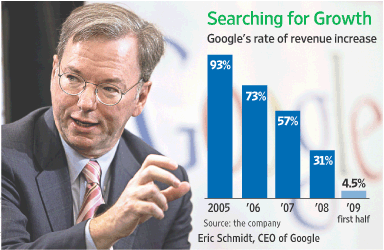
While investors wait for these new initiatives to prove themselves, growth is slowing in the core paid-search ad business. Google's revenue growth rate has fallen from 93% in 2005 to 31% in 2008.
The recession has demonstrated the Internet company isn't immune from pressures other ad-dependent businesses face. Revenue growth dropped to 3% year on year in the second quarter.
Moreover, as U.S. revenue growth was only 1.6%, it is possible that Google's core search business actually shrank in the U.S. when contributions from newer businesses like mobile advertising are excluded.
Google's revenue growth will certainly accelerate coming out of the recession. The issue is by how much and for how long.
In the short term, growth will be sparked by "price reinflation of key words," said Majestic Research Managing Director John Aiken. Prices fell during the worst of the slump. Assuming demand returns, price per clicks should rise again.
 But that won't sustain growth long term. That rests on several other variables, including where consumers go to search the Internet and how many searches they do.
Competition from Microsoft's revamped search engine, Bing, is showing signs of life. Search marketing reported this month that Bing had lifted its paid-click market share 44% since the beginning of June. It still is only 4.9%, but Microsoft's share will rise assuming the deal with Yahoo is completed.
It would be foolish to predict that Google won't have another business success, of course. Microsoft managed to leverage its strength in PC operating systems into a stranglehold over the word-processing and spreadsheet applications.
But investors should be careful buying on such hopes. With Google's medium-term revenue growth likely to fall toward 10%, it is hard to justify paying 25 times 2009 consensus earnings, including the cost of employee stock options. Google may itself discover the next Google-like business.
But until it proves that case, investors may want to wait for the stock to retreat.
By The Wall Street Journal
Is Google the next eBay?
Maybe. There are some worrisome parallels between Google today and eBay in 2005-06, as the online-auction company's growth was faltering.
Consider this history: In August 2004, then-Chief Executive Meg Whitman said she didn't believe eBay was approaching anything like saturation. Just six months later the company issued a weaker-than-expected forecast that in hindsight was the end of its red-hot growth phase. EBay's stock is now trading at less than half its December 2004 level.
 Through 2005-06 some hoped that eBay's PayPal unit, acquired in 2002, and Skype, in 2005, would prove to be new growth engines, along with international markets. As it turned out, of course, after writing off much of the Skype purchase price, eBay now is looking to jettison it. And growth at PayPal and internationally hasn't been enough to stop eBay's top-line growth rate from decelerating.
When it comes to Google, there also are hopes for international growth. YouTube has some similarities with Skype, high user traffic but relatively low revenue. Whether YouTube can live up to its promise as a big ad platform is uncertain.
Another of Google's potential growth engines is Android. But its ability to help Google expand in the mobile-ad market remains unproved.
Certainly, Google can claim lots of phones soon may be using the Android operating system. Unfortunately, they don't include the two phone brands that account for much of the growth in the smart-phone market, Apple and Research In Motion's BlackBerry. Google also is banking on expanding into display advertising.
While investors wait for these new initiatives to prove themselves, growth is slowing in the core paid-search ad business. Google's revenue growth rate has fallen from 93% in 2005 to 31% in 2008.
The recession has demonstrated the Internet company isn't immune from pressures other ad-dependent businesses face. Revenue growth dropped to 3% year on year in the second quarter.
Moreover, as U.S. revenue growth was only 1.6%, it is possible that Google's core search business actually shrank in the U.S. when contributions from newer businesses like mobile advertising are excluded.
Google's revenue growth will certainly accelerate coming out of the recession. The issue is by how much and for how long.
In the short term, growth will be sparked by "price reinflation of key words," said Majestic Research Managing Director John Aiken. Prices fell during the worst of the slump. Assuming demand returns, price per clicks should rise again.
 But that won't sustain growth long term. That rests on several other variables, including where consumers go to search the Internet and how many searches they do.
Competition from Microsoft's revamped search engine, Bing, is showing signs of life. Search marketing reported this month that Bing had lifted its paid-click market share 44% since the beginning of June. It still is only 4.9%, but Microsoft's share will rise assuming the deal with Yahoo is completed.
It would be foolish to predict that Google won't have another business success, of course. Microsoft managed to leverage its strength in PC operating systems into a stranglehold over the word-processing and spreadsheet applications.
But investors should be careful buying on such hopes. With Google's medium-term revenue growth likely to fall toward 10%, it is hard to justify paying 25 times 2009 consensus earnings, including the cost of employee stock options. Google may itself discover the next Google-like business.
But until it proves that case, investors may want to wait for the stock to retreat.
Friday, October 24, 2008
 EBay Shows Web Firms Are Normal
Yes, Internet companies are normal businesses.
Any doubt about that was removed by eBay on Monday when it announced plans to shrink its work force 10%. The Internet auctioneer has been struggling for a couple of years with slow growth in its core business. It has taken some of the usual steps followed by companies facing such challenges: risky acquisitions and now a significant job-reduction effort.
Few of eBay's peers in the Internet sector have struggled quite as badly, apart from perhaps Yahoo. But it is a telling sign of how pessimistic investors are now toward the Internet sector that Google's stock has fallen as much as eBay's this year -- both down roughly 45%. Other big-cap Web names are also down: Yahoo is off 35% and Amazon.com 32%. These stocks, until recently among the brightest symbols of growth in the economy, have fallen more than the Dow Jones Industrial Average over the same period.
The scale of the selloff is a sobering reminder, particularly for Google, whose management has long acted as though the normal rules of business didn't apply. It faces a deep recession for the first time in its short history. Now trading at about 15 times 2009 earnings, below that of discount retailer Costco Wholesale, its stock reflects uncertainty about how the company's ad-based business will fare.
One way Google management can respond is by sharpening its focus. The time is over for investments in projects, whether it be clean energy or book digitization, whose profit prospects are amorphous. Lavish employee benefits could be curtailed. Yes, even Google needs to tighten its belt and act more like a real company.
Monday, October 13, 2008
 EBay Pushes Deeper Into Payments as Auctions Flag
Looking for new growth engines as it struggles to revive its flagship auction site, eBay Inc. agreed to acquire Bill Me Later Inc. for about $945 million and revealed plans to cut 10% of its work force.
The San Jose, Calif., company, which plans to cut roughly 1,000 employees and 600 temporary workers, also warned Monday that third-quarter revenue would come in at the low end of its forecast.
Shares of eBay ended down 5.5% at $17.89 on the Nasdaq Stock Market, the lowest close in more than five years.
The moves come as eBay increasingly pins its turnaround efforts on its fast-growing PayPal unit, which handles payments for Internet transactions. It was acquired in 2002 and now accounts for more than a quarter of eBay's revenue.
Bill Me Later, based in Timonium, Md., is a service that allows Web shoppers to extend payment in exchange for a small fee, rather than paying immediately with a credit card. Unlike PayPal, which is popular among mom-and-pop sellers, it is often used by large retailers such as Toys R Us Inc. and Borders Group Inc. Bill Me Later, whose investors include Amazon.com Inc., serves 75 of the top 200 online retailers, said PayPal chief Scott Thompson.
But making online payments central to the company's turnaround has caused tension with some of eBay's sellers.
While many sellers were used to having choice in how they conducted their online sales, several now said they feel forced to use PayPal to generate revenue for eBay. The purchase of Bill Me Later may reinforce that perception.
EBay Chief Executive John Donahoe said in an interview the acquisition and layoffs are an effort by the company to be opportunistic and streamline its operations.
"This is the time that strong companies can get stronger," he said, adding that the layoffs will affect the auctions business more than PayPal and other units.
EBay has said the use of PayPal and online payments is intended to modernize the auction site.
Mr. Donahoe has instituted various changes to the auction site this year to attract repeat buyers and rejuvenate trading, such as requiring sellers to improve customer service in exchange for certain perks, but results have been mixed.
The economic slowdown has also hurt consumer spending, on which eBay depends for its auctions site to succeed.
At the same time, PayPal's revenue growth has outpaced that of eBay's traditional business, growing 33% in the second quarter compared with 13% at eBay's marketplaces unit, which includes auction and fixed-priced sales.
Overall, eBay posted growth of 20% in the second quarter.
Sellers' friction over PayPal stems in part from a change that eBay is making later this month. That's when eBay will start requiring all transactions on its auction site to be completed online.
The change means customers and sellers who had once used checks and money orders to close a sale will now only be able to use credit cards or services such as PayPal.
EBay said the shift helps the company catch up with other e-commerce destinations such as Amazon.com and Gap.com, where transactions are conducted only via credit cards and online payments.
But merchants such as Michele Godino, who sells antiques on eBay, said she feels as if she and other merchants are increasingly being forced to use PayPal to produce more revenue for eBay. "As a business owner and an adult, I feel like I should determine what payments I accept," she said.
In Australia, some eBay sellers are so steamed about the move to online-only transactions that they protested by writing letters and talking to the Australia Competition and Consumer Commission, a supervisory body. In July, eBay dropped its plan to go to online-only sales in Australia.
Mr. Donahoe defends the increased presence of PayPal on eBay, saying using the electronic-payments service makes transactions safer for both buyers and sellers.
EBay, which reports third-quarter earnings on Oct. 15, said Monday it would post revenue at the low end of its $2.1 billion to $2.15 billion forecast. But the company still expects to exceed its third-quarter earnings forecast.
The company expects to incur restructuring charges for the layoffs of about $70 million to $80 million, mostly in the fourth quarter, but save $150 million annually thereafter.
Along with Bill Me Later, eBay also said Monday it would buy Danish classifieds sites Den Bla Avis and BilBasen for $390 million.
By: Mylenne Mangalindan
Wall Street Journal; October 7, 2008
Subscribe to:
Posts (Atom)